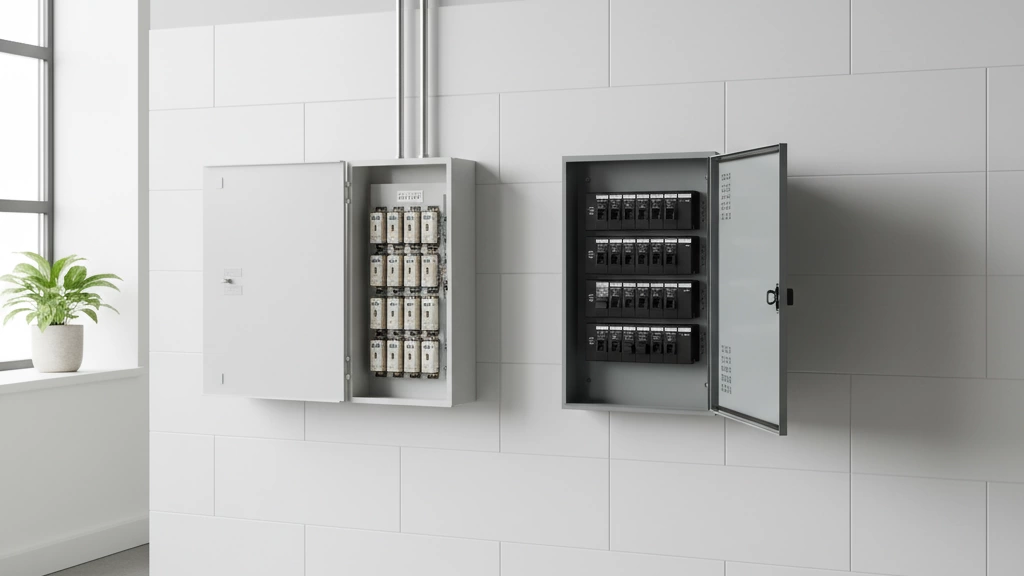
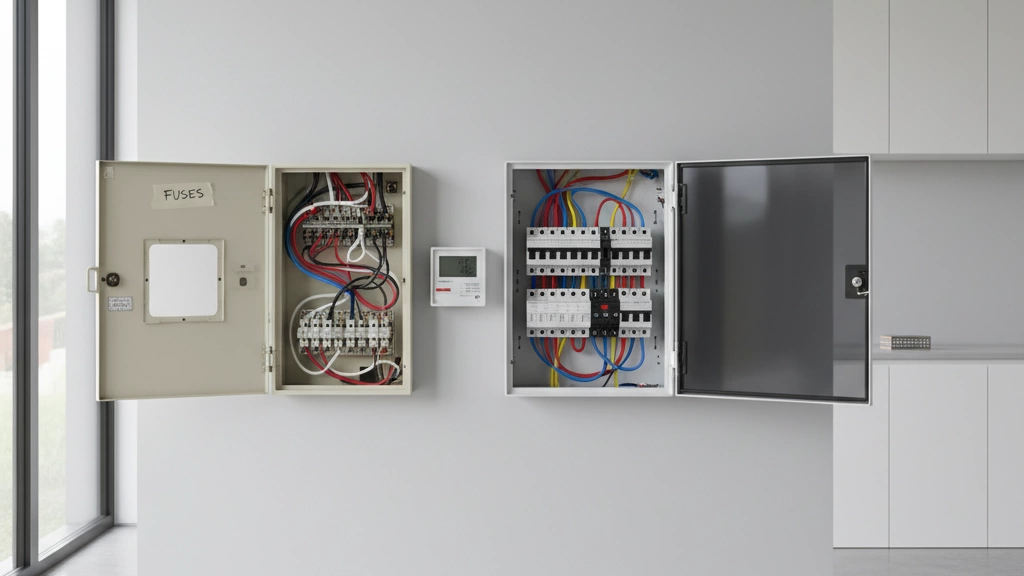
A fuse box is an older style of electrical panel that protects your home’s wiring by using fuses instead of modern circuit breakers. You’ll usually find it in a basement, garage, utility room, or near the electrical meter.
Visually, a fuse box is:
A small metal or bakelite cabinet, often gray, brown, or off‑white
A front hinged door you swing open to access the fuses
Inside, you’ll see either:
Screw‑in fuses that look like oversized glass light bulbs, or
Cartridge fuses that look like small tubes or rectangular blocks
Older panels from brands like Sylvania, Zinsco, and especially Federal Pacific Electric (FPE) are common red flags. Many insurers and electricians consider these brands high‑risk due to overheating, loose connections, and documented fire hazards. If you see any of these names on your panel, you should plan for an upgrade sooner rather than later.
Main Types of Fuses You’ll See
In residential fuse boxes, you’ll typically find three types:
Plug Fuses (Screw‑In Fuses)
Round, screw into a socket like a light bulb
Common ratings: 15A, 20A, 30A
Glass or ceramic body with a visible metal strip inside
When overloaded, the strip melts and the fuse “blows”
Type‑S (Tamper‑Resistant) Plug Fuses
A safer version of plug fuses
Use a threaded adapter in the fuse socket so you can only install the correct amperage (for example, a 15A fuse cannot be replaced with a 30A)
Designed to prevent “over‑fusing” – a major cause of fires in old fuse boxes
Cartridge Fuses
Cylindrical or rectangular “sticks” usually used for main disconnects or large appliances (AC, range, water heater)
Fit into a pull‑out holder you remove by hand
Rated for higher amperage and often protect the entire sub‑panel or large loads
Each fuse is a one‑time safety device. Inside, a thin metal element is designed to melt when too much current flows, breaking the circuit and stopping the flow of electricity before wires overheat.
Everyday Homeowner Experience With a Fuse Box
Living with a fuse box feels very different from a modern breaker panel. Typical day‑to‑day experiences include:
Fuses blowing when:
You run the microwave and toaster on the same circuit
A vacuum, space heater, or hair dryer overloads a line
Walking to the fuse box with a flashlight to figure out which fuse blew
Unscrewing each fuse to check which one has a broken or blackened element
Replacing the fuse with a new one from a box of spares you (hopefully) keep handy
Sometimes guessing at the right fuse rating, which is where trouble starts if someone “solves” the nuisance blowing by installing a 30A fuse on a 15A circuit – a serious fire hazard
Because fuses are consumable, homeowners often keep:
A small storage box of 15A, 20A, and 30A plug fuses
A few cartridge fuses for main or large appliance disconnects
Fuse boxes did their job for decades, and they were a big safety improvement compared with no protection at all. But in a modern home with today’s electrical loads, old fuse panels – especially Sylvania, Zinsco, and Federal Pacific units – are now considered obsolete and risky compared to current circuit breaker technology.
What Is a Circuit Breaker Panel and How Does It Work?
A circuit breaker panel (also called a breaker box or electrical panel) is the “control center” for your home’s power. Electricity comes from the utility through the meter, into the main breaker, and then gets split into individual circuits for lighting, outlets, HVAC, EV chargers, and more.
Instead of fuses that melt once and need replacing, circuit breakers are reusable switches. When there’s trouble, they trip OFF to stop power, and you simply reset them.
How a Circuit Breaker Trips (Thermal-Magnetic Basics)
Most residential breakers use a thermal-magnetic trip mechanism:
Thermal trip (overload protection)
If you run too many devices on one circuit (space heater + hair dryer, for example), the current stays high for too long.
A small bimetal strip inside the breaker heats up, bends, and eventually trips the breaker.
This protects wiring from overheating and starting a fire.
Magnetic trip (short-circuit protection)
If a hot wire touches neutral/ground or metal (a dead short), current spikes instantly.
An internal magnetic coil reacts in milliseconds and snaps the breaker off.
This is what saves equipment (and often your panel) from major damage.
This all happens automatically inside the breaker—no parts to replace, nothing to throw away. You just find the tripped breaker, switch it fully OFF, then ON again.
Common Modern Circuit Breaker Brands
In today’s homes, you’ll typically see these major residential panel and breaker brands:
Square D (especially the QO and Homeline series)
Siemens
Eaton (includes many Cutler-Hammer branded panels)
Cutler-Hammer (often now under Eaton)
All of them offer panels in different amp ratings (100A, 150A, 200A, 225A) and compatible breakers, including AFCI, GFCI, and smart options.
For larger or industrial-style systems, we also work with advanced solutions like medium-voltage circuit breakers, similar in concept to home breakers but built for higher voltages and tougher environments. You’ll find examples on our site under our medium voltage circuit breaker portfolio.
AFCI, GFCI, and Smart Breaker Trends in 2025
In 2025, code requirements and buyer expectations have moved far beyond simple standard breakers. Modern panels now regularly include:
AFCI (Arc-Fault Circuit Interrupter) breakers
Detect dangerous arcing (damaged cords, loose connections in the wall).
Required in most living areas in many regions (bedrooms, living rooms, hallways, etc.).
Strong protection against electrical fires caused by old or damaged wiring.
GFCI (Ground-Fault Circuit Interrupter) breakers
Monitor the balance of current going out and coming back.
If power is leaking to ground (like through a person to a wet floor), they trip in fractions of a second.
Used for bathrooms, kitchens, laundry rooms, garages, basements, and outdoor circuits.
Dual-function AFCI/GFCI breakers
Combine arc-fault and ground-fault protection in one device.
Common for circuits serving kitchens, laundry, and other “wet + high-use” areas.
Smart breakers and connected panels In 2025, more homeowners are choosing panels that can:
Show real-time energy use per circuit on your phone.
Send alerts when a breaker trips or a circuit is overloaded.
Let you remotely shut off specific circuits (useful for rentals, vacation homes, or safety).
Integrate with solar, batteries, and EV chargers to optimize when and how you use power.
These features make a modern circuit breaker panel not just safer than an old fuse box, but also smarter and easier to manage—especially if you’re running high-demand devices like heat pumps, Level 2 EV chargers, or home offices.
Electrical Fuse Box vs Circuit Breaker: Head‑to‑Head
Here’s the straight comparison of a fuse box vs circuit breaker panel so you can see which one actually makes sense for a modern home.
Fuse Box vs Circuit Breaker Panel (Quick Table)
Feature
Fuse Box
Circuit Breaker Panel
Clear Winner
Basic safety
Easy to over‑fuse, higher fire risk
Built‑in limits, better fault protection
Breaker
Resetting after fault
Replace fuse every time
Flip breaker back on
Breaker
Protection types
Standard overload/short only
AFCI, GFCI, dual‑function, surge, smart options
Breaker
Ongoing cost
Keep buying spare fuses
No consumables, rare breaker replacement
Breaker
Number of circuits
Limited spaces (older 60–100A)
More spaces, expansion room
Breaker
Insurance impact
Often surcharges or denial in 2025
Favored by insurers, easier to insure
Breaker
Home resale value
Seen as outdated / red flag
Viewed as modern and up to code
Breaker
Ease of use
Screwing in fuses, guessing sizes
Labeled switches, simple on/off
Breaker
Code compliance
Usually doesn’t meet current code
Designed for current electrical standards
Breaker
Safety: Which Is Actually Safer?
Fuse box
Can be “over‑fused” (e.g., 30A fuse on a 15A circuit) — huge fire risk.
No built‑in arc‑fault or ground‑fault protection.
Circuit breaker panel
Uses thermal‑magnetic breakers that trip before wires overheat.
Can add AFCI and GFCI breakers for modern code‑level safety.
Winner: Circuit breaker panel – safer by design and supports modern protection tech.
Resetting & Everyday Use
Fuse boxes:
When a circuit overloads, the fuse melts and you must replace it.
If you don’t have the right fuse on hand, you’re stuck in the dark.
Circuit breakers:
Trip once, then you just reset the switch after fixing the issue.
Easier to see which circuit has a problem and label everything clearly.
Winner: Circuit breaker panel – faster resets, less hassle, no consumables.
Cost & Long‑Term Value
Fuse box:
Cheaper in the short term if you leave it as‑is.
Costs add up in fuses, insurance surcharges, and lower home value.
Circuit breaker panel:
Higher upfront cost, but:
Better insurance rates.
Better resale value.
No constant fuse purchases.
Winner: Circuit breaker panel – higher ROI over the life of the home.
Circuits, Expansion & Modern Loads
If you’re adding things like EV chargers, central AC, heat pumps, or solar, a fuse box usually can’t keep up.
Fuse boxes are often 60A–100A with limited spaces.
Modern breaker panels offer 150A–200A+ service with room to grow.
Winner: Circuit breaker panel – it’s the only realistic option for modern electrical loads.
In 2025, in almost every category that matters — safety, convenience, insurance, and home value — the circuit breaker panel wins the fuse box vs circuit breaker battle by a wide margin.
Safety Risks of Old Fuse Boxes You Can’t Ignore
Old fuse boxes aren’t just “outdated” – in 2025, they’re a real safety and insurance problem. Here’s what you need to know before you keep putting off that panel upgrade.
Over‑fusing: The Silent Fire Starter
One of the biggest dangers with old fuse panels is over‑fusing – putting a larger fuse on a smaller circuit.
Example: installing a 30A fuse on a 15A circuit so it “stops blowing.”
The wire in that 15A circuit is only sized for 15 amps.
With a 30A fuse, the wire can overheat long before the fuse ever blows.
That overheating usually happens inside walls, where you can’t see it. Over time, insulation dries out, connections loosen, and you now have a real fire risk with no obvious warning.
If you’ve ever seen:
Different-size fuses mixed on the same panel
Handwritten notes like “use 30A, 20A keeps blowing”
…that’s a major red flag. That panel is not protecting anything the way it should.
Federal Pacific & Zinsco: Panels with a Bad Reputation
Some older panels aren’t just outdated—they’re notoriously unsafe:
Federal Pacific Electric (FPE) / Stab-Lok panels
Multiple independent tests have shown a high failure rate where breakers or fuses do not trip under overload or short-circuit conditions.
In plain English: the system can let dangerous fault currents flow and never disconnect, which massively increases fire risk.
Zinsco / Sylvania-Zinsco panels
Known for bus bars that corrode and overheat, with breakers that can melt into the bus and fail to trip.
Visual signs: discoloration, melted plastic, or breakers that feel loose or wobbly and still never trip.
Many insurers and inspectors treat Federal Pacific and Zinsco as automatic replacement candidates, even if they “seem to work.” The problem isn’t whether your lights turn on—it’s whether the system will shut off correctly during a fault.
If you’re dealing with automotive or specialty systems, even those rely on correctly rated protection devices, like a properly sized auto electrical fuse box for vehicles. Your home deserves at least that level of protection consistency.
No Arc-Fault or Ground-Fault Protection
Old fuse boxes were designed long before modern safety tech:
No AFCI (Arc-Fault Circuit Interrupter)
Arcing from damaged cords, loose outlets, or old wiring is a leading cause of electrical fires.
Fuse boxes do nothing about these arc faults; they just wait for a big overload or short.
No GFCI (Ground-Fault Circuit Interrupter)
GFCI protection is now required in bathrooms, kitchens, garages, outdoors, basements, and around water.
Fuse panels typically have zero built-in GFCI protection, meaning higher risk of electric shock in wet or damp areas.
With a modern circuit breaker panel, AFCI and GFCI protection can be built right into the breakers, or added with protected outlets. With an old fuse box, you’re usually stuck piecing together partial solutions and still falling short of current safety standards.
Real-World Examples of Old Fuse Box Dangers
Here’s what we actually see in the field when we inspect old fuse boxes:
Melted or darkened fuse holders
Signs that the connection has been running hot for years. Often linked to space heaters, window AC units, or portable electric heaters on old circuits.
Rooms running off “cheater” fuses
Fuse adapters or oversized fuses used to “stop the nuisance blowing” when people add more electronics, AC units, EV chargers, or big appliances.
Hidden junction boxes and bootleg fixes
Because panels are maxed out, previous owners splice wires in ceilings or walls. The fuse box doesn’t see the extra load correctly and can’t protect those hidden connections.
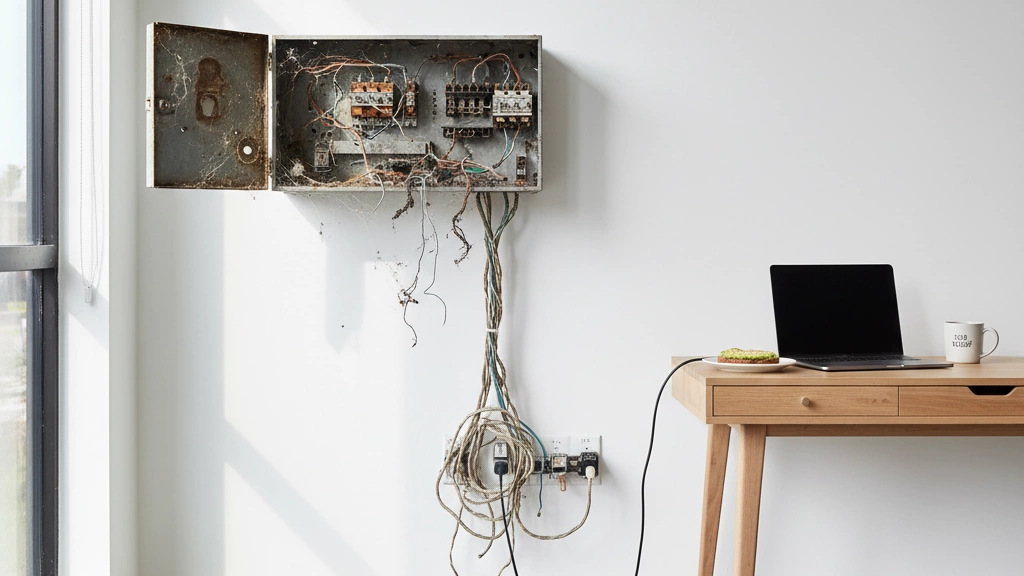
Partial burn marks near the panel
Charring around the fuse box, rust on the metal, or brittle cloth wiring entering the panel – all warning signs that the system has already overheated at some point.
If you’re seeing frequent blown fuses, warm fuses, burning smells, or any discoloration around the panel, that’s not “just old-house charm.” That’s your warning to act now, not later.
In short: If you still rely on an old fuse box—especially Federal Pacific or Zinsco—you’re accepting avoidable fire and shock risks, and likely paying more in insurance and headaches than it would cost to modernize the system.
When Insurance Companies Force the Upgrade
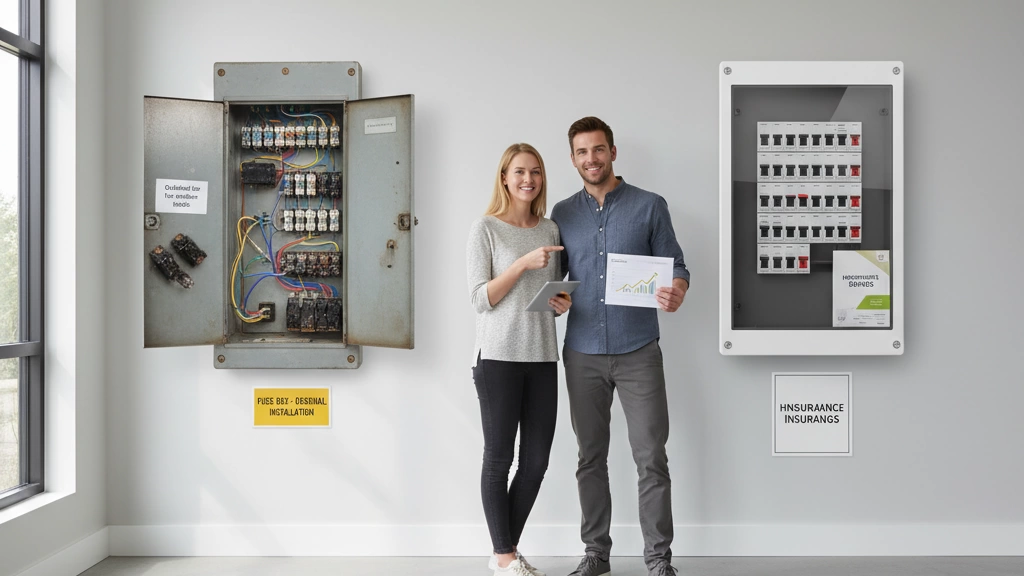
In 2025, insurance companies are one of the biggest reasons homeowners finally move from an electrical fuse box to a modern circuit breaker panel.
How insurers treat fuse panels now
Most major insurers see old fuse boxes and certain breaker panels as high fire-risk. That usually means one of three things:
Coverage denied – Some insurers simply refuse new policies on homes with:
60 amp fuse boxes
Federal Pacific Electric (FPE) panels
Zinsco/Sylvania panels
Policy non-renewal – You get a notice saying: upgrade your electrical panel by a set deadline, or your home policy will not be renewed.
Heavy surcharges – Even if they keep you, they often add a “hazard” fee.
Typical premium surcharges in 2025
Across most markets in 2025, I see:
Extra $200–$800 per year for homes with:
Old fuse boxes (especially 60A service)
Known fire hazard panels (Federal Pacific, Zinsco)
Some cases go higher if:
The home has aluminum wiring
There’s no proof of recent electrical inspection
The property is older than 50–60 years
Run the math: if you’re paying $400 more per year, in 5 years that’s $2,000 burned on surcharges instead of invested into a proper electrical panel upgrade.
Why insurers push for a breaker panel
Insurers care about risk and payouts. A modern circuit breaker panel with AFCI/GFCI protection dramatically cuts the chance of:
Electrical fires from overloaded circuits
Shock hazards in kitchens, bathrooms, garages, and outdoors
Claims from melted wiring and smoke damage
Many underwriters now require proof of a licensed residential electrical panel replacement before they’ll remove the surcharge or issue a standard policy.
If you’re planning a full power upgrade or working on more complex distribution (for example, small commercial or outdoor installations), the same risk logic applies. That’s why utilities and contractors lean on modern gear like an outdoor low-voltage power distribution box instead of outdated enclosures.
Bottom line
If your home still runs on an old fuse box or a flagged panel brand, expect insurance to:
Charge more
Limit coverage
Or force an upgrade on a deadline
In many cases, it’s cheaper long term to replace the fuse box with breakers once, rather than keep paying higher premiums every year.
Cost to Upgrade from Fuse Box to Circuit Breaker Panel in 2025
Upgrading an old fuse box to a modern circuit breaker panel in 2025 typically runs $1,800 – $4,500 for most homes. Bigger homes, long wire runs, or major code fixes can push that higher, but this is the range I see most often.
Typical price ranges (2025)
Ballpark costs (labor + materials):
Scope / Service
Typical 2025 Cost (USD)
Basic 100A panel swap (same location)
$1,800 – $2,500
Standard 200A service upgrade
$2,500 – $4,500
200A upgrade + long meter distance / trench
$3,500 – $6,000+
Panel upgrade + major code corrections
$3,000 – $6,500+
These are residential electrical panel replacement prices for normal homes, not commercial jobs.
What actually drives the price
When you replace a fuse box with breakers, the electrician is not just “swapping a box.” The cost depends on:
Amperage (service size)
60A → 100A: cheaper, but rarely enough for EVs, AC, or future loads.
100A → 150A: mid-range option.
200 amp service upgrade: most common in 2025 and what I usually recommend if you’re already opening the wall.
Distance to the meter / utility connection
Panel right next to the meter: lower cost.
Panel on the opposite side of the house, or detached garage: higher cost because of more copper wire, conduit, and labor.
Drywall and finish work
If the panel is surface-mounted in a garage, less mess and cost.
If it’s flush in a finished wall, expect:
Drywall cutting
Patching and possibly repainting (sometimes done by a separate contractor)
Code upgrades and safety add-ons Depending on your local code, the electrician may need to:
Add GFCI/AFCI breakers in certain areas
Install new grounding / bonding (water pipe, ground rods, etc.)
Add whole-home surge protection
Correct old wiring issues found during the panel swap
These electrical panel upgrade items add cost, but they’re also what can make insurers and inspectors happy.
Permits and local rules
Most cities require an electrical permit and final inspection.
Permit fees usually sit in the $100–$400 range, depending on the region.
Some utilities charge for disconnect/reconnect or meter upgrades.
Rural areas: more distance to the meter or pole, sometimes more trenching.
Some utilities require you to upgrade the service drop or meter base as part of a circuit breaker panel installation, which adds parts and labor.
This is why you’ll see big spreads in online fuse box replacement cost estimates.
Financing options and rebates
Most homeowners don’t plan for a panel upgrade, so I treat it like a mini renovation:
Payment options
Staged payments (deposit + after inspection)
Low-interest financing or monthly installments through partner lenders
Bundling the panel upgrade with other electrical work (EV charger, AC line, solar-ready wiring) so you only open the walls once
Potential rebates / incentives
In some regions, utilities or energy programs offer rebates for:
Upgrading undersized service when adding heat pumps, EV chargers, or solar
Installing smart-ready or surge-protected panels
These programs change often, so I always tell people: ask your electrician to check current local incentives, or keep an eye on industry updates via resources like our electrical systems blog.
If you know your panel size, house age, and rough distance to your meter, a professional can usually give you a realistic range in one visit—no guessing, no vague “it depends.”
Signs Your Fuse Box Needs Immediate Replacement
If you’re still running an old fuse box, there are a few clear warning signs you shouldn’t ignore. These point to real safety risks, not just “inconveniences.”
1. Frequent blown fuses
If you’re replacing fuses every few weeks or anytime you run a kettle, microwave, or space heater:
Your circuits are likely overloaded or improperly sized
The wiring and fuse box may no longer be safe for modern power demands
This is one of the most common signs of a bad fuse box that needs upgrading
2. Flickering or dimming lights
Lights that flicker or dim when you:
Turn on the vacuum
Start the washing machine
Run the oven or hair dryer
…usually mean your electrical panel can’t keep up or you have loose, overheated connections. Both are serious old fuse box dangers and can lead to overheating and fire.
3. Warm or melted fuses
Stop and check immediately if you notice:
Fuses that are hot to the touch
Discoloured, browned, or melted plastic around the fuse
A burning or “hot metal” smell near the panel
This is a major red flag. Heat at the fuse box often means poor connections, over-fusing, or deteriorated components—all of which can become fire hazards fast.
4. Only 60-amp fuse box service
Many older homes still have 60 amp fuse panels. In 2025, that’s far below what most households actually use. A 60A service struggles badly if you have:
Electric oven or cooktop
Dryer or electric water heater
Heat pump or central AC
Multiple computers, TVs, and gaming consoles
If you’re planning a 200 amp service upgrade, your old 60A fuse box is almost certainly done. It simply wasn’t built for today’s loads.
5. Adding EV charger, AC, solar, or major loads
If you’re thinking about any of this:
EV charger (even a “Level 2” home charger)
Central or ducted air conditioning
Heat pump or electric heating
Solar system or battery storage
New kitchen or home office circuits
…your fuse panel is very likely undersized and not compliant with current codes. This is where a proper circuit breaker panel installation becomes non‑negotiable for safety, performance, and future resale value.
If you’re seeing one or more of these signs, it’s time to seriously consider a residential electrical panel replacement before it becomes an emergency. For more technical insight into how modern switching and protection gear is designed to handle today’s loads safely, you can look at our breakdown of low-voltage switchgear and key protection components.
The Upgrade Process – What to Expect
Upgrading from an electrical fuse box to a circuit breaker panel is a clean, structured job when it’s done right. Here’s how I typically handle a circuit breaker panel installation from start to finish.
Step-by-step: From Permit to Inspection
Site visit & quote
I inspect your existing fuse panel, service size (often 60A or 100A), grounding, and wiring.
We talk about your plans (EV charger, AC, solar, home office) so we size the new panel correctly (often a 200 amp service upgrade).
You get a clear, written quote with scope, parts, and timelines.
Permit & scheduling
I pull the electrical permit with your local authority.
Coordinate with the utility if a service disconnect/reconnect is needed.
Schedule a 1–2 day window for the residential electrical panel replacement.
Temporary power (when possible)
In many homes, I can keep a temporary circuit on for Wi‑Fi, fridge, or key outlets using an extension from a safe source.
You’ll be told in advance when power will be off and for how long.
Remove the old fuse box
Power is safely shut off at the meter or service disconnect.
I remove the old fuse panel (including Federal Pacific, Zinsco, or other problem brands).
Any unsafe or overheated wiring is flagged and corrected.
Install the new breaker panel
Mount the new breaker panel (often 100A or 200A) in place of the fuse box.
Re-route and neatly organize branch circuits, with proper wire clamps and labeling.
Install new breakers, including GFCI/AFCI breakers where code requires.
Grounding & bonding upgrades
Upgrade grounding electrodes and bonding as needed for current code.
Fix obvious code issues found during the electrical panel upgrade (double-lugged neutrals, missing bushings, etc.).
Labeling every circuit
I test each circuit and label it clearly: lights, kitchen receptacles, range, dryer, EV charger, etc.
You’ll know exactly which breaker controls what—no guessing.
Inspection & power restored
The inspector reviews the new panel, grounding, and clearances.
Once approved, the utility reconnects (if required) and power is fully restored.
I walk you through how to reset breakers and what to watch for.
Typical Timeline: 1–2 Days
Most homes: 1 day for the full electrical fuse box vs circuit breaker upgrade.
More complex jobs (relocation, meter move, long runs): 1.5–2 days.
I plan the work so your downtime is as short as possible and you know the schedule upfront.
Why Choose cnsovio for Your Panel Upgrade
When you replace a fuse box with breakers, you’re trusting someone with your home’s safety. Here’s what I back that up with:
Licensed & insured electricians – No cutting corners, no unlicensed subcontractors.
Code-compliant work – Done to 2025 standards for AFCI/GFCI and 200A-ready setups where appropriate.
Warranty on labor and parts – You’re covered if something related to our work fails.
Clean, organized installs – Straight runs, tidy wire management, and clear labels. I treat your panel like the “nerve center” it is.
Documented work – I provide photos and details that can help with home insurance fuse box documentation and future resale.
If you’re ready to move away from an old 60 amp fuse box or questionable brands and want a modern breaker panel installed properly, you can see how I work and what I stand for on the main cnsovio electrical services page and the detailed about us section.
FAQs – Fuse Box vs Circuit Breaker Panel
Can I just replace fuses with circuit breakers in the old fuse box?
No, not safely. You can’t just swap in “breaker-style” parts into an old fuse box and call it good.
Old fuse panels were never designed for modern circuit breaker panel installation.
Clearances, bus bars, and grounding are different and usually not code‑compliant.
In many regions, inspectors and insurers simply won’t accept a “converted” fuse box.
If you want breakers, you need a proper breaker panel upgrade, not a patch.
Are push‑button or Type‑S fuses still safe?
They can be safe if:
The panel is in good condition
The correct fuse sizes are being used
The wiring is not overloaded or deteriorated
Type‑S (tamper‑proof) fuses are actually safer than old screw‑in fuses because they stop people from “over‑fusing” (like jamming a 30A fuse on a 15A circuit).
That said, even with good fuses, an old 60 amp fuse box usually:
Can’t support today’s loads (EV chargers, big AC, induction cooktops)
Lacks AFCI/GFCI protection that modern breaker panels offer So they’re “safe enough” in some cases, but not ideal long term.
Will upgrading lower my electric bill?
Usually not directly. A new circuit breaker panel doesn’t use less power by itself.
Where you might see savings:
Cleaner connections mean less wasted energy on overheating.
Panel upgrades often go with modernize old wiring and LED lighting, which do cut bills.
Some utilities offer rebates for panel upgrades tied to EV chargers, heat pumps, or solar.
Expect better safety, capacity, and insurance options first; lower bills are a possible side benefit, not the main reason.
How long do modern breaker panels last?
A quality breaker panel from brands like Square D, Siemens, Eaton, or Cutler-Hammer can last 30–40 years or more.
Key points:
Breakers may need replacement sooner if they trip often or are damaged.
Code and insurance requirements change faster than panels wear out.
If your panel is 30+ years old, it’s time to at least have it inspected.
Do I need a 200‑amp panel in 2025?
If you’re planning for the future, 200 amp service is usually the smart move.
You should seriously consider a 200 amp service upgrade if you:
Want an EV charger (Level 2)
Have or plan central AC / heat pump
Are adding electric oven, dryer, or tankless water heater
Are thinking about solar or a home battery
Many homes can “get by” on 100 amps, but for most Global homeowners in 2025, 200 amps is the new normal and protects your home value.
Is it a DIY job to replace a fuse box with breakers?
No. Replacing a fuse box with a breaker panel is not a DIY project.
You’re dealing with:
Live service from the utility that doesn’t shut off at your main
Permits, inspections, and code requirements
Critical safety and insurance implications
You need a licensed, insured electrician for any residential electrical panel replacement. A DIY panel swap can:
Void insurance
Fail inspection
Create serious fire and shock hazards
This is one area where cutting corners simply isn’t worth the risk.
Most Common Home Depot Electrical Fuse Types If you’re standing in the Home Depot electrical aisle staring at hundreds of fuses, you’re not alone. When a fuse blows, you want the right replacement fast, without guessing. I’ll walk you through the most common Home Depot electrical fuses you’ll actually see on the shelf, what they’re […]
We use cookies to enhance your browsing experience, serve personalised ads or content, and analyse our traffic. By clicking "Accept All", you consent to our use of cookies.