HRC Fuse Breaking Capacity and IEC 60282-1 Compliance
A procurement checklist for high rupturing capacity fuses: breaking capacity, IEC 60282-1 test categories, rated voltage and temperature derating.
Read More
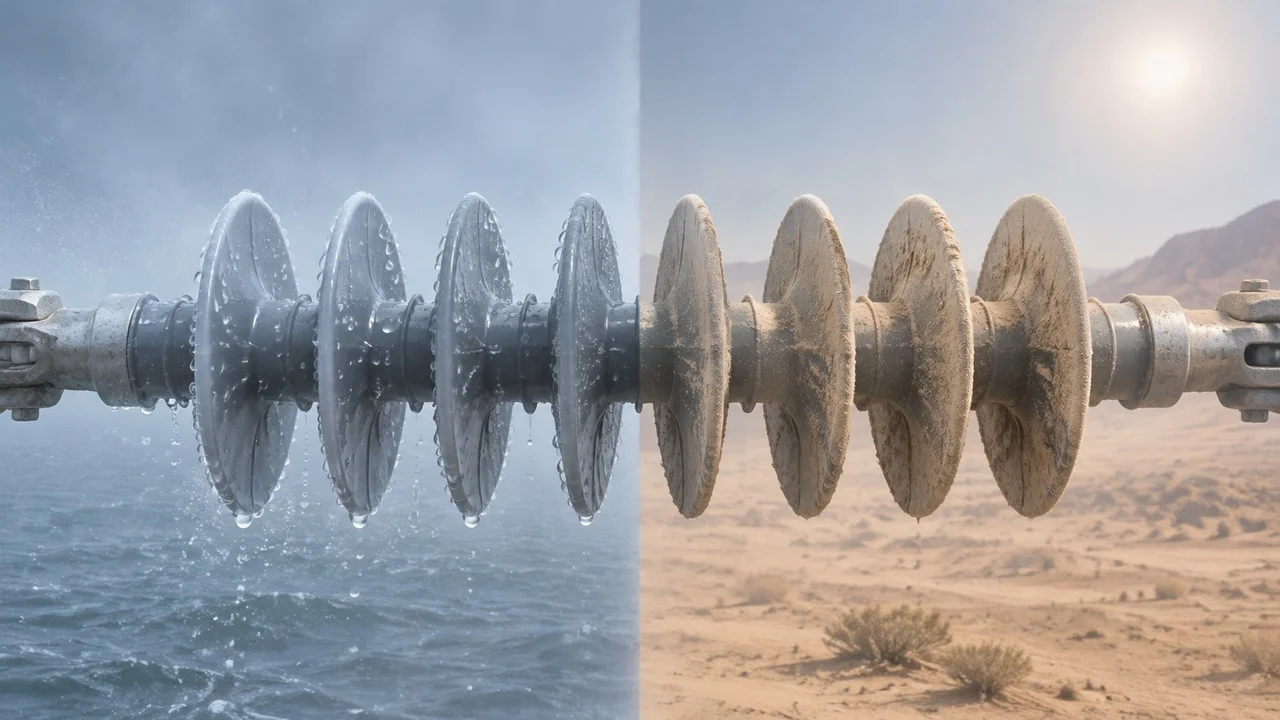
Composite insulators are often specified for one reason — they handle polluted environments better than bare porcelain — but “polluted” covers two very different failure modes. Coastal sites deposit conductive salt that dissolves in fog and drives leakage current. Desert sites deposit dry dust that mostly sits inert until a rare dew or rain event turns it into a conductive layer, while ultraviolet radiation and large daily temperature swings attack the polymer housing. Specifying the same shed profile and material for both is a common shortcut. This guide separates the two environments, explains the ageing mechanisms, and gives inspection criteria and a specification matrix for each.
A composite insulator is an assembly, not a single moulding. A pultruded glass-fibre reinforced epoxy rod carries the mechanical load in tension; a silicone rubber housing with moulded sheds provides the leakage path and environmental protection; crimped metal end fittings transfer the load to the conductor and the tower. The interfaces between those three parts — rod to housing, housing to fitting — are the critical sealing points. Almost every severe composite insulator failure begins at an interface, not in the middle of a shed.
Silicone rubber is chosen for hydrophobicity, UV resistance and the ability to recover surface properties after contamination. The rod is chosen for high tensile strength and low weight, which is why composite units are a fraction of the mass of an equivalent porcelain string and are easier to install on remote lines. High voltage composite insulators used on distribution and transmission lines follow this same three-part construction.
Hydrophobicity means water beads into discrete droplets instead of forming a continuous film. That single property suppresses leakage current, because a dry surface between droplets breaks the conductive path. Silicone rubber maintains it through low-molecular-weight siloxanes that migrate from the bulk material into any deposited pollution layer, so a dirty surface can regain hydrophobicity during a dry period. Hydrophobicity is commonly graded on the STRI scale from HC1 (fully hydrophobic) to HC7 (continuous wet film).
Two practical consequences follow. First, a composite insulator can tolerate a pollution layer that would cause a porcelain unit to flash over. Second, hydrophobicity is not permanent — it can be temporarily lost under sustained wetting, corona activity or certain cleaning methods, and it declines as the housing ages. A condition survey that measures hydrophobicity is therefore more informative than one that only looks for visible damage.
On a coastal line, windborne salt deposits on the sheds. When fog, drizzle or high humidity wets the layer, the salt dissolves, surface conductivity rises, and leakage current begins to flow. Uneven drying forms dry bands; the voltage concentrates across them; small dry-band arcs appear. If the arcs bridge enough of the leakage path, a pollution flashover occurs at normal operating voltage — a particularly unwelcome failure because it needs no lightning impulse and can repeat after reclosing.
The defences are creepage distance, shed geometry and material. A longer leakage path reduces the voltage gradient; alternating large and small sheds improve rain washing and limit the build-up of continuous wet channels; hydrophobic silicone limits film formation. In severe coastal or industrial zones, specify creepage according to the site pollution classification with margin rather than relying on the catalogue’s standard profile. Wash-down regimes should be agreed with the supplier, since aggressive cleaning can damage the housing surface.
A desert site works differently. Dust accumulates thickly because rain is rare, and the deposit is often only moderately conductive — until a dew, fog or brief shower wets it all at once. That rare wetting event can produce a sudden, severe pollution flashover on a line that has looked clean for months. Wind-driven sand abrades the shed surface, UV radiation degrades the polymer, and large day-night temperature swings stress the seals at the end fittings.
For these sites, prioritise UV-stabilised housing compounds, erosion-resistant shed profiles with generous thickness, and protected end-fitting seals. A self-cleaning profile that relies on frequent rain is less useful here than one that limits dust trapping and tolerates occasional manual washing. Verify the enclosure and cabinet sealing of associated equipment too — the IP ratings explained guide covers the related ingress questions for pole-mounted control boxes. Outdoor switchgear such as the ZW32-12G outdoor breaker faces the same dust and thermal-cycling conditions at its bushings and enclosure joints.
Tracking and erosion are the classic polymer failure modes: sustained surface arcing carbonises a conductive path or burns away shed material. Silicone formulations with appropriate filler loading resist tracking far better than early-generation materials, but the housing is still the consumable part of the assembly. Corona from a damaged grading ring or a poorly positioned fitting can erode the sheath near the end fitting, which is exactly where moisture ingress would be most damaging.
Brittle fracture of the FRP rod is rarer but more serious. It occurs when moisture and acids reach the rod through a breached seal or housing damage, under sustained mechanical tension. Because the rod carries the entire mechanical load, this is a mechanical drop-conductor risk rather than just an electrical fault. That is why inspection concentrates on the first few centimetres next to each end fitting, on any puncture or cut in the sheath, and on the condition of the crimped fitting and its seal. Substation equipment such as the GW9 isolator switch deserves the same attention at its support insulation interfaces.
Creepage is specified in mm per kV under IEC 60815 guidance, and composite insulators are covered by IEC 61109. For a coastal site, choose a profile that promotes washing and avoids deep, closely spaced under-ribs where salt-laden moisture can sit. For a desert site, favour profiles that shed dust, allow easy dry-brush or low-pressure washing, and keep enough thickness to tolerate sand abrasion over decades.
Do not assume that maximising creepage is always optimal. Very deep sheds increase the total leakage path on paper but can trap contamination, shield the surface from rain and wind, and make inspection harder. Ask the supplier for the declared creepage distance, the shed spacing and profile drawing, and the test evidence for the housing’s tracking and erosion performance. Insulation coordination should then be checked against the medium voltage switchgear or line withstand levels so that a well-specified insulator is not paired with a weaker bushing or arrester.
| What to check | Method | What it reveals |
|---|---|---|
| Hydrophobicity class | Spray-water grading against the HC scale | Loss of surface protection before flashover risk rises |
| Housing damage | Close visual inspection, binoculars or drone | Cracks, shed tearing, punctures, chalking, erosion |
| End-fitting seals | Focused inspection of the first sheds and crimp | Moisture path that could lead to rod corrosion |
| Corona and arcing | UV or corona camera, night patrol | Grading ring damage, local field stress |
| Pollution deposit | Visual assessment, ESDD/NSDD sampling where used | Whether creepage and washing regime still fit the site |
| Mechanical integrity | Fitting alignment, damage marks, abnormal deflection | Rod or crimp degradation |
| Site condition | Primary risk | Specification priority |
|---|---|---|
| Coastal, high salt fog | Pollution flashover in wet conditions | High creepage, hydrophobic silicone, washable alternating sheds |
| Industrial, conductive dust | Tracking and dry-band arcing | Tracking-resistant compound, accessible cleaning regime |
| Desert, dust and UV | Rare wetting flashover, UV and sand ageing | UV-stabilised housing, shed thickness, dust-shedding profile |
| High altitude | Reduced external dielectric strength | Additional creepage and clearance correction |
| High vandalism or impact risk | Mechanical damage to housing | Composite construction, protected end fittings |
| Mixed coastal-industrial | Combined conductive and adhesive deposits | Conservative creepage plus planned washing and HC monitoring |
Composite insulators usually cost more per unit than a basic porcelain profile but less to transport and install, especially on remote lines where weight drives crane and labour cost. They also avoid the periodic zero-value insulator testing that glass and porcelain strings require, and their hydrophobicity can defer or eliminate washing cycles in moderately polluted sites. Against that, the polymer housing has a finite ageing life and a condition assessment regime that many utilities are still building into their maintenance systems.
Compare the two over the full interval: purchase, transport, installation, washing, inspection and expected replacement. On a heavily polluted coastal feeder, a composite unit with a well-documented tracking and erosion test record often wins clearly; on a clean inland line with an established porcelain inspection programme, the difference may be marginal. Either way, require the housing compound’s test evidence and the end-fitting sealing specification — those two items separate a durable unit from a cheap one that looks identical on the drawing.
Coastal salt and desert dust demand different composite insulator designs. The first is a wet-conduction problem solved by creepage, hydrophobicity and washing; the second is an infrequent-wetting problem compounded by UV, abrasion and thermal cycling. In both cases the interfaces at the end fittings are the critical long-term risk, so condition surveys should grade hydrophobicity and inspect seals rather than only count damaged sheds. Specify creepage, shed profile, housing compound and test evidence together, and align the result with the site’s pollution classification and maintenance plan.
Silicone rubber is hydrophobic and transfers that property into deposited pollution layers, so water forms droplets instead of a continuous conductive film. Combined with adequate creepage and a washable shed profile, this greatly reduces pollution-flashover risk compared with a bare porcelain surface.
It is a surface wetting grade, commonly HC1 to HC7, from fully water-repellent to a continuous wet film. It is measured with a standard spray-water comparison and is an early indicator that a housing is ageing or temporarily losing protection.
Yes. Dust builds up during long dry periods, then a dew, fog or brief shower wets the whole layer at once. The sudden conductive film can trigger a pollution flashover at normal operating voltage, which is why creepage and shed profile matter even in arid regions.
The most serious mode is brittle fracture of the FRP rod, usually after moisture reaches it through a damaged housing or a failed end-fitting seal under tension. Inspect the sheath near both end fittings and the crimped joints closely.
They do not need the zero-value insulator testing used for porcelain and glass strings. Washing may still be required in severe pollution; agree the method with the supplier, since aggressive cleaning can damage the silicone surface and temporarily reduce hydrophobicity.