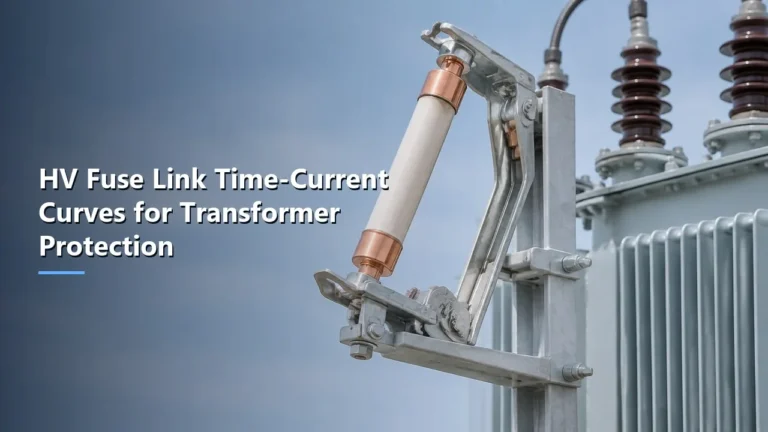
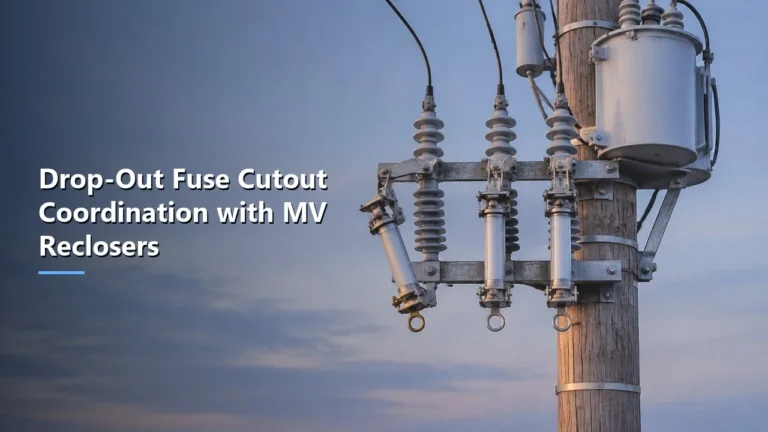
HV Fuse Link Time-Current Curves for Transformer Protection
How to read HV fuse link time-current curves when protecting 11kV distribution transformers, including pre-arcing time and upstream coordination.
Read More
“HRC” on a electric fuse datasheet stands for high rupturing capacity, but the label alone tells you very little. What matters is the declared breaking capacity at the rated voltage, the test standard behind it, and whether the fuse is a full-range or back-up device. Those three items decide whether the fuse can safely clear a prospective short-circuit current at the installation point, and whether it can also clear the small overcurrents nobody thinks about until a fault occurs. This guide turns an HRC specification into a procurement checklist anchored on IEC 60282-1.
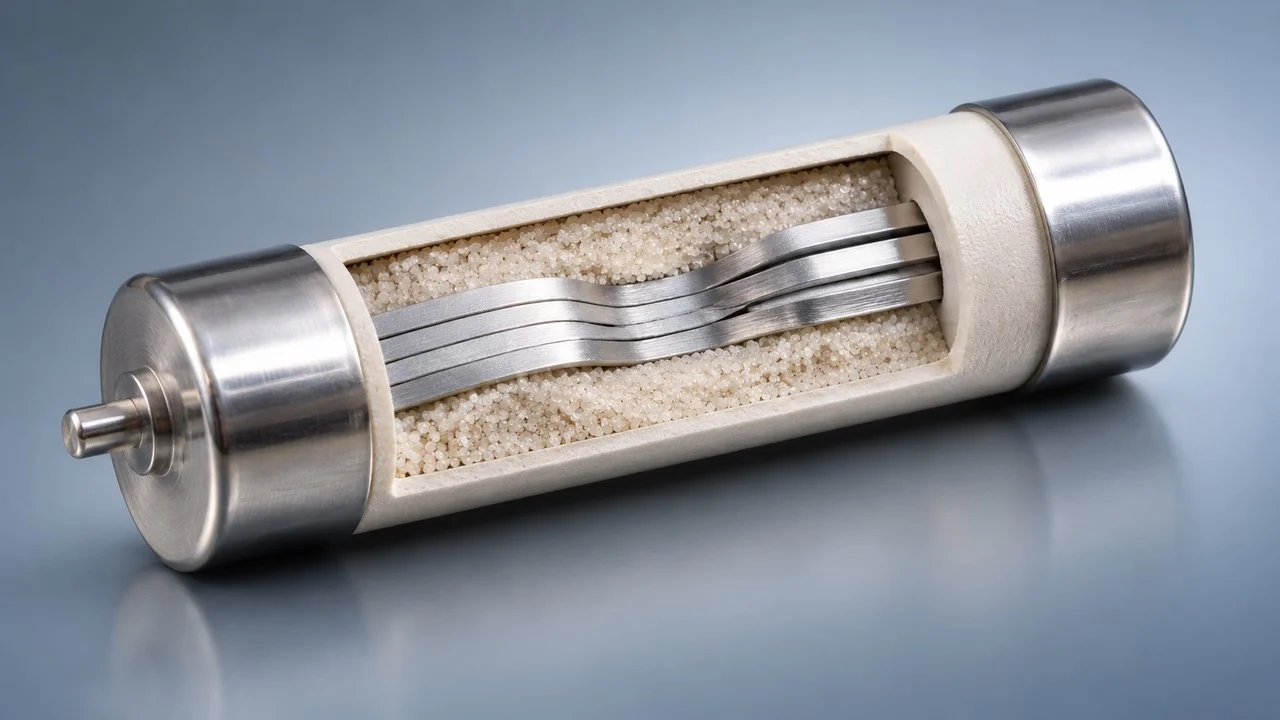
An HRC or current-limiting fuse uses a precisely shaped silver or copper element surrounded by high-purity quartz sand inside a strong ceramic body. When fault current flows, the element’s restricted sections melt in sequence, the sand absorbs the arc energy and fuses into a glass-like body, and the current is cut off well before the first prospective peak. That current-limiting action is what gives the design its high breaking capacity and its low let-through energy.
It is a different technology from the expulsion links used in overhead fuse cutouts, which clear the arc with gas generated from the tube liner and are typically applied on outdoor distribution laterals. IEC 60282-1 addresses current-limiting high-voltage fuses; expulsion fuses are covered by a separate part of the standard family. Mixing the two in a single specification is a frequent source of confusion in tenders, so state the type explicitly before discussing ratings. A distribution product such as the RW12 high voltage fuse belongs to the expulsion family and is specified on different duties.
Rated breaking capacity is the highest prospective short-circuit current the fuse is type-tested to interrupt at its rated voltage under specified test conditions. It must exceed the prospective fault current at the installation point, calculated from the network impedance with a margin for future reinforcement. A fuse with a generous current rating but an inadequate breaking capacity is not a protected circuit — it is a component that may rupture under fault.
Two details deserve attention. First, breaking capacity is tied to voltage: do not apply a value demonstrated at a lower voltage to a higher-voltage system. Second, current-limiting fuses have a minimum breaking current as well as a maximum. Back-up fuses are designed to interrupt high fault currents only and depend on another device — a switch, contactor or relay — to clear lower overcurrents. Full-range fuses can clear any current that causes the element to melt. If a tender does not say which type is offered, the installation may be left with no protection for a moderate but sustained fault.
IEC 60282-1 defines the rating, construction and test requirements for high-voltage current-limiting fuses. Type tests cover breaking capacity across defined test duties at different current levels, temperature rise at rated current, dielectric withstand, time-current characteristics and the determination of I²t and cut-off current. The test duties exist because a fuse does not behave the same at a small overcurrent, a moderate fault current and a very high fault current — the most onerous interruption point is often not the maximum current.
Ask for the type-test report for the exact fuse family and rating, not a generic certificate for the manufacturer’s range. Then ask for the routine-test record from a recent production batch. The type test vs routine test distinction matters here: the design is proven by type test, while the unit you receive is covered by routine checks such as resistance, dimensions, seal integrity and insulation. Where a project follows IEEE/ANSI practice, confirm how the equivalent ratings and test duties map across, since the IEC vs IEEE standards comparison shows that the two systems do not use identical definitions.
A fuse’s rated voltage is the maximum system voltage for which its breaking behaviour and arc voltage have been verified. Applying a fuse at a voltage above its rating risks a restrike after current cut-off. Applying it at a much lower voltage is usually electrically permissible, but current-limiting fuses generate a transient arc voltage during interruption, and that switching overvoltage should be checked against the insulation level of the equipment being protected — particularly transformers and motors.
Also record the rated frequency and the insulation level of the fuse base or holder. The fuse, its mounting and any striker or indicator mechanism form one assembly, and the assembly’s impulse withstand and creepage must suit the panel. In compact medium voltage switchgear, clearances around the fuse compartment can be tighter than in an open substation, which makes the base rating and ventilation part of the same check.
Two values describe how well a fuse protects downstream equipment. Cut-off current is the peak current the fuse actually lets through before interrupting, which is lower than the prospective peak. Total clearing I²t is the thermal energy passed during the whole operation. Together they determine whether a transformer, cable, contactor or busbar can withstand a fault without damage.
Compare these against the withstand of the protected equipment, not merely against the network fault level. A fuse that clears a 31.5kA prospective fault is not automatically the right choice if its let-through energy exceeds what a downstream contactor can tolerate. For coordination with other protective devices, use the manufacturer’s pre-arcing and total clearing curves and check the full range of prospective currents, including the minimum breaking current for back-up types.
A fuse carries rated current continuously, and its element is deliberately close to its thermal limit. That makes temperature rise unusually sensitive to installation conditions. Enclosed compartments, high ambient temperature, direct solar exposure, grouping with other heat-producing devices, and poor contact at the fuse clips all reduce the usable continuous current. A fuse that nuisance-operates in a hot panel may be correctly rated on paper but incorrectly applied.
Ask for the temperature-rise test conditions and the derating curve, check contact resistance and clip pressure at installation, and verify that the compartment ventilation matches the manufacturer’s assumption. At high altitude, reduced air density affects both cooling and external insulation. Record the measured temperature during commissioning load runs so that a later rise can be distinguished from an original installation problem.
Element geometry sets the time-current characteristic. Notched silver elements, low-melting-point alloy spots that produce the “M effect” at low overcurrents, and parallel element strips all produce different curves and ageing behaviour. The quartz sand’s grain size, purity and packing density control arc absorption; moisture ingress into the filler is a known cause of degraded interruption performance. Body sealing and end-cap integrity are therefore functional features, not cosmetic ones.
Check the striker or operation indicator if one is fitted. In three-phase applications a striker can trip the associated switch so that a single-phase fuse operation does not leave the load single-phased. Confirm compatibility between the fuse, its base, the striker mechanism and the switch’s trip linkage — an assembly mismatch here is only discovered during a real fault.
| Item | What to specify | Evidence required |
|---|---|---|
| Fuse type | Current-limiting HRC, full-range or back-up | Manufacturer datasheet and designation |
| Rated voltage and frequency | Maximum equipment voltage, 50/60Hz | Nameplate and type-test report |
| Rated current | Continuous current with installation derating | Temperature-rise data and derating curve |
| Breaking capacity | Exceeds prospective fault current at site | IEC 60282-1 breaking test duties |
| Minimum breaking current | Required for back-up type fuses | Manufacturer declared value |
| I²t and cut-off current | Within downstream equipment withstand | Type-test values and curves |
| Time-current curves | Pre-arcing and total clearing | Curve sheet with revision date |
| Base, striker and indicator | Compatible assembly, three-phase trip logic | Assembly drawing and trip test |
| Document | Why it is needed | What to verify |
|---|---|---|
| IEC 60282-1 type-test report | Proves the design’s breaking performance | Exact family, rating and test duties |
| Routine test record | Covers the delivered production batch | Resistance, seal, insulation, dimensions |
| Time-current and I²t curves | Coordination and equipment withstand | Curve revision matches the supplied fuses |
| Derating and temperature-rise data | Application in enclosed panels | Ambient, altitude and enclosure assumptions |
| Installation and replacement instructions | Safe handling and correct clip torque | Striker alignment, three-phase replacement rule |
| Declaration of conformity | Contractual and regulatory evidence | Standard edition and manufacturer identity |
After a fuse operates, replace all three phases of the group where the manufacturer requires it, and inspect the base for heat damage before refitting. A fuse is a one-shot device; the documentation is what makes its replacement predictable.
An HRC fuse specification is complete only when breaking capacity, rated voltage, rated current, full-range or back-up classification, I²t, cut-off current and installation derating are all stated together and supported by IEC 60282-1 type-test evidence for the exact rating. The most expensive mistakes are not a wrong current rating but a back-up fuse used where a full-range device was needed, a fuse whose let-through energy exceeds the downstream withstand, or a correctly rated fuse installed in a compartment that runs far hotter than the test conditions. Put those checks into the tender and the commissioning test sheet, and a small component becomes a verifiable part of the protection scheme.
High rupturing capacity. It describes a current-limiting fuse with a silver or copper element in quartz sand inside a ceramic body, capable of interrupting high prospective fault currents while limiting the let-through peak and energy.
No. IEC 60282-1 covers high-voltage current-limiting fuses. Expulsion-type fuses used in distribution cutouts are addressed by a separate part of the IEC 60282 family, with different test duties and rating definitions.
A full-range fuse can clear any current that melts its element. A back-up fuse is designed for high fault currents only and relies on another device, such as a switch or relay, to clear lower overcurrents. Using a back-up fuse without that device leaves a protection gap.
The element runs close to its thermal limit at rated current. High ambient temperature, poor ventilation, grouping with heat-producing devices and resistance at the fuse clips all add heat. Check the temperature-rise data and the manufacturer’s derating curve for the actual enclosure.
It is the peak current the fuse actually lets through before interruption, lower than the prospective peak. Together with total clearing I²t it determines whether the protected transformer, cable or contactor can withstand the fault without damage.