How to Import Switchgear From China: Step-by-Step Guide
A step-by-step import guide for MV switchgear and vacuum circuit breakers from China, covering specification, factory verification, FAT, packing and customs.
Read More
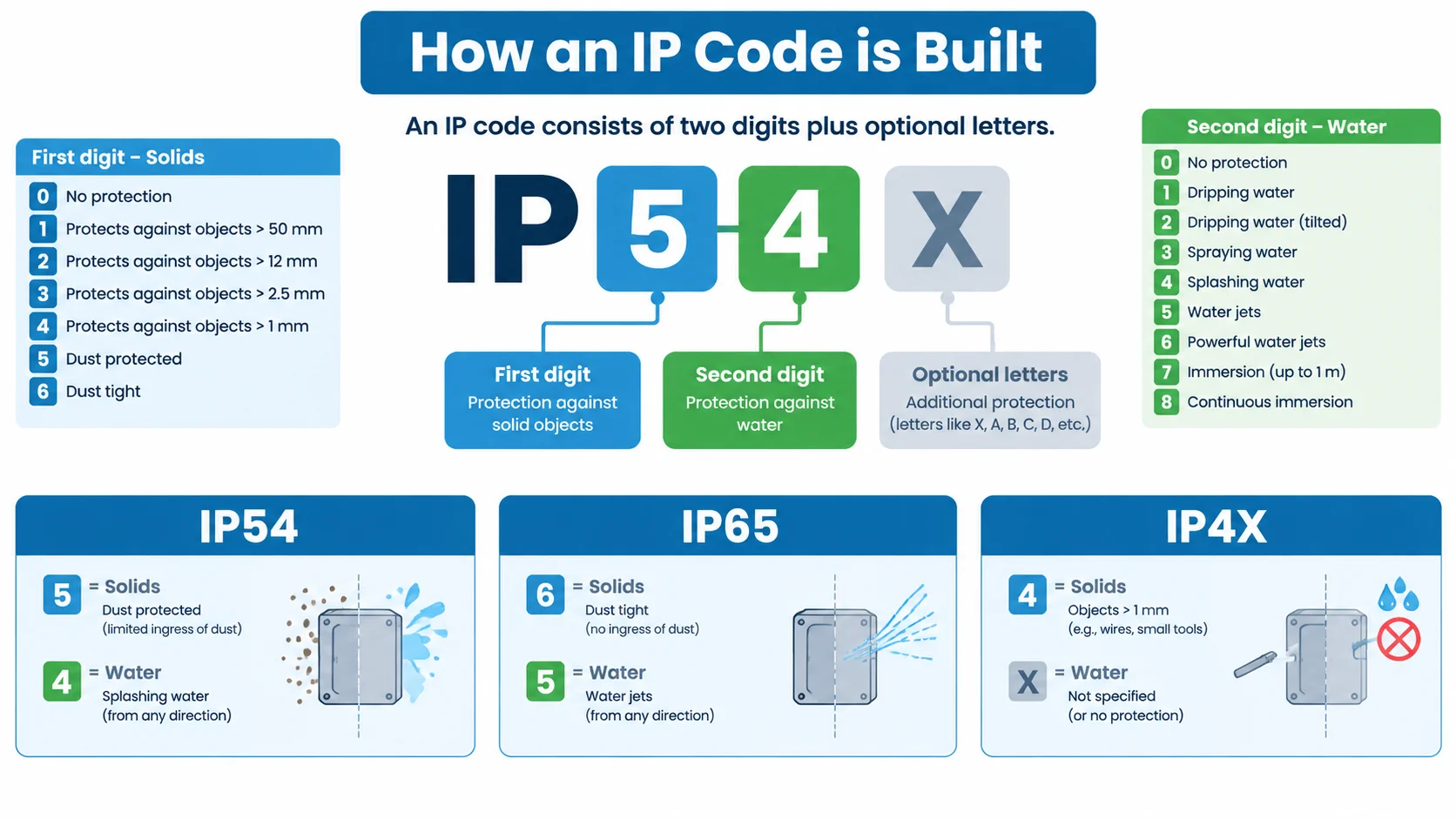
IP rating explained in one line: it is a two-digit code from IEC 60529 that states how well an enclosure keeps solid objects and water out of the equipment inside. The first digit covers solids and dust, the second covers water. An IP54 enclosure is dust-protected and splash-proof; an IP65 enclosure is dust-tight and resists water jets. They are not interchangeable, and a higher number is not automatically better for your site.
For anyone specifying electrical enclosures — a low-voltage switchgear section, an outdoor distribution cabinet, a ring main unit, or a junction box — the IP code is where marketing language meets physics. This guide explains what each digit certifies, what the second digit does not tell you, the practical difference between IP54 and IP65, and where a rated enclosure loses its rating during installation.
IEC 60529 defines an ingress protection code and the test methods used to verify it. The code does not certify corrosion resistance, impact strength, condensation behaviour, or suitability for an explosive atmosphere — those are separate standards, and confusing them is how projects end up with a supposedly sealed enclosure full of water after one monsoon.
The rating is also a claim about a tested sample, not a guarantee about a product family. If an enclosure is modified on site — a hole drilled for a cable gland, a fan cut into a door — the original rating no longer describes it. That single fact explains most of the water damage found in outdoor electrical installations.
| Digit | First digit: solids | Second digit: water |
|---|---|---|
| 0 | No protection | No protection |
| 1 | Objects over 50 mm (back of hand) | Vertical dripping |
| 2 | Objects over 12.5 mm (finger) | Dripping with enclosure tilted 15° |
| 3 | Objects over 2.5 mm (tools, wires) | Spraying water up to 60° from vertical |
| 4 | Objects over 1.0 mm (thin wires) | Splashing water from any direction |
| 5 | Dust protected — dust ingress does not interfere with operation | Water jets, 6.3 mm nozzle, 12.5 L/min |
| 6 | Dust tight — no dust ingress | Powerful jets, 12.5 mm nozzle, 100 L/min |
| 7 | — | Temporary immersion, 1 m for 30 minutes |
| 8 | — | Continuous immersion, depth and duration by agreement |
| 9 / 9K | — | High-pressure, high-temperature jet (steam cleaning) |
Two readings of this table matter more than the rest. First, IP5X and IP6X are both “first digit 5 or 6” but describe different things: dust protected means dust gets in but does not stop the equipment working; dust tight means essentially none gets in. Second, the water digits are not a ladder — an IPX7 enclosure is tested for immersion and is not necessarily tested for jets, so an IPX7 unit can fail a hose test that an IPX5 unit passes.
After the two digits, IEC 60529 allows additional and supplementary letters. The additional letters describe protection against access to hazardous parts: A for the back of the hand, B for a finger, C for a tool of 2.5 mm diameter, D for a wire of 1.0 mm diameter. This is why a panel may be marked IP4X with doors closed and IP2X with doors open — the same enclosure, different access condition, and a very common marking on metal-clad indoor switchgear.
The supplementary letters are H for high-voltage apparatus, M for water testing during operation, S for stationary testing, and W for weather conditions. In switchgear specifications you will occasionally see IP54W, which means the water test was performed under simulated weather rather than still air. It is a stronger claim than IP54 alone, and it is rarely offered unless someone asks.
| Aspect | IP54 | IP65 |
|---|---|---|
| Dust | Protected, not tight | Tight |
| Water test | Splash from any direction, 10 L/min | Jet from any direction, 12.5 L/min at 30 kPa |
| Typical use | Indoor plant rooms, covered outdoor cabinets | Exposed outdoor cabinets, washdown areas |
| Ventilation | Can be vented with filters | Needs sealed or labyrinth ventilation |
| Heat penalty | Moderate | Higher — sealed boxes trap heat |
| Relative cost | Baseline | 10–25% higher for the same size |
The heat point is the one that gets skipped in tenders. A sealed IP65 enclosure cannot dissipate heat through airflow, so either the internal losses are low enough for the surface area, or the design needs a heat exchanger or an air conditioner. Specifying IP65 for a cabinet containing a 400 A breaker and a bank of relays, then discovering the internal temperature reaches 55 °C, is a common and entirely predictable failure.
Medium-voltage metal-clad indoor switchgear is normally IP4X for the enclosure with compartment doors open at IP2X, which protects against tools and wires rather than water. Compact ring main units for outdoor use are commonly IP33, IP43 or IP54 depending on the enclosure type and whether the cable compartment is sealed.
Low-voltage outdoor cabinets are where IP54 and IP55 dominate, with IP65 reserved for washdown or extremely exposed locations. Our page on the outdoor low-voltage distribution cabinet shows the practical configuration, and the MV switchgear range covers the indoor metal-clad arrangements where IP4X is the norm.
The gap between a rated enclosure and a working installation is almost always at a penetration. Cable entries are the first: a gland plate with unsealed spare holes, or glands selected for cable diameter rather than for the enclosure rating, turns IP65 into something closer to IP4X. Spare gland plate openings must be blanked with rated blanks, not left open or covered with tape.
The second is door seals. A gasket that is compressed beyond its recovery limit, painted over during site touch-up, or damaged by a door that does not hang square will leak. Check door alignment after transport, because a case that has been dropped once is a case with a twisted frame. The third is ventilation: filters that were sized for airflow but not for water, and fan cowls that were removed because they obstructed a cable route. A compact unit such as an XGN15 ring main unit avoids most of these problems by having no ventilation opening at all.
For an exposed outdoor installation, IP54 is the practical minimum and IP55 is safer if the site sees driving rain. Coastal sites need more than a number: stainless steel or hot-dip galvanised hardware, a coating system with a declared dry film thickness, and gaskets rated for UV exposure. Salt fog testing to IEC 60068-2-52 is the evidence to ask for, and it is not implied by any IP rating.
Desert sites invert the problem. Ingress protection against rain matters less than dust and heat, so IP6X with a heat management plan beats an IP65 box that cooks its own contents. If you are specifying complete outdoor distribution arrangements rather than single enclosures, the solutions overview shows how enclosures, transformers and switchgear are combined for these conditions.
Ask for the test report, not the catalogue badge. For IP5X and IP6X the test uses a dust chamber with talcum powder; for IPX4 an oscillating spray; for IPX5 and IPX6 a hose with a specified nozzle and flow rate at a specified distance and duration. The report should name the laboratory, the enclosure model and the exact configuration tested, including whether cable entries were fitted.
A factory that performs a routine hose test at final assembly is doing more than most, and it is a reasonable production check even though it is not a certification. What you want to avoid is a type test on a bare enclosure with no glands, followed by a shipped product with four unsealed entries.
The first digit is about solids, the second about water, and neither tells you anything about corrosion, impact or condensation. IP54 suits covered outdoor cabinets; IP65 suits exposed or washdown locations and brings a heat penalty with it. Specify the rating, then specify the cable entries, gaskets and heat management that let the enclosure keep it. If you are matching enclosures to site conditions, send us the environment and the internal losses and we will confirm which rating and cooling arrangement actually fits.
Not universally. IP65 is dust-tight and jet-resistant, which is better for exposed outdoor use, but it seals in heat and costs more. For a ventilated indoor cabinet, IP54 with filtered ventilation is often the better engineering choice.
The X means the water protection has not been specified or tested. IP4X protects against solid objects over 1.0 mm, which is the normal marking for indoor metal-clad switchgear with doors closed.
IPX8 means continuous immersion under conditions agreed between manufacturer and buyer, so the depth and duration must be stated. It is not a universal underwater rating.
Only with a sealed heat exchanger, a labyrinth vent, or a filtered fan designed to maintain the rating. A plain louvre or fan cut into the door voids the rating immediately.
IP covers ingress of solids and water. IK, defined in IEC 62262, covers resistance to mechanical impact measured in joules. An enclosure needs both if it is exposed to physical damage.