HRC Fuse: Construction, Types & Applications
How an HRC fuse is built and why it can interrupt 100 kA: element, tin joints and silica sand filler, the main types, the ratings to check, and HRC versus breaker.
Read More
The composite vs porcelain insulator decision is usually framed as a simple price comparison, and that framing is what leads to expensive regrets later. Porcelain has a hundred-year service record and the lowest purchase price. Composite insulators cost more per unit but weigh a fraction as much, do not shatter, and behave very differently in polluted air.
Which one belongs on your line depends on three things: the pollution class at the site, the mechanical load the structure can accept, and how much routine cleaning you are prepared to fund. This comparison works through material, weight, electrical behaviour, failure modes, and total cost, then gives a decision rule for each common project type.
Porcelain insulators are made from clay, feldspar, and quartz fired at high temperature to form a dense ceramic body, then glazed to close the surface against moisture. The glaze is the working surface: it provides the smooth, non-porous finish that resists water and contamination. The body carries the mechanical load in compression and bending, and the sheds are formed in the ceramic itself.
Composite insulators separate the two functions. A fibreglass-reinforced polymer rod carries the mechanical load in tension, and a silicone rubber housing with moulded sheds provides the insulation and the pollution-resistant surface. Metal end fittings are crimped to the rod, and the housing is bonded over it. Because the load path and the insulating path are different materials, each can be optimised — which is the source of most composite advantages.
Composite insulators are commonly 70–90% lighter than porcelain units of the same voltage rating. That single fact cascades through a project: lighter strings can be handled by smaller crews and lifting equipment, tower steel and foundations can be designed for lower loads, transport costs fall, and installation takes less time per structure. On a long transmission project, the weight difference changes the structural design, not just the logistics. On a retrofit or a line crossing a difficult access route, it can decide whether the project is practical at all.
| Property | Porcelain insulator | Composite insulator |
|---|---|---|
| Structure | Single rigid ceramic body | FRP rod with silicone rubber housing |
| Behaviour under load | Strong in compression, brittle in impact | High tensile strength, tolerant of shock and vibration |
| Failure mode | Shatters or cracks; damage may be hard to see | Resists impact and vandalism; ageing is gradual |
| Weight | Heavy, needs machinery and strong structures | Light, often manually handled |
| Design flexibility | Standard shapes and sizes | Custom shed profiles and lengths are practical |
The practical consequence is that porcelain demands care during handling and installation — a dropped or impact-damaged unit may carry a hidden crack that fails years later. Composite units tolerate the same mishandling far better, which reduces the risk of latent damage during a rush installation.
Pollution flashover is the failure mode that most often decides insulator type, especially in coastal, industrial, and desert corridors. The mechanism is well understood: contamination settles on the insulator surface, moisture from fog, dew, or light rain dissolves it, and the resulting conductive film allows leakage current that can develop into a flashover.
On a glazed porcelain surface, water tends to spread into a continuous film, which is exactly the condition that promotes leakage current. Silicone rubber behaves differently. Its surface is hydrophobic — water beads into isolated droplets rather than forming a film, so there is no continuous conductive path even with heavy contamination present. Silicone rubber also exhibits hydrophobicity transfer: low-molecular-weight siloxanes migrate from within the material to the surface and encapsulate the pollution layer, making the contamination itself water-repellent.
That is why composite insulators are the natural specification for pollution classes III and IV without adding extra discs or oversizing the string, and why they usually need far less washing. Porcelain can serve the same sites, but it has to be given a longer creepage distance and a realistic cleaning programme.
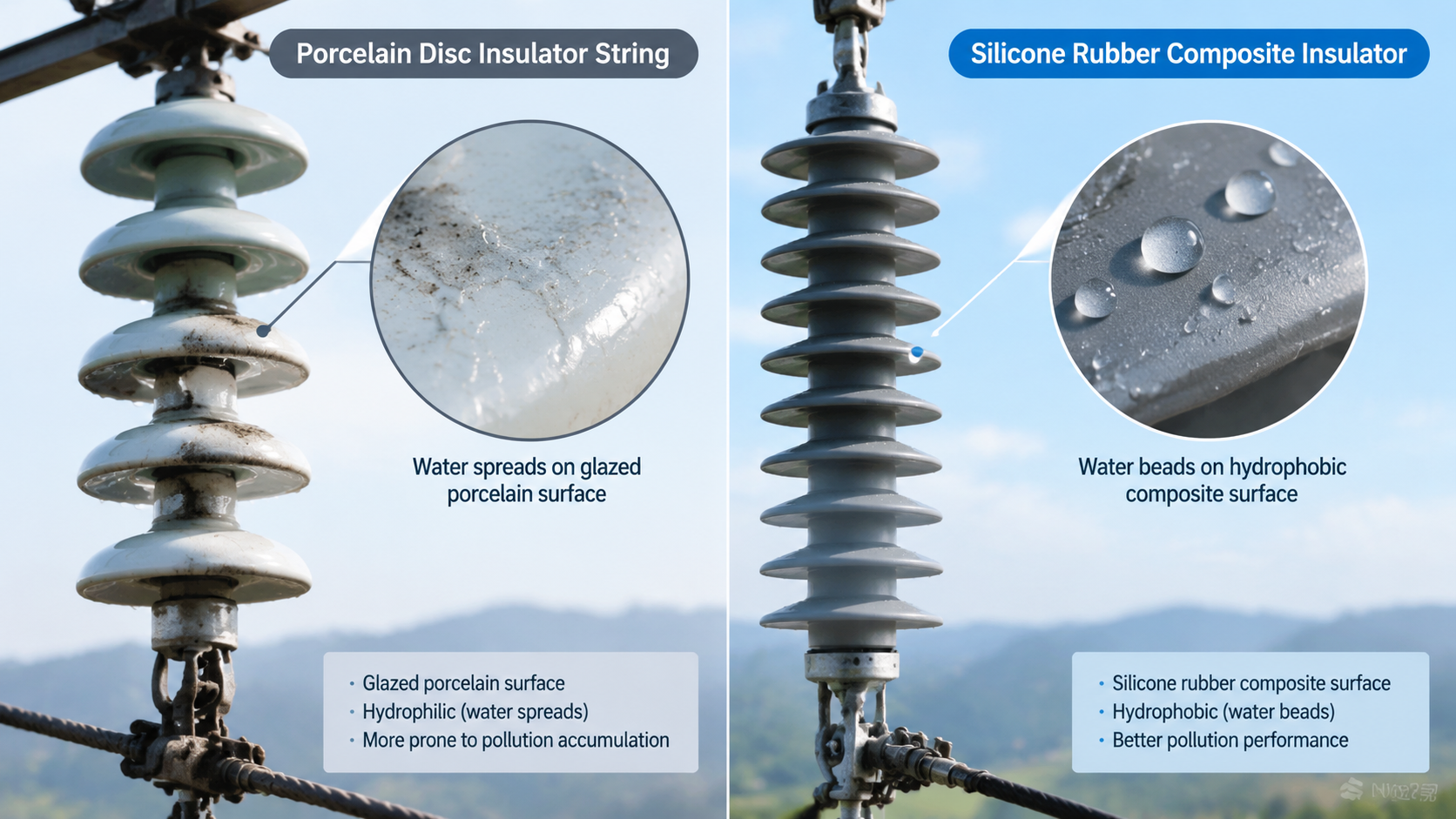
Both technologies meet the same dielectric requirements, and both are type tested to the same family of standards, so the choice is not about whether one insulates better. The differences are in how each reaches its performance level. Porcelain needs a physically larger creepage distance and more sheds to hit a given pollution class; composite insulators reach the same target with a more compact profile and shorter length. On a tower where phase spacing or clearances are tight, that compactness has value beyond the unit price.
Where composite designs need scrutiny is long-term ageing. Housing quality governs UV resistance, tracking, and erosion behaviour, and the range of material quality on the market is wide. Ask for type test evidence, housing material specification, and references from comparable climates before assuming all composite insulators age the same way.
| Maintenance task | Porcelain | Composite |
|---|---|---|
| Surface cleaning or washing | Required periodically in polluted, coastal, or industrial sites | Rarely required; hydrophobic surface is effectively self-cleaning |
| Damage detection | Cracks and punctures may be invisible; zero-value or voltage distribution testing helps | Visual inspection for tracking, erosion, and housing damage |
| Anti-pollution coatings | Sometimes applied to extend cleaning intervals | Not normally needed |
| Component replacement | Individual discs in a string can be replaced | The unit is replaced as a whole |
Porcelain wins on initial cost, and that advantage is real for clean inland sites with cheap access and available maintenance crews. Composite insulators carry a premium per unit, but the premium is offset by lighter structures, faster installation, less cleaning, and fewer outages from pollution flashover. A coastal substation that would otherwise wash ceramic insulators on a short cycle can often justify composite units on maintenance savings alone; the reduced flashover risk is additional.
When comparing quotes, compare total installed and operating cost rather than unit price: include transport and handling, crane time, tower steel and foundations, the washing programme over the expected life, and the cost of one unplanned pollution-related outage.
For heavy-pollution and coastal projects, the high-voltage composite insulator range covers distribution and transmission duties with silicone rubber housings, and the product catalogue lists the matching fittings and clamps required per configuration. The same insulators are specified as busbar supports and equipment connections inside medium and high voltage switchgear, where the design constraints are closer to those of outdoor service than they first appear.
Composite and porcelain insulators are both mature technologies, and neither is universally better. Porcelain offers the lowest purchase price and a century of predictable behaviour where conditions are benign. Composite insulators offer far lower weight, resistance to impact, and decisively better pollution performance, at a higher unit cost that is usually repaid through lighter structures and reduced maintenance. Decide from the pollution class and the mechanical constraints first; the price comparison only makes sense once those two are fixed.
If your project sits in a pollution class III or IV corridor, send us the system voltage, required creepage distance, and mechanical load, and we will confirm the composite insulator configuration that meets it — including how it compares with carrying extra discs in a ceramic string.
Neither is better in every case. Porcelain is the lower-cost, long-proven option for clean inland sites. Composite insulators are lighter, more impact-resistant, and substantially better in polluted, coastal, or humid environments, at a higher initial cost.
Silicone rubber is hydrophobic, so water forms separate droplets instead of a continuous conductive film. The material also transfers hydrophobicity to the pollution layer on its surface, which further suppresses leakage current and reduces flashover risk.
Modern silicone composite insulators have demonstrated long service lives, but durability depends heavily on housing material quality and UV exposure. Porcelain has the longer documented track record, so for composite units it is worth confirming type test data and references from comparable climates.
Typically 70–90% lighter than the porcelain equivalent at the same voltage rating, which reduces transport, crane, and tower loading requirements and speeds up installation.
Rarely. Their hydrophobic, self-cleaning behaviour means far less washing than porcelain, particularly in coastal and industrial areas where ceramic insulators may need a regular cleaning cycle.
They can, and mixed strings do occur in retrofit work, but it is better practice to keep the electrical and mechanical characteristics consistent along a section. Confirm compatibility with the utility specification and check creepage and mechanical ratings across the mixed assembly.