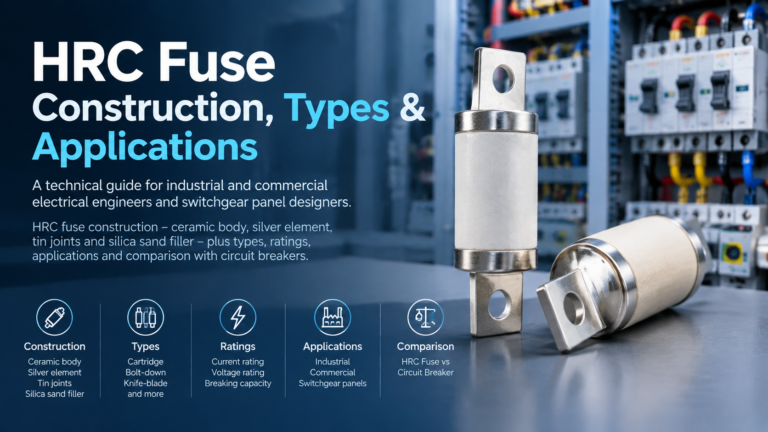
HRC Fuse: Construction, Types & Applications
How an HRC fuse is built and why it can interrupt 100 kA: element, tin joints and silica sand filler, the main types, the ratings to check, and HRC versus breaker.
Read More
The power fuse vs fuse link distinction causes more wrong purchase orders than almost any other habit in electrical procurement, because both terms are used loosely and interchangeably in catalogues and on site. They are not the same thing. A power fuse is the complete protective device — holder, base, and the replaceable element inside it. A fuse link is only the replaceable element, the calibrated part that actually melts. Confusing them leads to ordering a link when a cutout is needed, or a cartridge when the holder is already on the panel. This guide separates the terms precisely, shows which fuse link types exist and what each characteristic is for, and sets out how to match a link to the device that holds it.
Two habits create the confusion. First, field language: technicians often say “the fuse blew” when they mean “the link blew”, because in an outdoor cutout the link is the only part that is replaced. Second, catalogue language: suppliers list high-voltage power fuses and fuse links in adjacent columns and use “fuse” for both. The clearest way to keep them apart is to ask a simple question — is this item a device or a consumable?
A power fuse is a complete overcurrent protective device. It performs three functions at once: it carries normal load current, it interrupts fault current within a defined breaking capacity, and it provides the enclosure and contacts that make the assembly safe to install and operate. Depending on the type, a power fuse assembly includes:
In short, a power fuse is the asset. It is specified once, installed once, and expected to last for years, and it is the item that carries the voltage rating, breaking capacity, and short-circuit withstand that the installation depends on.
A fuse link is the replaceable current-sensing element that sits inside the power fuse. It is a calibrated conductor — typically silver, copper, or a eutectic alloy, often with a reduced section or a tin joint to control melting behaviour — with end fittings that match the holder. It is a consumable: after it operates, it is discarded and replaced.
A fuse link on its own performs no interruption duty and provides no isolation. It has no breaking capacity independent of the device that holds it, no contacts, and no enclosure. What it does have is the rating that matters most for protection: the current rating and the time-current characteristic.
| Comparison | Power fuse | Fuse link |
|---|---|---|
| What it is | Complete protective device | Replaceable element inside the device |
| Role | Carries load current, interrupts fault current, provides enclosure and contacts | Senses overcurrent and melts to open the circuit |
| Lifetime | Reusable; replaced only on damage or wear | Single use; replaced after every operation |
| Ratings carried | Voltage, continuous current, breaking capacity, short-time withstand | Voltage, continuous current, time-current characteristic |
| Typical purchase pattern | Project equipment, ordered once per installation | Spare parts, ordered in quantities to keep on site |
| Examples | Drop-out fuse cutout, HRC fuse with base and carrier, fuse-switch, cartridge fuse assembly | Expulsion link for a cutout, K or T characteristic link, HRC element for an NH or DIN fuse |
Getting the terms right prevents four specific and expensive mistakes:
The fuse link‘s time-current curve decides how fast it responds, and different loads demand different curves. A motor that draws six times its rated current at start, or a transformer that draws a large magnetising inrush, will blow a fast link that would be perfectly correct on a resistive feeder.
| Link type | Characteristic | Typical duty |
|---|---|---|
| K (fast) | Faster melting at high currents | General distribution protection where quick clearance is wanted |
| T (slow) | Deliberate time delay | Transformer and capacitor protection, where inrush must be tolerated |
| Expulsion link | Gas-blast interruption inside a tube | Drop-out cutouts on overhead MV distribution |
| Current-limiting link | Sand-filled, extremely fast, cuts off before peak current | Backup protection where let-through energy must be limited |
| gG / gL (LV) | General purpose, full-range protection | Cable and general circuit protection in low-voltage panels |
| aM (LV) | Motor-rated partial-range protection | Motor starters, used with an overload relay |
At medium voltage, the same logic appears in the shape of the holder rather than the name: an outdoor RW12 high voltage fuse takes an expulsion link sized to its holder, while a cast-resin fuse base takes a DIN or cylindrical current-limiting element. Both are power fuses; the links are entirely different parts. The naming conventions used on drawings are not always obvious either, which is why the symbols are worth confirming against the reference for the electrical symbol for a fuse.
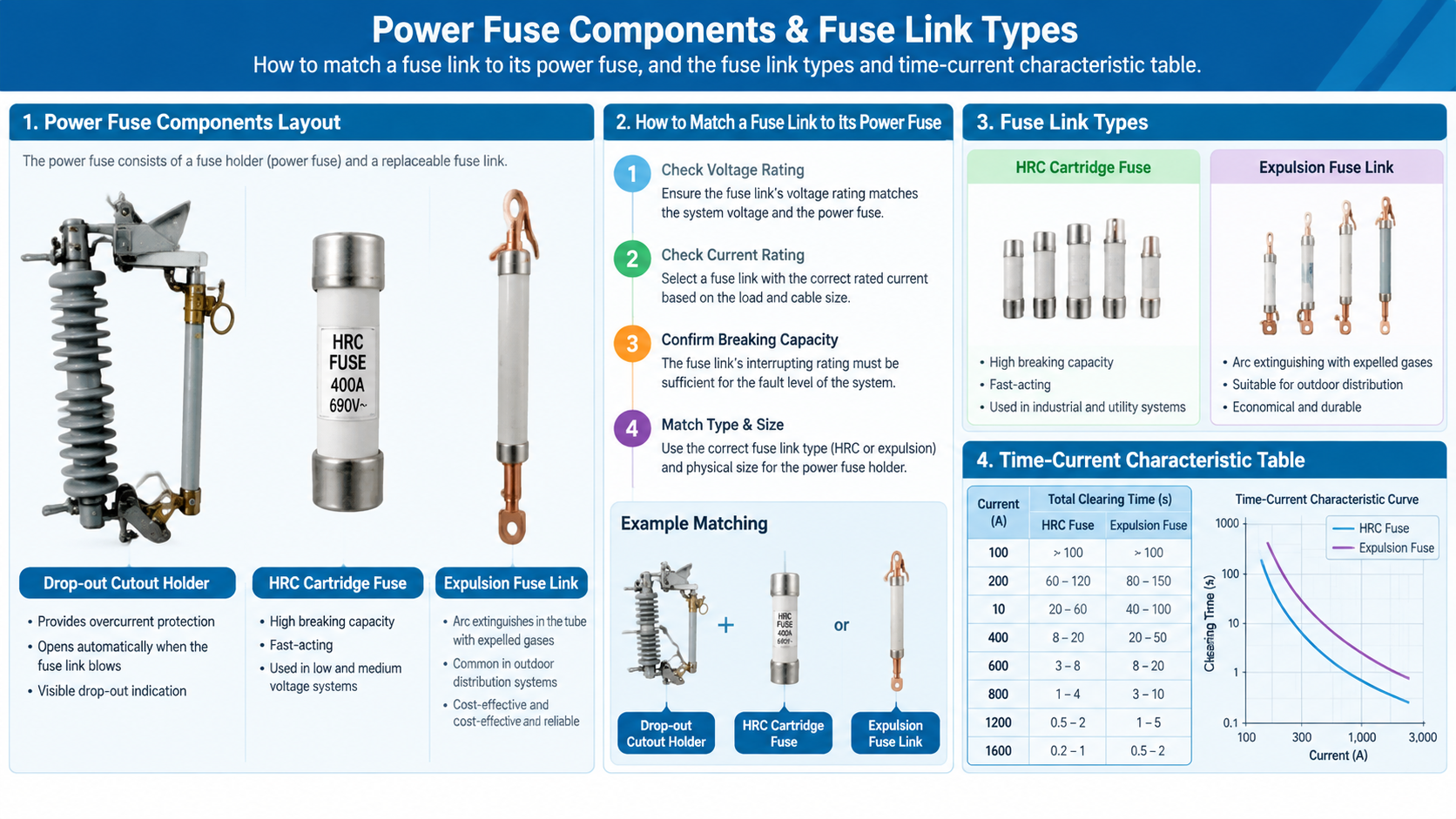
A power fuse is the device; a fuse link is the consumable inside it. The power fuse defines what the installation can withstand — voltage, continuous current, and breaking capacity — while the fuse link defines how the protection behaves on a given load through its current rating and time-current characteristic. Specify the device from the system, then select the link from the load, the inrush, and the coordination study, and keep a proper stock of spares in the correct characteristics.
If you are replacing a mixed fleet of cutouts and holders, our guide to electrical fuses and circuit breakers explains how fuse protection fits alongside breaker-based schemes, and we can review your single-line diagram to confirm link ratings and coordination.
No. A fuse is the complete protective device including the holder, contacts, and enclosure. A fuse link is only the replaceable calibrated element inside the device, and it is discarded once it operates.
No. A link has no contacts, mounting, or arc-quenching enclosure by itself. It must be installed in the power fuse or holder it was designed for.
The power fuse carries the voltage rating, continuous current, breaking capacity, and short-time withstand of the complete assembly, along with the enclosure and contact system. A link carries only its voltage, current, and time-current characteristic.
K links are faster-acting and suit general distribution protection, while T links are deliberately time-delayed to ride through transformer magnetising inrush and motor starting currents without nuisance operation.
Enough to cover the seasonal fault rate plus replacements for commissioning and testing. Because every link is single use, stock at least a few links of every rating and characteristic in use.