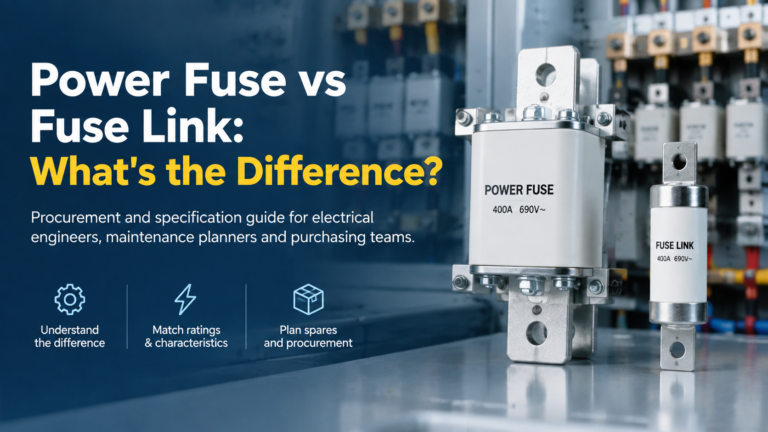
Power Fuse vs Fuse Link: What’s the Difference?
A power fuse is the complete device; a fuse link is the replaceable element inside it. How to tell them apart, match ratings and characteristics, and avoid procurement errors.
Read More
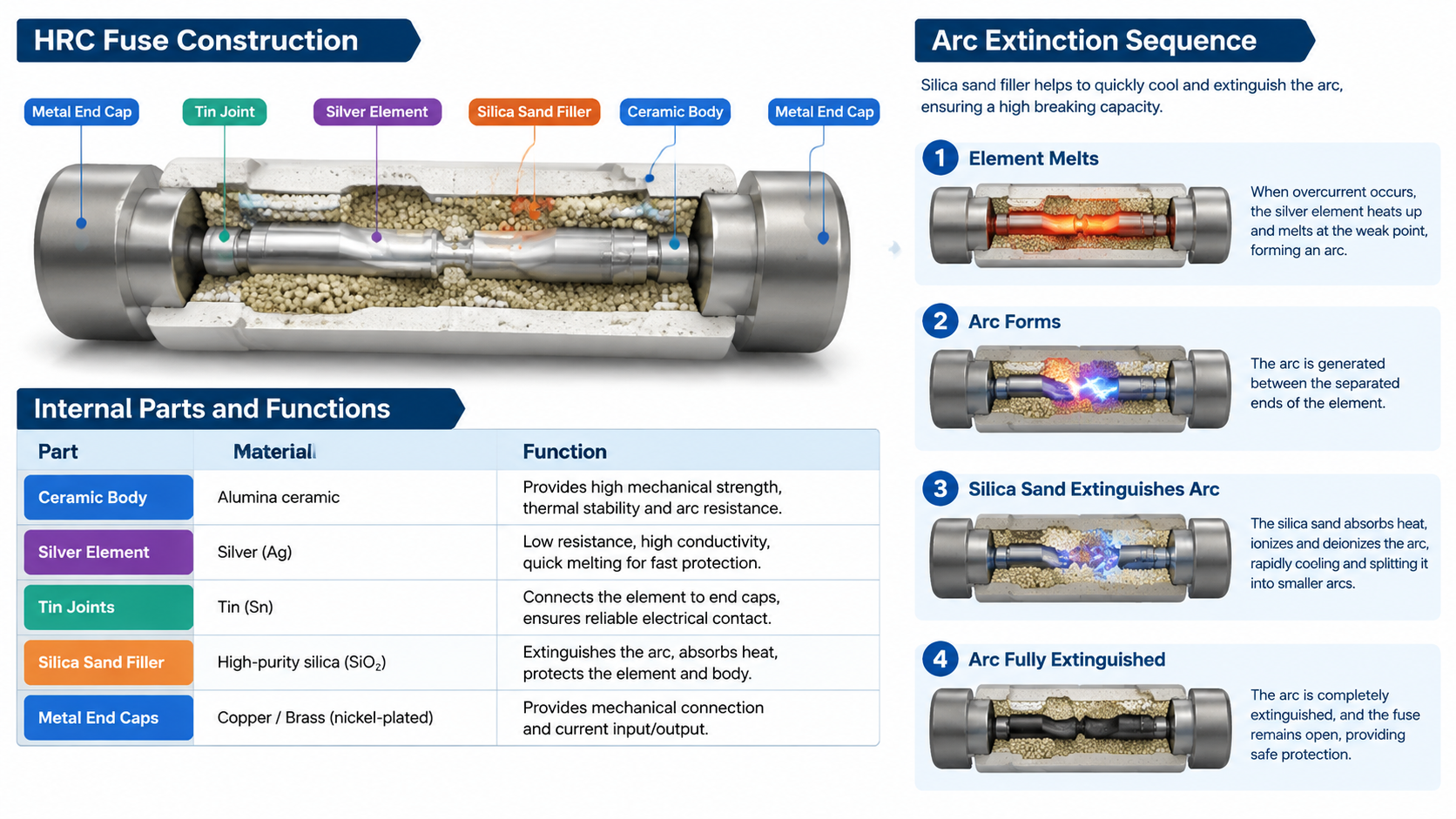
An HRC fuse — high rupturing capacity fuse — is what you specify when the prospective fault current at a board is large enough that an ordinary fuse would simply explode. The HRC fuse construction is what makes that possible: a sealed ceramic body, a calibrated silver or copper element, tin joints that set the melting behaviour, and a filling of quartz sand that absorbs the arc energy and turns it into an insulating solid.
This guide covers the parts and materials, how the arc is extinguished, the main types and where each is used, the ratings that have to be checked, and how HRC fuses compare with circuit breakers.
Rupturing capacity, or breaking capacity, is the maximum prospective fault current a device can interrupt safely without damage, fire, or arc escape. For a general-purpose fuse it may be a few kiloamperes; HRC fuses are rated into the tens of kiloamperes and, in heavy industrial designs, above 100 kA. That rating is what allows an HRC fuse to be used at the intake of a distribution board or ahead of a transformer where the available fault current is enormous.
A second defining characteristic is current limiting. An HRC fuse interrupts so quickly that the fault current is cut off before it reaches its prospective peak, which sharply reduces the thermal and electromagnetic stress on cables, busbars, and switchgear downstream.
| Component | Material | Function |
|---|---|---|
| Body | High-strength ceramic or fibre-reinforced tube | Withstands the internal pressure and temperature of interruption and provides insulation |
| Fuse element | Silver or copper, sometimes alloy, with a shaped or notched profile | The calibrated conductor that melts at the rated current and controls the time-current characteristic |
| Tin joints or reduced sections | Tin or controlled weak points on the element | “M-effect” joints melt first at moderate overload, giving reliable operation at lower currents |
| Filler | Quartz or silica sand, densely packed | Absorbs arc heat, reacts with vaporised metal, and forms a high-resistance insulating mass that extinguishes the arc |
| End caps or blade contacts | Copper, brass, or plated metal | Terminate the element and connect the fuse to its holder or base |
| Holder or base (as a system) | Ceramic, moulded, or metal assembly | Positions the fuse, provides contacts, and allows safe insertion and removal |
| Type | Construction | Typical application |
|---|---|---|
| NH / blade type | Flat blade contacts on a rectangular ceramic body, with a striker for indication on many designs | Industrial and commercial distribution boards, cable and motor feeder protection |
| DIN type | Standardised cylindrical body with DIN end contacts | Control panels and modular distribution, where dimensional standardisation matters |
| Cylindrical / cartridge type | Sealed cylindrical ceramic or reinforced tube | Control circuits, small distribution boards, general equipment protection |
| BS 88 type | Standardised British dimensions and characteristics | UK and Commonwealth installations, public utilities |
| Medium-voltage / HV HRC (XRNP and similar) | Larger ceramic body rated for kV-class service | Transformer and cable protection in MV switchgear, often as backup to a breaker |
| Liquid-filled | Insulating liquid used for arc suppression | High-voltage systems requiring efficient arc quenching |
At medium voltage, HRC designs overlap with expulsion fuses, which behave differently and are used in different holders. For a comparison of the wider fuse families, see our overview of types of electrical fuse. Symbols and designations differ between families too, and the conventions are set out in the guide to the electrical symbol for a fuse.
Where the fuse is used as an outdoor overcurrent device on overhead lines, the equivalent hardware is a cutout with an expulsion link, such as the RW12 high voltage fuse range, rather than a sealed sand-filled cartridge.
| Feature | HRC fuse | Circuit breaker |
|---|---|---|
| Reusability | Single use; replaced after operation | Resettable and reusable |
| Response speed | Very fast, with current limitation | Fast, but generally slower than a current-limiting fuse |
| Breaking capacity | Very high, often above 100 kA | High, and rating-dependent |
| Adjustability | None; behaviour fixed by the characteristic | Settings adjustable, with remote and automated control possible |
| Maintenance | None beyond replacement and inspection | Periodic testing, lubrication, and mechanism checks |
| Function beyond protection | Protection only | Protection plus switching and isolation |
| Best suited to | High fault levels, simple robust protection, backup duty | Circuits needing frequent switching, remote control, or coordination flexibility |
The two are frequently used together rather than in competition, and a fuse link or HRC element is the part that is replaced after operation: the breaker provides switching and coordinated protection, and the HRC fuse sits in series to limit fault energy and back up the breaker on very high fault currents.
HRC fuses earn their place through two properties: a breaking capacity high enough to clear the largest faults a network can deliver, and current-limiting behaviour that cuts the fault off before it peaks. The construction that delivers this — ceramic body, calibrated element, tin joints, and densely packed silica sand — has barely changed in decades because it works. Specify by rated current, voltage, breaking capacity, characteristic, and I²t; replace like for like; and use the fuse in series with a breaker where switching and coordination flexibility are also needed.
If you are protecting a medium-voltage transformer or cable and need to confirm coordination between an HRC fuse and the upstream breaker, review electrical fuses and circuit breakers or send us your fault level and single-line diagram.
High rupturing capacity. It indicates a fuse designed to safely interrupt very high prospective fault currents, typically in the tens of kiloamperes and above, without rupture of the casing or escape of the arc.
A ceramic or fibre-reinforced body, a silver or copper element with tin joints or reduced sections, densely packed quartz or silica sand filler, and metal end caps or blade contacts that connect to the holder.
The arc that forms when the element melts is drawn into the surrounding silica sand. The sand absorbs the arc energy, melts, and fuses into a glass-like insulating mass that quickly raises the arc resistance and extinguishes it within a fraction of a cycle.
No. HRC fuses are single-use devices. Once the element has melted, the fuse is replaced with an identical unit of the same rating, characteristic, and dimensions. Current-limiting behaviour also means it interrupts the fault before the prospective peak current is reached, so the let-through energy to downstream equipment is far lower than the network could otherwise deliver.
gG or gL fuses provide general-purpose full-range protection for cables and general circuits. aM fuses are motor-rated, provide short-circuit protection only, and must be used together with an overload relay.