Recloser vs Circuit Breaker vs Sectionalizer
The functional differences between a recloser, a circuit breaker and a sectionalizer, how the three coordinate to isolate a faulted section, and which arrangement suits each network.
Read More
An insulator has three jobs at once: hold the conductor up, keep the conductor electrically separate from everything that is earthed, and survive whatever the weather and the environment do to it for the next thirty years. The types of insulators in power system exist because those three jobs are weighted differently at 11 kV on a rural cross-arm and at 400 kV on a transmission tower, and the insulator range you specify has to match that weighting.
This guide covers the main families — pin, post, suspension, strain, shackle, and composite — explains which voltage class and mechanical duty each one is built for, and shows how pollution class drives the creepage distance you have to specify.
Every insulator type below is a different compromise between those three duties, which is why the nominal voltage range and mechanical load appear in the type name rather than in a footnote.
| Type | Typical voltage | Dominant mechanical stress | Where it is used |
|---|---|---|---|
| Pin insulator | Up to 33 kV | Compression and bending | Straight sections of overhead distribution lines |
| Shackle (spool) insulator | Up to 11 kV | Tension | Low-voltage and MV line terminations, sharp angles |
| Post insulator | 11 kV to 800 kV | Bending, torsion, compression | Substations, busbar supports, switchgear, isolators |
| Suspension (disc) insulator | 33 kV to EHV | Tension | Transmission towers, long spans, dead-ends |
| Strain insulator | 11 kV to 400 kV | Very high tension | Dead-end poles, corners, river crossings, terminals |
| Long rod insulator | 66 kV to EHV and HVDC | Tension | Coastal, industrial, and HVDC lines |
| Composite (polymer) insulator | Full range | Any, depending on form | Polluted, coastal, seismic, and weight-critical sites |
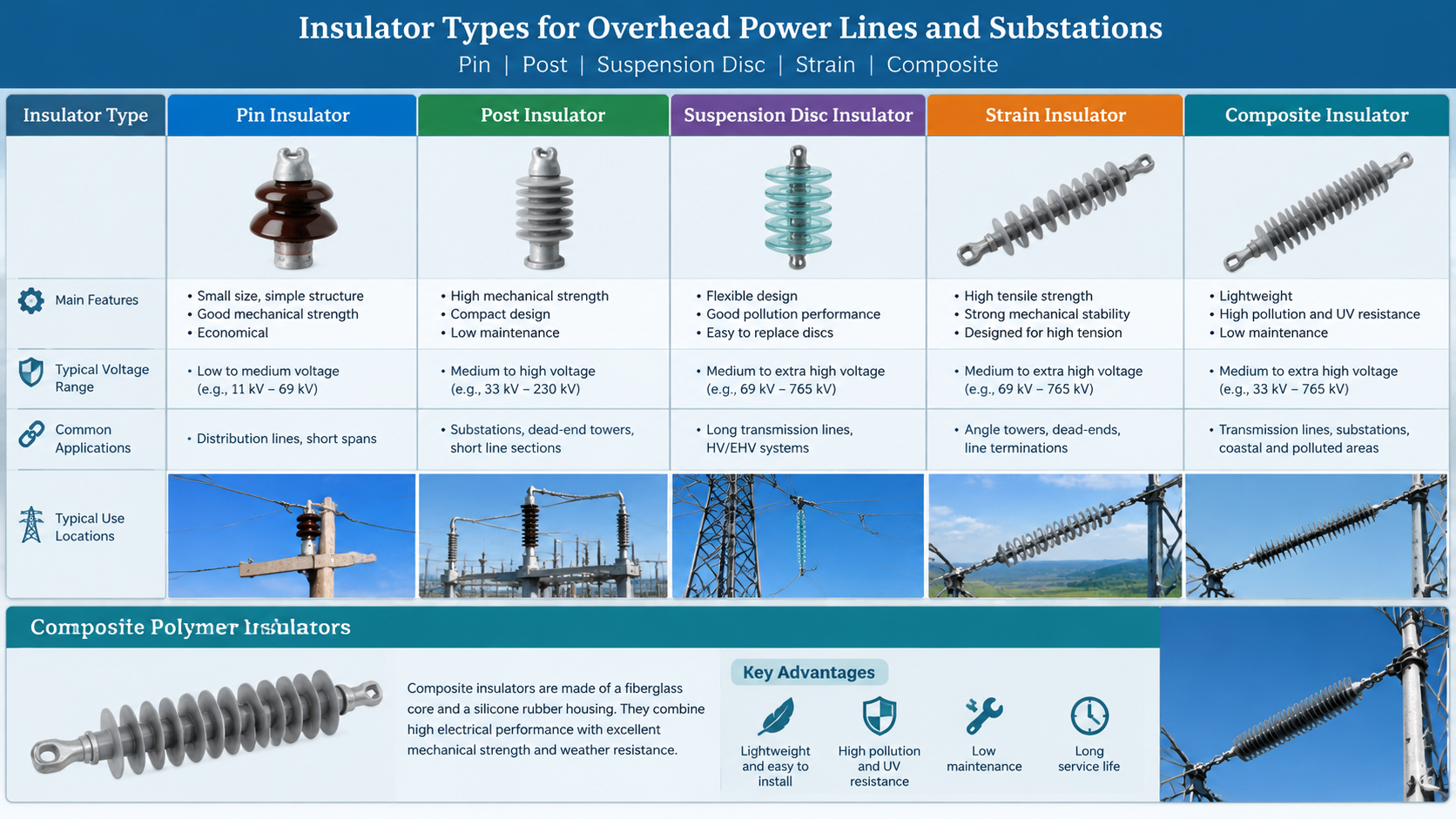
A pin insulator is a rigid single-unit body bolted to the cross-arm by a metal pin, with the conductor sitting in a groove on top and tied in place. It is the standard, lowest-cost choice for distribution lines up to 33 kV. Above that voltage the shell thickness has to grow exponentially to prevent puncture through the body, which makes the unit heavy, expensive, and prone to cracking at the pin base under wind load. That physical limit, more than any standard, is what pushes transmission lines onto suspension strings.
Post insulators are rigid cylindrical units with metal end fittings, mounted vertically or horizontally on steel structures. They carry busbars, isolators, and equipment connections in substations and switchgear, and they are designed for the bending, torsional, and compressive loads that appear during short-circuit electromagnetic forces as well as in normal service. Individual units can be stacked into columns for higher voltages, and their shed profile is arranged to prevent a continuous water film in heavy rain. Inside substations you will find them on transformer connections, disconnectors such as the GW9 high voltage isolator switch, and busbar supports.
A suspension insulator is a string of disc units hanging from the tower, with the conductor supported at the bottom. This modular approach is what makes high-voltage transmission practical: the string length, and therefore the insulation level, is increased simply by adding discs. A typical 132 kV string uses seven to nine standard discs, with more added for heavier pollution. Individual damaged discs can be replaced without dismantling the string, and the flexible arrangement distributes mechanical load along the assembly.
Strain insulators are built for the points where a line pulls hard — dead-end poles, angle towers, terminations, and crossings — and are rated for exceptional tensile load. Shackle, or spool, insulators serve the same tension duty at low voltage and the lower medium-voltage range, mounted on the pole with a clevis or strap so the unit can align with the line tension. Both types matter more than their modest appearance suggests: mechanical failure at a dead-end drops the conductor, and that is a far more serious event than a flashover.
A composite insulator combines a fibreglass-reinforced polymer core that carries the mechanical load with a silicone rubber housing and sheds that provide the insulation. The result is a unit that is typically 70–90% lighter than the porcelain equivalent, that resists impact rather than shattering, and that performs markedly better under pollution because the silicone surface is hydrophobic. A silicone surface makes water bead into isolated droplets instead of spreading into a continuous conductive film, and the low-molecular-weight siloxanes in the rubber migrate to the surface over time, making the pollution layer itself water-repellent. That is why a high-voltage composite insulator is the usual specification for coastal, industrial, and desert sites, and for towers where the crane or tower load cannot take heavy ceramic strings.
The trade-off is UV and ageing exposure: composite housings depend on material quality, and cheaper compounds track, erode, or discolour faster. For critical lines, confirm the supplier’s type test data and material specification rather than the unit price alone.
| Property | Porcelain | Toughened glass | Composite (polymer) |
|---|---|---|---|
| Weight | Heavy | Heavy | Very light |
| Pollution performance | Moderate; needs adequate creepage and cleaning | Moderate | Excellent; hydrophobic surface |
| Damage behaviour | Cracks, may fail invisibly | Self-destructs into small pieces, obvious | Resists impact; ageing is gradual |
| Inspection | Periodic cleaning and crack inspection | Easy — a broken unit is visible from the ground | Visual check for tracking, erosion, and housing damage |
| Typical strength of the case | Long service history, predictable | Simplifies zero-value detection | Lower weight, lower maintenance, better in severe pollution |
Pollution class sets the minimum creepage distance, which is usually the number that actually decides the insulator size. The widely used IEC 60815 classification runs from light to very heavy pollution, and the required specific creepage rises with the class.
| Pollution level | Typical environment | Indicative minimum specific creepage |
|---|---|---|
| Light | Clean rural areas, low salinity | Up to about 18 mm/kV |
| Medium | Agricultural land, moderate dust | About 22 mm/kV |
| Heavy | Coastal salt fog, industrial zones | About 25 mm/kV |
| Very heavy | Severe salt, cement works, smoke | About 31 mm/kV |
A practical selection sequence follows from that table: confirm the system voltage and the highest operating voltage, establish the site pollution class, derive the required creepage distance, then choose the type that meets it at the lowest total cost. For 11–33 kV inland distribution, porcelain pin insulators remain the economical answer. For the same voltage on a coastline or in an industrial park, composite pin or post units do the job with less cleaning. Above 66 kV, suspension strings sized by voltage and pollution class are the default, with composite long rods increasingly used in their place.
Insulators are only one part of the assembly. How they are arranged alongside breakers and busbars inside a panel is covered in our guide to high voltage switchgear, and the same switchgear range shows how busbar supports and post insulators are applied in practice.
Insulator type is a mechanical decision as much as an electrical one. Pin insulators handle distribution lines up to 33 kV, post insulators support substation busbars and equipment, suspension and strain strings carry the tension of higher-voltage transmission, and composite units deliver the same electrical performance with far less weight and far better pollution behaviour. Choose the type from the voltage class and mechanical duty, then let the pollution class set the creepage distance and the shed profile — that order of decisions prevents both overspending and flashovers.
Pin, shackle, post, suspension (disc), strain, long rod, and composite (polymer) insulators. Pin and shackle types serve low and medium voltage distribution, post types serve substations and switchgear, and suspension, strain, and long rod types serve high-voltage transmission.
Suspension insulator strings made of individual disc units are the standard above 66 kV, because the string length can be increased with voltage and pollution class. Composite long rod insulators are an increasingly common lightweight alternative.
No. Pin insulators are limited to about 33 kV; beyond that the shell becomes impractically thick, heavy, and prone to mechanical cracking, so suspension or post designs take over.
Creepage distance is the shortest path along the insulator’s external surface between the live and earthed ends. It must be long enough for the site’s pollution level, because a conductive pollution film combined with moisture can otherwise allow leakage current and a pollution flashover.
Composite insulators are much lighter, resist impact instead of shattering, and perform better in polluted, coastal, and humid environments because of the hydrophobic silicone rubber surface. Porcelain remains competitive where long service records and lowest initial cost matter most.
It depends on pollution class. Clean rural sites may need no routine washing, while heavy industrial or coastal sites may require periodic washing or the use of anti-pollution coatings. Composite units generally extend the interval because contamination is less likely to form a continuous conductive film.