How to Import Switchgear From China: Step-by-Step Guide
A step-by-step import guide for MV switchgear and vacuum circuit breakers from China, covering specification, factory verification, FAT, packing and customs.
Read More
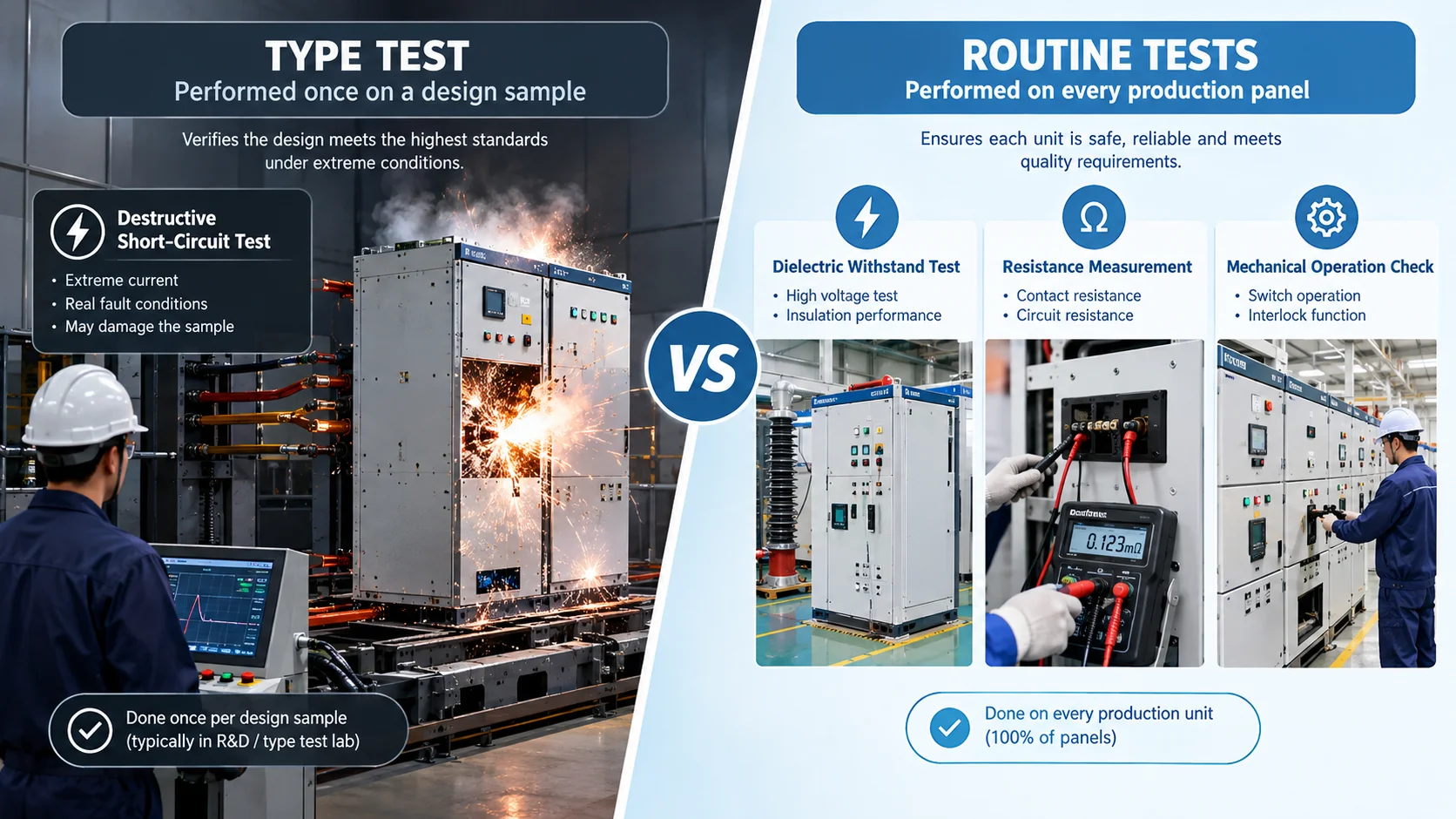
The difference between a type test and a routine test is the difference between proving a design and proving a product. A type test is performed once on a representative sample to demonstrate that the design meets its ratings. A routine test is performed on every single unit that leaves the factory, to demonstrate that this particular assembly was built correctly. Both appear in switchgear tender documents, and buyers regularly accept one when they should have asked for the other.
This guide explains what each test family covers, how the two are defined in IEC 62271-1 and in the IEEE framework, how to read the reports you are handed, and what to write into a purchase order so that the evidence you receive actually matches the switchgear you bought.
A type test answers “does this design achieve 20 kA for 4 seconds?” A routine test answers “was this panel assembled the way the tested design says it should be?” Type tests are destructive or at least punishing — a short-circuit test destroys the breaker under test — so they are done once, at a laboratory, and the report is reused for every unit of that design. Routine tests are non-destructive and fast, so they are done on all units, at the factory, before packing.
The practical consequence is that a type test report proves nothing about workmanship, and a routine test report proves nothing about design margins. A supplier who offers only routine test reports is asking you to trust an unverified design; a supplier who offers only a type test report is asking you to trust that every panel was built like the sample.
Type tests, called design tests in IEEE vocabulary, are defined in IEC 62271-1 with product-specific additions such as IEC 62271-100 for circuit breakers and IEC 62271-200 for metal-enclosed switchgear. The family is broad, and each test corresponds to a different claim on the datasheet.
| Type test | Claim it supports | Notes |
|---|---|---|
| Dielectric | Power-frequency and lightning impulse withstand | Phase-to-phase, phase-to-earth, across the open gap |
| Temperature rise | Rated normal current | Measured at busbar joints and contacts |
| Short-time withstand | Withstand current for 1–4 s and peak | Often combined with the peak test |
| Making and breaking | Rated short-circuit breaking current | Destructive; performed on dedicated samples |
| Mechanical operation | M1 (2,000) or M2 (10,000) operations | Also verifies interlocks |
| Electrical endurance | E1 or E2 class | E2 means extended electrical life, reconditioning not required |
| Ingress protection | Declared IP rating | Tested on the configured enclosure |
| Internal arc | IAC class and accessibility type | Required by IEC 62271-200 for MV assemblies |
| Gas tightness | Sealed-for-life or closed pressure system | Expressed as a leak rate per year |
Routine tests are performed on every assembly before dispatch. For medium-voltage switchgear built to IEC 62271-1, the set is short and specific: a power-frequency withstand test on the main circuit, a withstand test on auxiliary and control wiring, a measurement of main circuit resistance, a mechanical operation test with interlock verification, and a gas tightness check on gas-insulated equipment.
IEC 62271-1 clause 7 divides testing into type tests, routine tests, and, for some products, sample tests. The same clause defines what each test must demonstrate and how it is performed. Product standards then add tests specific to the equipment: IEC 62271-100 for circuit breakers, IEC 62271-200 for metal-enclosed assemblies, IEC 62271-103 for switches.
In the North American framework the vocabulary shifts. IEEE C37.09 defines design tests, production tests, conformance tests and field tests. Design tests map to type tests and production tests map to routine tests, but the required test list and the acceptance criteria are not identical. If a project is specified under IEEE and the factory works under IEC, the review has to reconcile the two lists rather than assume they are the same. The wider differences in rating structure between the two frameworks are covered in the standard references themselves, and it is worth having your consultant confirm which framework governs before the test package is compiled.
A type test report covers a specific configuration: a specific breaker model inside a specific enclosure, with specific busbar spacing, specific current transformers, and a specific cable compartment arrangement. Change any of those and the report no longer covers what you are buying. This is the single most common gap in Chinese switchgear quotations, and it is almost always unintentional rather than dishonest.
The check is mechanical. Take the report’s stated model, ratings and configuration, and compare them line by line with the quotation and the drawing. If the report says 1,250 A and the quotation says 2,000 A, you need the 2,000 A report. If the report covers a 630 mm wide panel and your layout calls for an 800 mm panel with a different breaker, ask which report covers that combination. A reputable factory will have the answer; a trading company will change the subject.
Five fields decide whether a report is useful. The testing laboratory should be an independent, recognised body — the well-known ones in this field include KEMA, CESI, IPH and the Chinese national laboratories — or a manufacturer’s own laboratory operating under a recognised accreditation. The date tells you whether the design is current. The model and ratings must match your purchase. The configuration description must match your drawings. And the test results must show measured values, not just a pass mark.
A report that lists only “passed” without measured values, test durations or applied voltages is a summary, not a test report. Ask for the full document including the calibration certificates of the test equipment — the omissions are usually where the interesting details are.
Routine reports should be serial-number specific and signed. Each entry needs a measured value and a limit: circuit resistance per phase in micro-ohms against the type test reference, applied test voltage and duration, number of mechanical operations completed, gas pressure before and after the tightness test. One page per panel is normal; a single page covering twenty panels is not.
Compare the circuit resistance values across the batch. Consistent readings within a few percent suggest controlled assembly. A panel reading 40% above its neighbours has a loose joint, and a loose joint is where a fault starts. This cross-check costs nothing and is the most useful thing you can do with a routine test package.
Three claims are frequently asserted without the test behind them. Internal arc classification is a type test with a defined current, duration and accessibility type; the result is written as IAC A FLR or B FLR, and a datasheet that says “arc resistant” without those parameters has not been verified. Ingress protection is a type test on the configured enclosure — with glands fitted, not on a bare box. Mechanical class M1 or M2 is a type test of 2,000 or 10,000 operations, and it is often confused with the routine mechanical test of five operations.
For gas-insulated designs the arc and tightness tests carry more weight, since a sealed compartment cannot be inspected later. The arrangement-level discussion in our AIS vs GIS switchgear guide explains why. For vacuum designs, the equivalent question is the electrical endurance class, which the vacuum circuit breaker range lists per model, alongside the comparison of vacuum and SF₆ breakers for duty-class selection.
Name the tests, not the certificates. The product range pages list the ratings each model is catalogued at, which is the list the test report has to cover. A clause that says “type test reports to be provided” invites a folder of unrelated documents. A clause that says “type test report for dielectric, temperature rise, short-time withstand, making and breaking, and internal arc, covering model X at rating Y, from a laboratory accredited to ISO/IEC 17025” gets you what you need.
For routine tests, require the serial-number-specific report with measured values for each panel, and make shipment conditional on receipt. Add a witnessed factory acceptance test if the order exceeds ten panels, and specify that the witness may open any panel and repeat any routine test at random.
Type tests prove the design, routine tests prove the unit, and neither substitutes for the other. Check that the type test report covers your exact model, rating and configuration, then check that the routine report carries measured values for your serial numbers. If you are reviewing a test package and want a second opinion on whether the evidence covers the equipment, send the report covers and the ratings table and we will mark up the gaps.
No. A type test is performed once on a representative sample of a design and the report is reused for all units of that design. Every unit does require routine tests before dispatch.
There is no formal expiry in IEC 62271-1, but reports are commonly treated as valid for five to ten years, and any design change — busbar spacing, breaker model, insulation material — invalidates the coverage.
Power-frequency withstand on the main circuit, withstand on auxiliary circuits, main circuit resistance measurement, mechanical operation with interlock checks, gas tightness where applicable, and a visual and dimensional inspection.
Production tests, defined in IEEE C37.09. Design tests correspond to type tests. The lists overlap but are not identical, so a project specified under IEEE must be reviewed against the IEEE list.
Only if its laboratory operates under a recognised accreditation such as ISO/IEC 17025. Independent third-party reports are preferred, and some utilities and consultants will not accept self-declared results for short-circuit or internal arc tests.