How to Import Switchgear From China: Step-by-Step Guide
A step-by-step import guide for MV switchgear and vacuum circuit breakers from China, covering specification, factory verification, FAT, packing and customs.
Read More
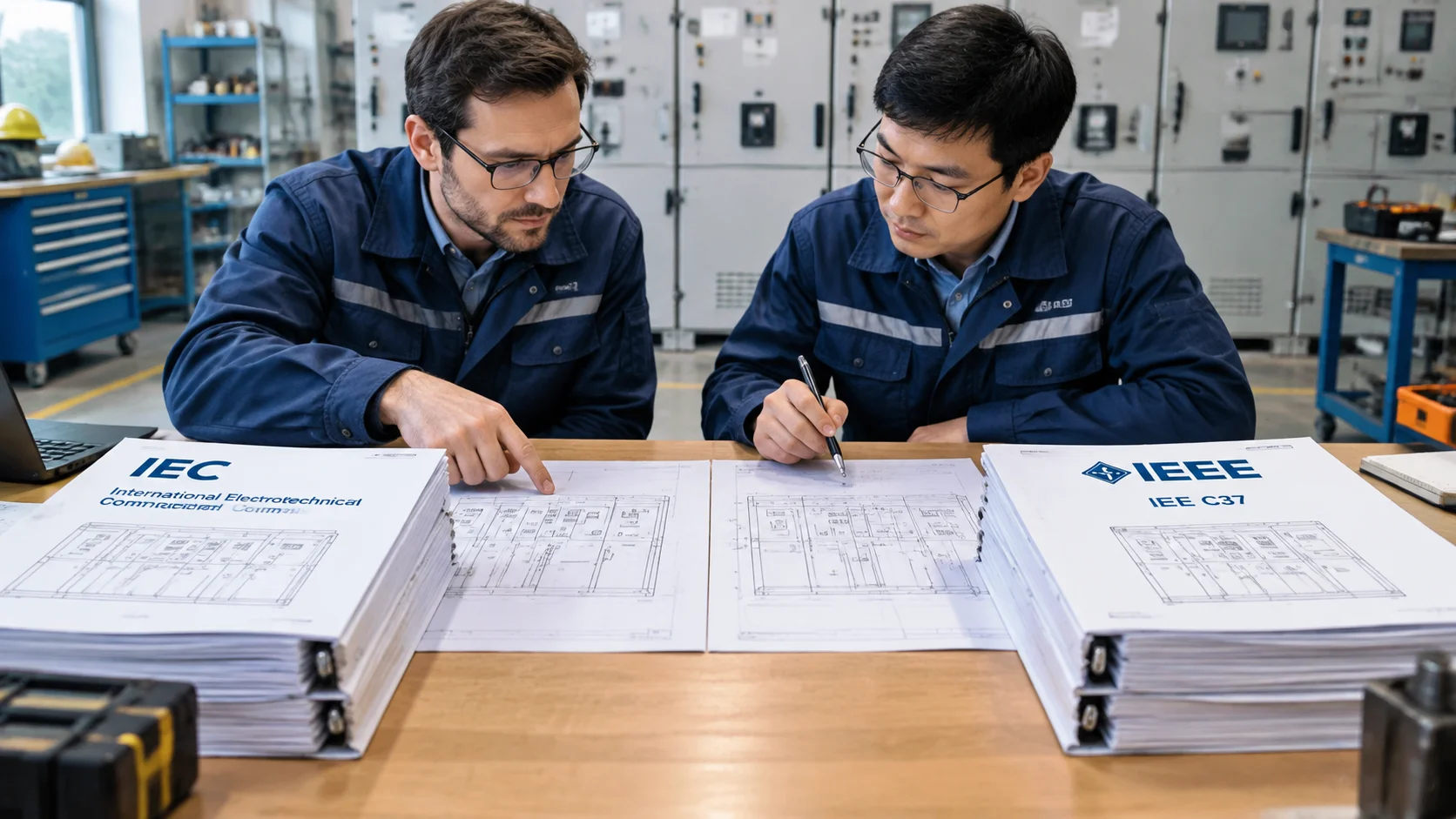
IEC and IEEE/ANSI describe the same medium-voltage switchgear with two different rating systems, and the differences are not cosmetic. A 13.8 kV system in the United States uses 15 kV class equipment with a 95 kV basic impulse level; the IEC equivalent for a 13.8 kV system is a 17.5 kV rated assembly with 95 kV lightning impulse and a 38 kV power-frequency withstand. Same job, different numbers, different drawings, different type test reports.
This article compares the two frameworks as they apply to metal-enclosed medium-voltage switchgear: which standard covers what, how the voltage and insulation ratings map to each other, where fault ratings diverge, and what to write in a specification so the equipment you receive can be reviewed against the standard you must follow.
IEC 62271-200 governs metal-enclosed switchgear from above 1 kV to 52 kV, with circuit breakers covered by IEC 62271-100 and common requirements in IEC 62271-1. In North America, IEEE C37.20.2 covers metal-clad switchgear, C37.20.3 covers metal-enclosed interrupter switchgear, and the breaker itself is rated under IEEE C37.04 and C37.06 and tested under C37.09.
Both systems produce safe, well-tested equipment. The practical problem is that a design compliant with one is not automatically compliant with the other, and the gap shows up in insulation levels, fault duration, and the acceptance tests a reviewer will ask to see.
| Subject | IEC framework | IEEE / ANSI framework |
|---|---|---|
| Common requirements | IEC 62271-1 | IEEE C37.04 (rating structure) |
| Circuit breakers above 1 kV | IEC 62271-100 | IEEE C37.04, C37.06, C37.09 |
| Metal-clad switchgear | IEC 62271-200 | IEEE C37.20.2 |
| Metal-enclosed interrupter switchgear | IEC 62271-103, 62271-200 | IEEE C37.20.3 |
| Switches and earthing switches | IEC 62271-102, 62271-103 | IEEE C37.20.4 |
| Instrument transformers | IEC 61869-2 and 61869-3 | IEEE C57.13 |
| Arc-resistant design | IEC 62271-200 internal arc class | IEEE C37.20.7 |
| Application guide | IEC 62271-1 annexes, IEC 60909 | IEEE C37.010 |
IEC rates equipment by its maximum voltage for equipment (Um), and the preferred values are 3.6, 7.2, 12, 17.5, 24, 36 and 40.5 kV. ANSI rates equipment by a class that sits one step above the nominal system voltage: a 13.8 kV system uses 15 kV class switchgear, a 4.16 kV system uses 5 kV class, and a 34.5 kV system uses 38 kV class.
| Nominal system voltage | IEC rated voltage (Um) | ANSI equipment class | Insulation level, IEC | Insulation level, ANSI |
|---|---|---|---|---|
| 4.16 kV | 7.2 kV | 5 kV | 60 kV LI / 20 kV PF | 60 kV BIL / 19 kV PF |
| 6.6 / 11 kV | 12 kV | 15 kV | 75 kV LI / 28 kV PF | 95 kV BIL / 36 kV PF |
| 13.8 kV | 17.5 kV | 15 kV | 95 kV LI / 38 kV PF | 95 kV BIL / 36 kV PF |
| 22 kV | 24 kV | — | 125 kV LI / 50 kV PF | No class |
| 33 / 34.5 kV | 36 kV | 38 kV | 170 kV LI / 70 kV PF | 150 kV BIL / 80 kV PF |
Two consequences follow. First, an IEC 12 kV panel is not interchangeable with a 15 kV class ANSI panel — the ANSI unit has a higher insulation level for the same nominal duty, which is why it costs more. Second, a 13.8 kV project specified in IEC terms will use 17.5 kV equipment, one full class above the ANSI equivalent. Buyers who compare a Chinese 12 kV quotation against a US 15 kV quotation are not comparing like with like.
ANSI historically set insulation levels higher relative to system voltage than IEC did, reflecting lightning exposure on overhead North American distribution and a conservative safety margin. IEC insulation levels were revised over decades to align with statistical overvoltage studies across 50 Hz networks, and are generally lower for the same nominal voltage.
The practical effect is on clearance and creepage. A 15 kV class ANSI panel has larger phase-to-phase and phase-to-earth clearances than an IEC 12 kV panel, and its bushings, current transformers and cable terminators are dimensioned accordingly. That is also why US-pattern equipment looks physically larger for the same current rating — it is not overbuilt, it is built to a different insulation table.
Both systems rate breakers by rated short-circuit breaking current, but the surrounding data differs. IEC specifies rated short-time withstand current with a duration of 1, 3 or 4 seconds (3 s and 4 s dominate in practice) and a rated peak withstand current of 2.5 times the symmetrical value for 50 Hz systems, 2.6 for 60 Hz. IEEE C37.06 lists preferred momentary and short-time ratings, with the short-time rating historically based on a 2-second duration.
Duty cycles also differ in emphasis. IEC 62271-100 defines rated sequences such as O-0.3 s-CO-180 s-CO and states the auto-reclosing requirement explicitly. IEEE C37.06 lists preferred ratings with a related required capability that includes reclosing, but presents the sequence and the number of operations differently. When a factory quotes “20 kA for 3 s” against an IEEE specification that says “20 kA momentary, 2 s”, the equipment may well be acceptable — but somebody has to write down why, in the review comments.
Current and voltage transformers sit inside the switchgear and carry their own standards. IEC uses IEC 61869-2 for current transformers and IEC 61869-3 for voltage transformers, with accuracy classes such as 0.2, 0.5, 5P and 10P and a rated burden expressed in VA. North America uses IEEE C57.13, with accuracy classes such as 0.3, 0.6, 1.2 and relaying classes C100, C200, C400, C800 expressed as a secondary terminal voltage.
These are not convertible by formula. A 5P20 CT and a C400 relaying CT may both suit the same feeder, but the burden calculation, the saturation behaviour and the way the relay setting is documented all differ. Our explanation of current versus voltage transformers covers the fundamentals, and the instrument transformer range shows the classes available.
IEC 62271-200 requires internal arc testing to be declared as a classification, with an accessibility type (A for installation-restricted areas, B for walk-in areas, C for outdoor) and a defined arc current and duration, typically 1 second. Arc-resistant designs are tested with indicators placed around the enclosure, and the result is expressed as IAC class A FLR or B FLR, where F, L and R denote front, lateral and rear accessibility.
IEEE addresses the same risk through C37.20.7, which defines accessibility types 1, 2, 2B, 2C and 3 and requires the design to be tested with the designated sides accessible. The philosophy is similar, the labelling is not. A specification that simply says “arc resistant” without naming the standard, the current, the duration and the accessibility type is a specification that cannot be verified.
Sometimes. A manufacturer can build a panel that meets IEC 62271-200 and additionally satisfies the IEEE insulation and rating tables, but this is a deliberate engineering exercise with separate type tests, not a documentation swap. Ratings that are easy to align are the electrical ones — 630 A and 20 kA mean the same thing in both systems. The hard parts are insulation levels, fault duration, arc classification and the instrument transformer classes.
If your project spans both worlds — a Chinese-built substation reviewed by a US-based engineer, for example — the cleanest approach is to nominate the governing framework in the specification, then list the specific clauses of the other framework that must also be demonstrated. Expect the supplier to price the additional type testing.
For breaker technology selection inside that framework, our comparison of vacuum and SF₆ circuit breakers covers where each is normally applied, and the vacuum circuit breaker range shows the ratings that are commonly available off catalogue.
IEC and IEEE describe equivalent equipment with different rating bases, different insulation tables and different test reporting. The voltages that look familiar are the ones that catch people out: 13.8 kV maps to 17.5 kV under IEC and 15 kV class under ANSI, and those are not the same panel. Write the governing standard into the specification, state the insulation and arc ratings numerically, and require the type test reports by test name. If you need a design reviewed against both frameworks, send the ratings table and we will mark up where the two diverge.
No. They cover the same equipment families but use different rating structures, insulation tables and test procedures. IEC 62271-200 is the assembly standard for metal-enclosed switchgear up to 52 kV; IEEE C37.20.2 covers metal-clad switchgear in North America.
Technically it can be installed, but acceptance depends on the authority having jurisdiction and on the project specification, which usually references UL and IEEE requirements. Equipment must be evaluated against those requirements, not assumed compliant.
ANSI insulation levels were historically set with a larger margin above nominal system voltage, partly reflecting lightning exposure on overhead distribution. IEC levels were revised against statistical overvoltage studies and are generally lower for the same nominal voltage.
There is no exact equivalent. A 15 kV class ANSI panel has a 95 kV BIL, which matches IEC 17.5 kV equipment on lightning impulse, but the power-frequency withstand and the clearance requirements differ.