Type Test vs Routine Test for Switchgear: What’s the Difference
Type tests prove the design once; routine tests prove every unit. Compare test scope, read the reports correctly, and specify both in your purchase order.
Read More
Import switchgear from China long enough and the pattern becomes predictable. The equipment is heavy, the lead time is measured in months, and by the time a container is on the water the technical details are frozen. Most of the problems buyers run into — mismatched voltages, missing test certificates, panels that do not fit the trench, spare parts nobody stocks — are decided long before the purchase order, in the specification and the supplier conversation.
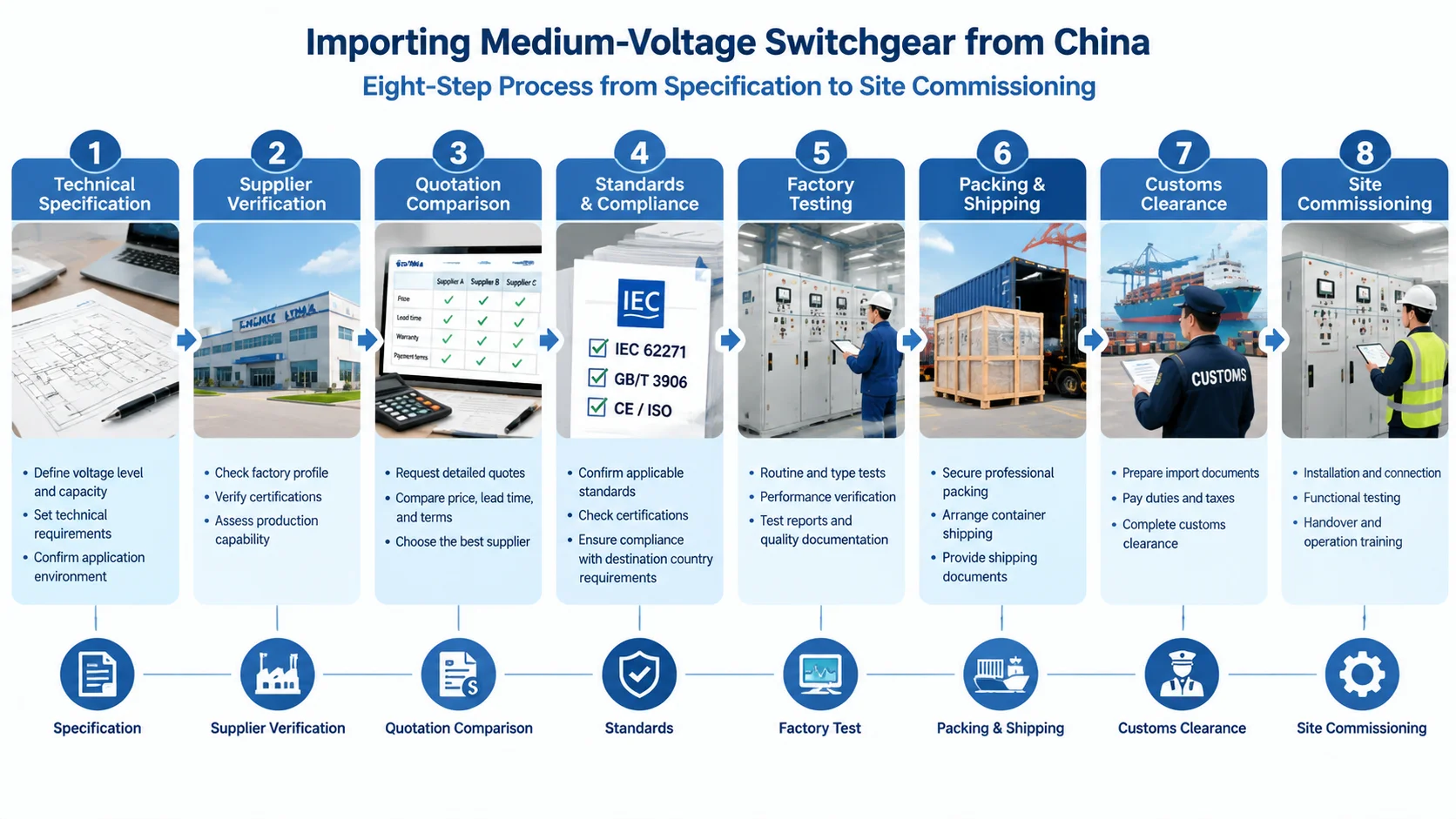
This guide walks through the process in the order it actually happens when you buy circuit breakers and medium-voltage switchgear from China: specification, supplier verification, quotation comparison, testing, shipping, customs, and commissioning. It also flags the red flags that separate a factory from a trading company with a catalogue.
Do not send a request for quotation until you have a single-line diagram and a ratings table. At minimum, state the system voltage and the equipment rated voltage, rated current, rated short-circuit breaking current, short-time withstand current and duration, whether the breaker must be withdrawable, the protection and metering requirements, the enclosure IP rating, and the ambient conditions at site.
The ambient detail is the one buyers skip most often. A standard Chinese catalogue assumes an ambient of −10 °C to +40 °C, altitude below 1,000 m, and average humidity of 95%. If your site is at 1,800 m in Ethiopia or runs at 50 °C in the Gulf, the insulation level and current ratings have to be derated. Sending that information with the enquiry avoids a redesign later, and it is the difference between a quotation you can compare and one you cannot. If you are still working out which breaker family you need, our comparison of vacuum and SF₆ circuit breakers is a useful starting point.
Ask for four documents before discussing price: the business licence with the registered scope of business, the ISO 9001 certificate with a verifiable certificate number, the type test reports for the exact model being quoted, and a customer reference list with contactable projects. A manufacturer will produce all four without hesitation. A trading company will produce the first two and stall on the rest.
Then check the numbers on the type test report against the datasheet. The report should name the test laboratory, the model, the ratings and the date, and it should cover the tests your market requires — dielectric, temperature rise, short-time withstand, making and breaking, and mechanical operation. A report that covers a 630 A, 20 kA model does not cover the 1,250 A, 31.5 kA panel in your quotation.
Three quotations with three different scopes are three useless numbers. Build a comparison matrix with the same line items for every supplier and insist on a line-by-line answer rather than a lump sum.
| Line item | What to require | Why it changes the price |
|---|---|---|
| Breaker brand and model | Named, with datasheet | Own-brand versus licensed design differs substantially |
| Current and voltage transformers | Ratios, class, burden | Metering-class and protection-class cores are priced differently |
| Protection relay | Brand, model, protocol | Local relay versus imported relay can double panel cost |
| Busbar | Material, cross-section, current rating | Copper versus aluminium, and busbar rating versus panel rating |
| Enclosure | IP rating, internal arc class | Arc-rated designs add 15–30% to the panel price |
| Testing | Routine tests, witnessed FAT | Witnessed factory testing is quoted separately |
| Spares and tools | Racking handle, spare coils, contact set | Frequently omitted and expensive to buy later |
| Delivery term | FOB port, CIF port, or DAP site | Not comparable across different Incoterms |
Chinese manufacturers build to IEC 62271 for medium voltage and IEC 61439 for low-voltage assemblies by default, and can usually supply IEEE/ANSI-compliant designs on request. Confirm which framework your project requires, and confirm it in writing — a panel designed to IEC 62271-200 is not automatically acceptable to a reviewer working from IEEE C37.20.2, even when both are 12 kV, 630 A, 20 kA. The same question decides whether the arrangement is air-insulated or gas-insulated, a choice our AIS vs GIS switchgear comparison covers in detail.
Certification is the second half of that conversation. CE marking on Chinese switchgear can mean a full EU type examination or a self-declaration with no third-party involvement; ask which, and ask for the declaration of conformity with the directive and standard references. For projects in the Gulf, Southeast Asia or Africa, the national utility’s own approval list often matters more than any CE mark.
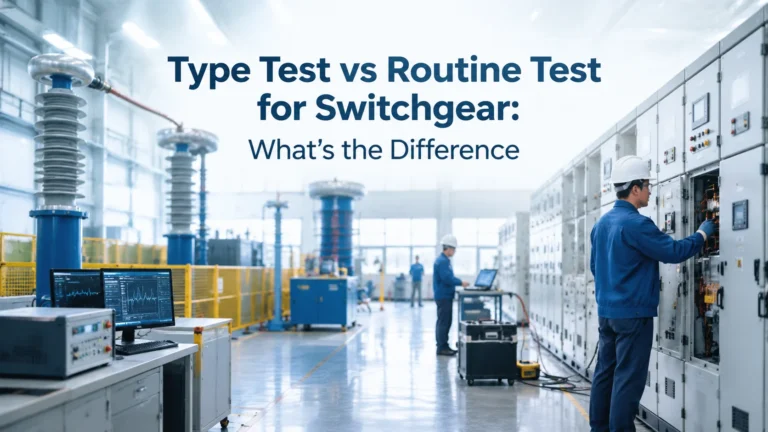
Every panel should ship with routine test reports: power-frequency withstand on the main circuit, withstand on auxiliary circuits, main circuit resistance measurement, mechanical operation test, and gas tightness for SF₆ units. These are cheap to produce and they are the record you will rely on during commissioning.
For orders above roughly ten panels, book a witnessed factory acceptance test. It costs a trip and a few days of the factory’s time, and it catches the mistakes that are expensive to fix at site: wrong current transformer ratios, missing interlocking, incorrect relay configuration, paint and labelling errors. Bring your own torque wrench and your own test sheet.
Switchgear ships as a combination of export-worthy wooden cases and, for larger line-ups, partially assembled sections. Specify the following: seaworthy plywood or fumigated timber with IPPC marking, internal bracing so the breaker trucks cannot move, desiccant bags and vapour barrier film for humid routes, and a packing list that maps every case to a panel number on your layout drawing. Compact units such as an XGN15 ring main unit usually travel as a single sealed case, while metal-clad vacuum circuit breaker panels are split into truck, busbar and cable sections.
Choose FCL for anything above about six panels. LCL shipments of switchgear get handled repeatedly, and the damage rate on a 1,200 kg panel that has been restacked three times is not worth the freight saving. Confirm the lifting points on the packing drawing and check that the case can be handled by the crane at your site, not just at the port.
Circuit breakers above 1 kV are commonly classified under HS 8535.21, and switchgear assemblies under HS 8537.20, but the final classification rests with your customs broker and should be confirmed before the invoice is issued. Prepare the commercial invoice, packing list, bill of lading, certificate of origin and, where applicable, the declaration of conformity.
Two timing traps. First, a certificate of origin needs to match the invoice description exactly; “electrical equipment” as a description invites a query at destination. Second, duty rates and any preferential treatment under a trade agreement depend on the origin documentation being right at the time of export — it is very hard to recover later.
Inspect on arrival, before signing the delivery note. Check case integrity, photograph everything, and open the breaker compartments to confirm the trucks are still on their rails. Store indoors or under cover, keep the desiccant in place, and energise the anti-condensation heaters if the equipment will sit for more than a few weeks.
During commissioning, verify the interlocking sequence rather than assuming it: the breaker must not be racked in or out with the switch closed, the earthing switch must not close onto a live circuit, and the doors must not open on an energised compartment. Then check the protection settings against your coordination study — factory default relay settings are not your settings.
Successful switchgear import comes down to four habits: freeze the specification before you ask for prices, verify the factory with documents rather than claims, force every quotation into the same comparison matrix, and inspect the equipment before it ships. Do those four things and the shipping and customs work becomes routine. If you are building a specification now, browse the product range to see the ratings and configurations available, or send your single-line diagram and we will confirm which panels fit and what the routine test package should contain.
Typical lead time is 30 to 60 days for standard panels and 60 to 90 days for engineered line-ups with imported relays, plus 25 to 40 days of sea freight and one to two weeks for customs clearance. Order-specific testing adds a further week.
Circuit breakers for voltages above 1 kV are commonly classified under HS 8535.21, while complete switchgear assemblies fall under HS 8537.20. Confirm the classification with your customs broker before the commercial invoice is finalised.
It is strongly recommended for orders above ten panels. A third-party or self-witnessed factory acceptance test catches rating, wiring and interlocking errors while they are still cheap to correct.
In many cases yes, but it must be specified up front and verified with the design calculations and test reports. A standard IEC design cannot be assumed to satisfy an IEEE C37.20.2 review without documentation.
Thirty percent deposit with the balance before shipment is standard for first orders. Negotiate a portion against the factory test report, and use a letter of credit for larger values where your bank supports it.