How to Import Switchgear From China: Step-by-Step Guide
A step-by-step import guide for MV switchgear and vacuum circuit breakers from China, covering specification, factory verification, FAT, packing and customs.
Read More
Most of the world’s medium-voltage distribution runs at 11 kV, 22 kV or 33 kV, and the equipment that serves those networks is not interchangeable. An 11 kV system takes 12 kV rated switchgear, a 22 kV system takes 24 kV equipment, and a 33 kV system takes 36 kV. Order by system voltage instead of equipment rating and you will receive something that either fails the dielectric test review or costs more than it needs to.
This guide maps the three voltage classes to their equipment ratings, explains how insulation levels, clearances and breaker types change across them, and sets out what to put in a specification for 11 kV, 22 kV and 33 kV vacuum circuit breakers and the switchgear around them.
Voltage class drives insulation level, which drives clearance and creepage distance, which drives panel dimensions, cable termination size, and the physical size of current transformers and bushings. It also drives cost in a non-linear way: a 36 kV panel is not 50% more expensive than a 12 kV panel, it is often closer to three times, because the clearances, the breaker interrupter and the cable box all grow together.
That is why the first number to fix in any specification is the maximum system voltage, not the nominal. Distribution networks described as 11 kV, 22 kV and 33 kV actually operate at equipment ratings of 12 kV, 24 kV and 36 kV, and the difference between those pairs is a design margin that exists for voltage regulation and transient overvoltage.
| Nominal system voltage | IEC equipment rating (Um) | Lightning impulse withstand | Power-frequency withstand | Typical breaking capacity |
|---|---|---|---|---|
| 11 kV | 12 kV | 75 kV | 28 kV | 20–31.5 kA |
| 22 kV | 24 kV | 125 kV | 50 kV | 20–25 kA |
| 33 kV | 36 kV | 170 kV | 70 kV | 25–31.5 kA |
| 35 kV (China) | 40.5 kV | 185 kV | 95 kV | 25–31.5 kA |
Note the last row. Chinese practice uses a 40.5 kV equipment rating for 35 kV systems, with insulation levels above the IEC 36 kV values. If you are buying from a Chinese manufacturer for a 33 kV project, confirm which rating you are being quoted — 36 kV and 40.5 kV equipment are both available, and the 40.5 kV panel is larger and more expensive.
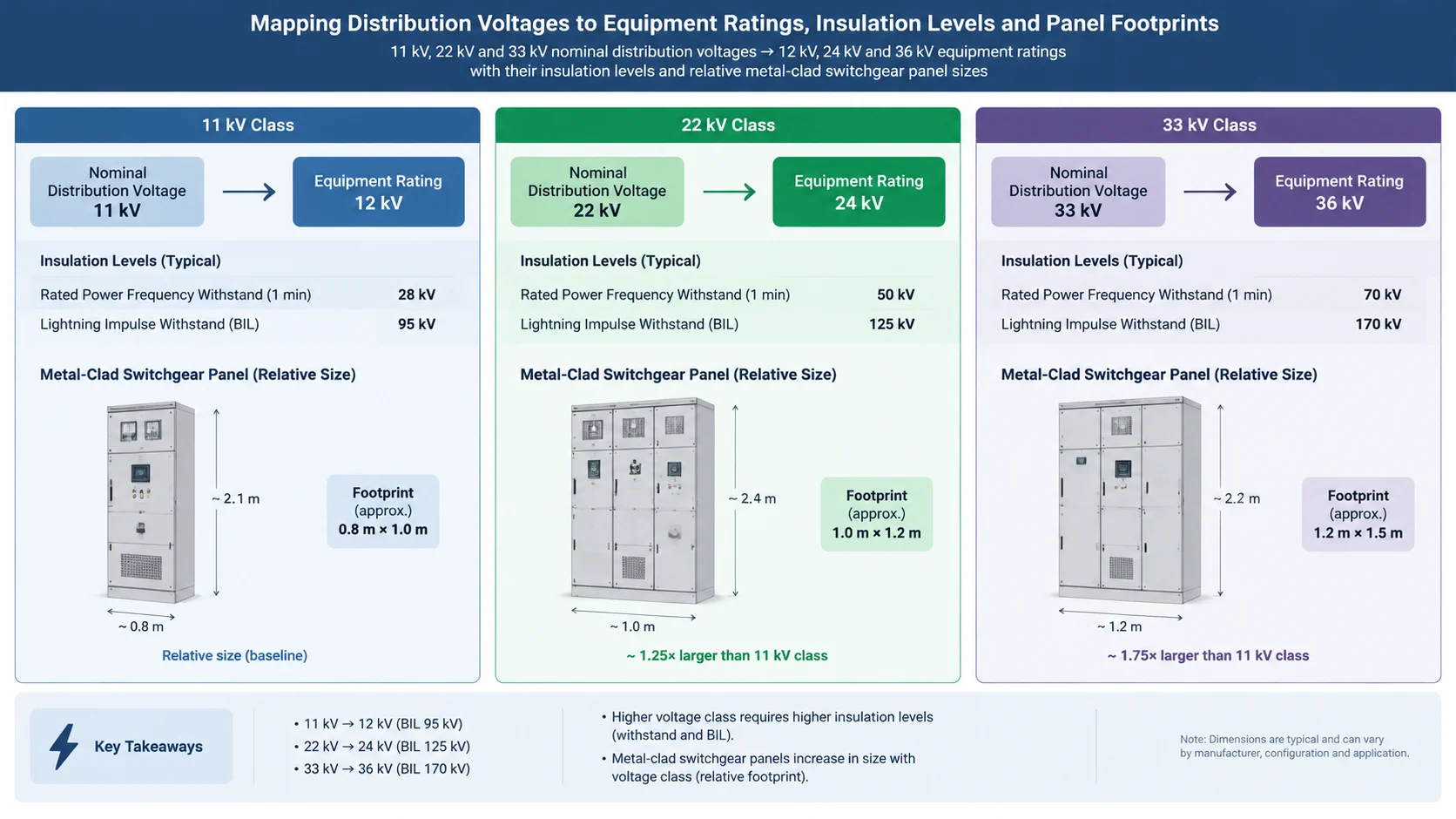
Insulation level is expressed as a lightning impulse withstand voltage and a power-frequency withstand voltage, measured phase-to-phase, phase-to-earth and across the open gap. The open-gap value is higher than the phase-to-earth value, and it is frequently the one omitted from a quotation summary.
The physical consequence is clearance. At 12 kV, phase-to-phase clearance inside a metal-clad panel is measured in tens of millimetres; at 36 kV it is measured in hundreds. That is why a 36 kV panel is roughly 1.4 m wide and 2.8 m deep against 0.8 m by 1.5 m at 12 kV, and why a substation room designed around 11 kV cannot simply be reused for 33 kV.
At 11 kV the dominant products are the ring main unit and the metal-clad withdrawable breaker panel. A 12 kV RMU fits in about 1.5 m of wall space for three ways, and a 12 kV vacuum breaker panel is the standard feeder unit in factories and secondary substations. This is the highest-volume voltage class in most of Asia, Africa and the Middle East, and it is where product choice is widest.
At 22 kV the same product families exist but the equipment is less common, which means longer lead times and fewer off-the-shelf options. Utilities using 22 kV often do so for historical reasons or for longer rural feeders, and specifications tend to be utility-specific. At 33 kV, metal-clad indoor switchgear (the 36 kV or 40.5 kV class) is the normal choice for substations, while outdoor vacuum breakers and reclosers serve pole-mounted and rural applications. For the indoor arrangements, the comparison in our AIS vs GIS switchgear guide is the relevant starting point, because at 33 kV the room footprint argument starts to favour gas insulation.
Three device families cover almost every requirement. A withdrawable vacuum circuit breaker panel gives full protection, metering and remote control, and is the default for substation incomers, bus couplers and transformer feeders. A ring main unit gives compact switching and isolation with fuse protection on the transformer branch, and is the default for distribution rings and small substations.
A recloser sits on the pole. It is a vacuum breaker with integrated protection and auto-reclosing, designed for overhead feeders where temporary faults are common, and it is normally specified at 12 kV, 24 kV or 36 kV to match the line voltage. If your feeders are overhead and exposed, the recloser is doing the work that a substation breaker cannot do remotely. Our switchgear range covers the panel and RMU options, and the differences between breaker technologies are set out in the comparison of vacuum and SF₆ breakers.
Fault levels at 11 kV in an industrial network commonly fall between 12.5 kA and 25 kA, and a 20 kA or 25 kA breaker covers most cases. At 33 kV, source impedance is higher but so are transformer sizes, and 25 kA to 31.5 kA is the usual band. Specifying 31.5 kA where 20 kA would do adds cost to every panel in the line-up, so run the fault calculation before the enquiry rather than after.
Two details matter as much as the number. First, the rated short-time withstand current and its duration must be stated — 20 kA for 4 s is a different requirement from 20 kA for 1 s. Second, the peak withstand and making capacity follow from the asymmetrical component, so confirm the values rather than assuming 2.5 times the symmetrical rating.
Earthing practice changes what the switchgear must withstand. An effectively earthed system limits the phase-to-earth voltage during a fault, which allows a lower insulation level for phase-to-earth than for phase-to-phase. An isolated or resonant-earthed system can raise the healthy-phase voltage to line-to-line level for hours during a single-phase fault, which drives higher insulation requirements and, at 22 kV and 33 kV, changes the surge arrester selection.
Ask the question explicitly in the enquiry: what is the neutral earthing method, and what is the earth fault current and duration? A supplier who receives only “33 kV, 630 A” cannot answer the insulation question, and will quote a generic panel that may be under-specified for an isolated system.
| Application | 11 kV | 22 kV | 33 kV |
|---|---|---|---|
| Distribution ring | 12 kV RMU, 630 A, 20 kA | 24 kV RMU, 630 A, 20 kA | 36 kV RMU or ring panel |
| Substation incomer | 12 kV VCB panel, 630–2,000 A | 24 kV VCB panel | 36 kV metal-clad VCB, 1,250–2,500 A |
| Overhead feeder | 12 kV recloser, 630 A | 24 kV recloser | 36 kV recloser |
| Transformer feeder | RMU with fuse up to ~630 kVA | RMU with fuse | VCB with relay above ~1,250 kVA |
| Compact substation | 12 kV RMU plus LV cabinet | 24 kV RMU plus LV cabinet | 36 kV switchgear in a kiosk |
For 11 kV distribution work, a compact sealed unit such as the XGN15-12F ring main unit is the usual fit, and the wider product range shows the ratings available at 24 kV and 36 kV.
Match the equipment rating to the system: 12 kV for 11 kV, 24 kV for 22 kV, 36 kV for 33 kV, with 40.5 kV appearing when Chinese specifications are involved. Get the insulation levels and open-gap withstand on the datasheet, state the neutral earthing method, and run the fault calculation before you ask for prices. If you are specifying across two or three voltage classes for one project, send the single-line diagrams and we will map the equipment ratings and confirm where the panel sizes change.
11 kV is the nominal system voltage and 12 kV is the rated voltage of the equipment that serves it. Order 12 kV equipment for an 11 kV system, with 75 kV lightning impulse and 28 kV power-frequency withstand at the standard insulation level.
36 kV to IEC, or 40.5 kV in Chinese practice for 35 kV systems. The two have different insulation levels and panel dimensions, so confirm which one is being quoted.
No. The insulation level is insufficient — 75 kV impulse against the 125 kV required at 24 kV — and the clearances are too small. This is a safety issue, not a commercial one.
Run the calculation, but 20 kA or 25 kA covers most industrial and urban distribution networks. State the duration as well, since 20 kA for 1 s and 20 kA for 4 s are different products.
A recloser for overhead feeders where auto-reclosing clears temporary faults, a breaker panel where protection, metering and remote control are required. Many networks use both, with reclosers downstream of substation breakers.