EV Charging Stations Switchgear Application Solution
How to specify EV charging station switchgear: the power path from MV feeder to charger, load sizing with simultaneity, MV switch options, LV protection and compact substations.
Read More
A compact substation is a decision made at the start of a project, not a substitution for a switchroom at the end of it. Buying a prefabricated substation means buying the enclosure, the medium-voltage switchgear, the transformer and the low-voltage distribution as one factory-assembled and factory-tested package, delivered to a foundation and energised in a fraction of the time a conventional brick-and-concrete substation requires.
This guide explains what the package contains, the main construction types and where each fits, the specification points that decide whether the unit works for twenty-five years, and the documentation and procurement questions worth settling before you place the order. The wider power distribution solutions that prefabricated units replace are worth understanding first, because they define the interfaces.
Designs vary, but a complete unit normally includes:
The value of the package is integration. Cable termination, interlocking, protection testing and routine tests are completed and repeated in the factory under controlled conditions instead of being assembled and verified on a site with a limited weather window.
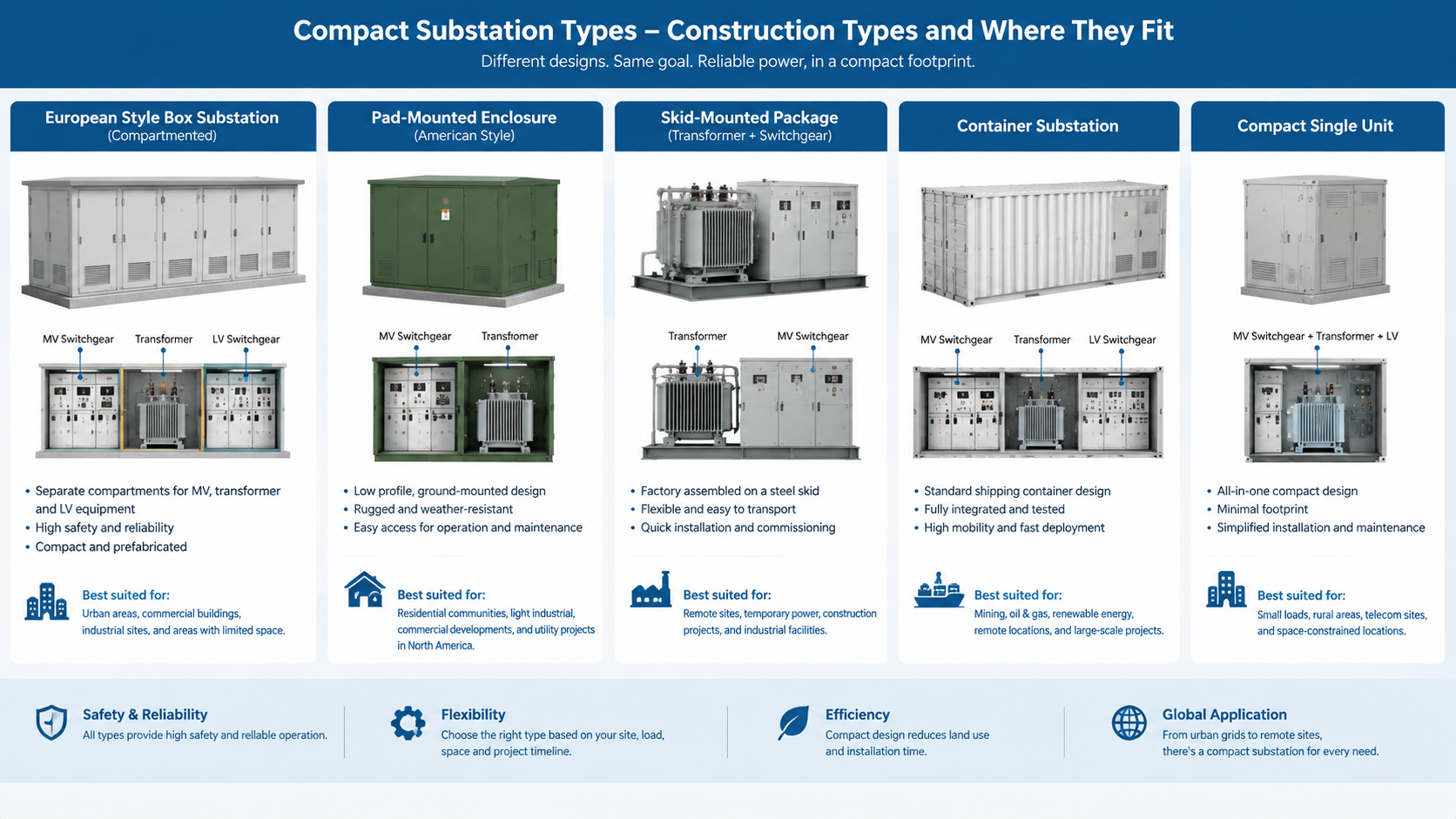
| Type | Arrangement | Typical application |
|---|---|---|
| European-style box substation | Compartmented enclosure with separated MV, transformer and LV rooms, often walk-in | Utility and industrial distribution where inspection access is needed |
| American-style or pad-mounted | Compact tamper-resistant enclosure at ground level, fed by underground cable | Residential and commercial developments with buried distribution |
| Skid-mounted package | Complete assembly mounted on a common steel base for simple handling | Rapid deployment where transport and installation time matters |
| Container or E-house | Full switchroom built inside a standard container structure | Large lineups, remote sites and projects needing an expandable building |
| Compact single-unit | Integrated MV, transformer and LV in one small enclosure | Small loads, including charging stations and renewable generation blocks |
Insulation technology is a separate decision from the enclosure type. Sealed gas-free designs are increasingly specified where the unit sits in a public or environmentally sensitive location, and the trade-offs are set out in our comparison of AIS and GIS switchgear.
The trade-offs are equally real. Service access is tighter than in a dedicated building, transformer ratings are limited by what fits, and expansion beyond a certain capacity usually means adding a second unit rather than extending the first.
Most problems with prefabricated substations trace back to a specification that described the electrical ratings but not the environment or the interfaces. Work through all of these:
Sizing starts with the load and the fault level, but layout follows from access and cable routing. Allow enough working space in front of the switchgear for racking a breaker out and for safe operation in arc-rated clothing, and confirm that the doors open without obstructing an access route. Check the transformer’s ventilation requirement against the position of the enclosure, and verify that the heat it rejects does not simply recirculate into the MV compartment. Where the enclosure is installed against a wall or in a recess, confirm that the specified IP rating is still achieved with the intended airflow, and design drainage so that standing water cannot reach the cable entry.
Transport deserves early attention too. Units are heavy, and access to the foundation may be limited by gate widths, overhead lines or ground bearing capacity. Planning the lift is cheaper than discovering the problem on delivery day.
A prefabricated substation should be supplied against the relevant standards for both the assembly and its internal components, with type and routine test evidence. What to ask for:
For anything beyond a small unit, insist that the enclosure environment is specified rather than assumed. A unit whose thermal design was never checked against the local summer ambient and the transformer losses will derate in service, and the derating will not be recoverable.
The delivery itself is short compared with the preparation. Before the unit arrives, the foundation should be cured and level, the earth electrode installed and tested, the cable routes prepared, and the protection settings agreed with the network operator. Gas or oil handling requirements, if any, should be planned, and the commissioning plan should set out who tests the transformer, who verifies the protection, and who confirms the interfaces between the switchgear and the transformer. Handled this way, a prefabricated substation can be energised within days of delivery instead of weeks.
A prefabricated or compact substation is bought as a system, not as a shelter with equipment inside it. Decide the construction type from the site and the load, specify the enclosure environment as carefully as the electrical ratings, settle the transformer interface explicitly, and require the type, routine and factory acceptance evidence that lenders and network operators will ask for. Get those right and the package delivers what it promises: a faster programme, a smaller footprint and a controlled environment for the equipment inside.
Send us the load schedule, fault level, site conditions and the space available, and we will advise on the compact substation configuration, and how it compares with a conventional switchroom using our medium and high voltage switchgear and low voltage switchgear ranges.
It is a factory-assembled substation package containing the medium-voltage switchgear, transformer and low-voltage distribution inside a weatherproof enclosure. It is built and tested in the factory, delivered to a prepared foundation and connected on site, replacing a conventional substation building.
The terms overlap. Compact usually describes the physical size of a small unit with integrated switchgear and transformer, while prefabricated emphasises factory assembly and testing. A compact substation is almost always a prefabricated one.
A complete substation assembly mounted on a common steel base so it can be lifted and positioned as a single unit, used where handling simplicity and fast deployment matter more than minimum footprint.
Usually yes, as a paired item selected for the installation. Because transformer and switchgear are often supplied by different manufacturers, the interface between them — primary connections, protection, earthing and thermal coordination — should be defined explicitly in the specification.
Type test certificates for the switchgear and the assembly, routine test certificates for the delivered unit, factory acceptance test records, general arrangement and schematic drawings, protection settings with the coordination study, and operations and maintenance documentation including spare parts.