HRC Fuse: Construction, Types & Applications
How an HRC fuse is built and why it can interrupt 100 kA: element, tin joints and silica sand filler, the main types, the ratings to check, and HRC versus breaker.
Read More
Three devices dominate distribution protection, and their names are routinely used as if they were interchangeable. A recloser vs circuit breaker vs sectionalizer comparison really comes down to three questions: can the device interrupt fault current, does it decide for itself, and does it reclose automatically?
Once those are answered, coordination stops being guesswork. This guide explains what each device can and cannot do, how they work together to isolate a fault, and which combinations suit common network configurations.
All three belong to the same family of medium and high voltage switchgear, and selecting the wrong one for a position is one of the more expensive mistakes in distribution design.
A circuit breaker makes, carries, and interrupts current — normal load current and fault current alike. Its protection intelligence sits outside it: current transformers measure the line, a protection relay evaluates the measurement against a setting, and the relay energises the trip coil. The breaker then separates its contacts and extinguishes the arc in vacuum, SF6, or oil, typically within a few cycles.
What it does not do is reclose by itself. After a trip, restoration requires a manual or remote command, or the operation of a separate reclosing relay. This is why breakers are the foundation of a protection scheme rather than a complete distribution automation device: they carry the interrupting duty and the fault level, while the intelligence and sequence logic come from the protection and control layer around them.
An automatic circuit recloser adds its own sensing, its own logic, and a mechanism for automatic reclosing. It detects an overcurrent, trips to interrupt the fault current, waits a programmed dead time, and then recloses. If the fault has cleared, the line is back in service within seconds. If it persists, the recloser repeats the cycle — commonly three or four attempts in a defined sequence, often one fast operation followed by slower delayed operations — and then locks out.
That behaviour exists because the majority of faults on overhead lines are transient: a tree branch touching the conductor, a bird, wind-blown debris, or a lightning-induced flashover. In those cases nothing needs repair, and a device that tripped once and stayed open would cause an unnecessary sustained outage. Reclosing logic is therefore the core value of a recloser, and it is why they are mounted on poles along distribution feeders rather than only in substations.
The interrupting duty still has to be met, and vacuum interruption is now standard in modern designs. A pole-mounted unit such as the ZW32-12G-T630-20 outdoor vacuum circuit breaker integrates vacuum interruption, protection, and auto-reclosing in a single weatherproof assembly with communication options, which is the form most new overhead distribution automation takes.
A sectionalizer is the device that confuses people most, because its name suggests it does the switching. It does switch — but only when the circuit is already dead. A sectionalizer has no fault-interrupting capability of its own. It counts the number of upstream trip operations that occur while it also detects fault current passing through it, and once the count reaches its setting, it opens during the dead time between the upstream device’s trip and reclose.
Two consequences follow. A sectionalizer must always be used downstream of a device that can sense and interrupt the fault, and its count setting must be lower than the upstream device’s lockout count, typically one less, so it isolates the faulted section before the upstream device locks out the whole feeder. Its opening time also has to be short enough to complete the isolation within the dead time, which is why timing margins rather than breaking capacity dominate its specification.
Sectionalizers are most useful on branch circuits and tapped sections where a recloser would be over-specified and expensive, or where time-current coordination with other devices would be difficult. They are lower in cost than reclosers, which is precisely why they remain common on long rural feeders. Note that a sectionalizer does not operate on a time-current curve — it operates on counts — so it is not coordinated in the way a fuse or a breaker is.
| Feature | Circuit breaker | Recloser | Sectionalizer |
|---|---|---|---|
| Interrupts fault current | Yes | Yes | No |
| Senses faults independently | No — relies on external relays and CTs | Yes — built-in sensing and logic | Detects current for counting, but does not trip on it |
| Automatic reclosing | No — requires a separate reclosing relay or manual action | Yes — programmable trip-reclose sequence | No |
| Needs an upstream protective device | No | No | Yes, always |
| Operating principle | Relay command, time-current coordination | Fault detection plus programmable sequence | Counting upstream operations during dead time |
| Interrupting capability | Highest; sized to the substation fault level | High; sized to the feeder fault level | Load-break rating only |
| Typical location | Substation and indoor switchgear | Pole-mounted on the feeder, or in a compact substation | Downstream of a recloser or breaker, on branches |
| Typical cost | Highest | Moderate | Lowest of the three |
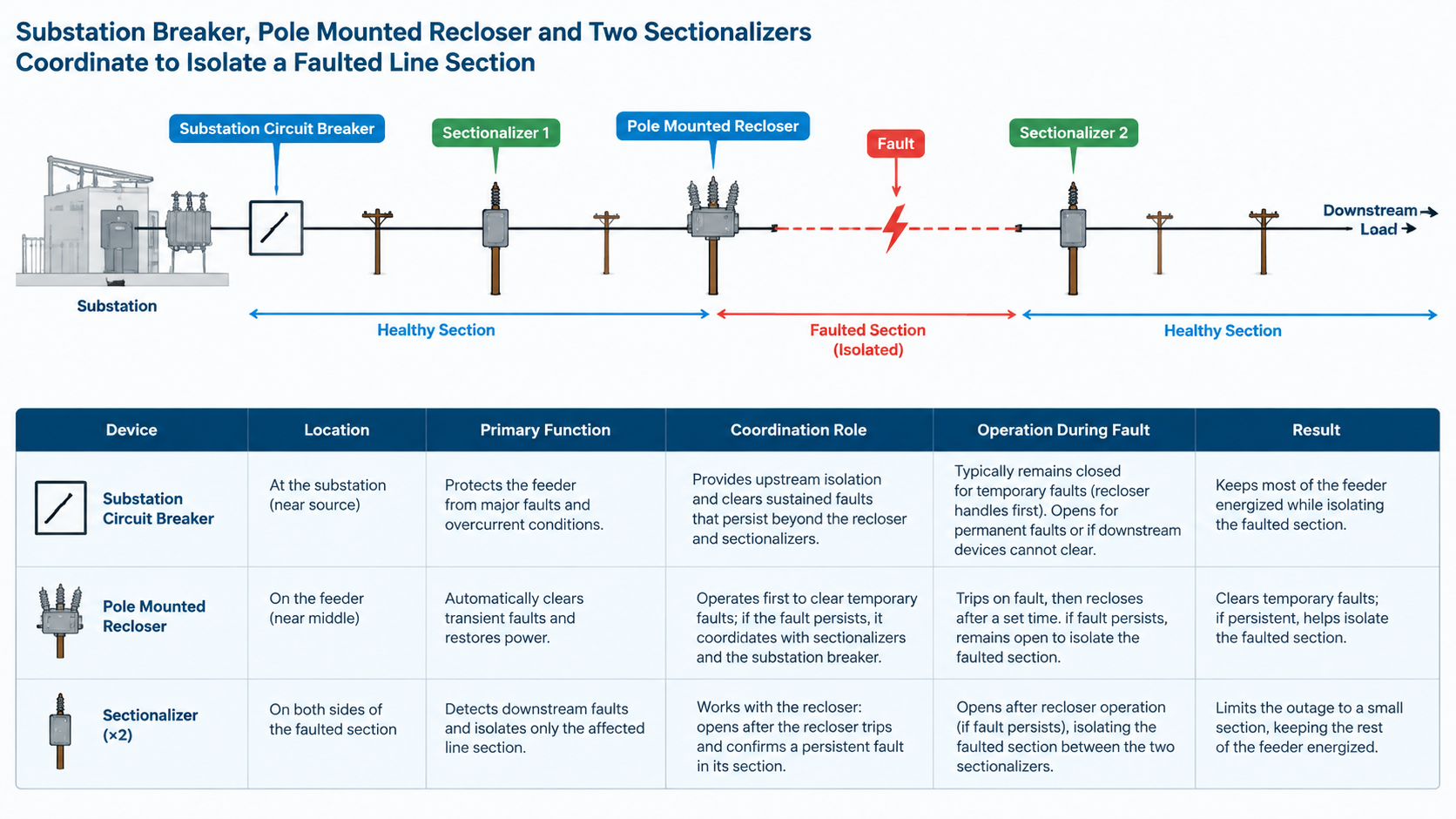
On a real feeder they form a sequence rather than a competition. A permanent fault occurs on a branch section. The upstream recloser trips, interrupting the fault current. During the dead time, the sectionalizer nearest the fault — having counted the operation and detected fault current through it — opens. The recloser then recloses, restoring the healthy part of the feeder while the faulted section stays isolated.
The numbers matter as much as the logic. A sectionalizer count setting must be at least one lower than the upstream lockout count — a two-count setting against a three-shot recloser is typical. Dead times that are too short cause sectionalizer misoperation, and in mixed-vendor installations the coordination study has to account for timing tolerances rather than assuming identical responses.
| Network situation | Typical arrangement |
|---|---|
| Substation feeder protection | Circuit breaker with overcurrent and earth-fault relays, plus a reclosing relay where auto-reclose is required |
| Long overhead rural feeder | Substation breaker plus two or more pole-mounted reclosers and sectionalizers to segment the line |
| Branch or spur off a protected feeder | Sectionalizer, with the upstream recloser or breaker providing fault interruption |
| Industrial plant distribution | Circuit breakers in switchgear, with reclosing normally disabled because automatic reclose into a plant fault is undesirable |
| Underground cable network | Reclosing is usually limited or disabled; cable faults are permanent and repeated reclosing risks further damage |
The underground case is the exception worth remembering: because cable faults rarely clear on their own, utilities often set the recloser to a single shot or turn automatic reclosing off on cable sections, while retaining it on the overhead sections of the same feeder.
Where a recloser is expected to coordinate with an indoor breaker scheme, the protection logic on both sides has to be reviewed together. The basics are covered in our guide to the medium voltage circuit breaker, and the relationship between a breaker and a compact switching assembly in the comparison of VCB and RMU switchgear.
The three devices are complementary, not alternatives. A circuit breaker interrupts fault current under relay command and anchors the protection scheme. A recloser adds its own sensing, logic, and automatic reclose sequence so that transient faults on overhead lines do not become sustained outages. A sectionalizer counts upstream operations and opens in the dead time to isolate the faulted section, cheaply. Specify by asking which of the three questions each position needs: interruption, autonomy, or sectionalizing. Then check the count settings and timing margins, because that is where coordination succeeds or fails.
If you are planning distribution automation for an overhead feeder, send us the single-line diagram, the available fault current at each point, and the intended protection sequence, and we can advise on the recloser and sectionalizer arrangement that fits.
A circuit breaker interrupts fault current when a protection relay commands it and does not reclose automatically. A recloser contains its own sensing and logic and automatically recloses after tripping according to a programmed sequence, which restores supply after transient faults.
No. A sectionalizer has no fault-interrupting capability. It counts upstream protective operations and opens only during the dead time when the line is already de-energised, so it always requires an upstream breaker or recloser.
The sectionalizer count must be lower than the upstream lockout count — commonly one less, such as a two-count setting with a three-shot recloser — so the faulted section is isolated before the upstream device locks out.
Most faults on overhead lines are temporary. Reclosing restores service within seconds without a crew visiting the site, so a large share of what would otherwise be sustained outages is eliminated.
Most faults on overhead lines are temporary. Reclosing restores service within seconds without a crew visiting the site, so a large share of what would otherwise be sustained outages is eliminated.