Recloser vs Circuit Breaker vs Sectionalizer
The functional differences between a recloser, a circuit breaker and a sectionalizer, how the three coordinate to isolate a faulted section, and which arrangement suits each network.
Read More
The AIS vs GIS switchgear decision is the first big technology choice in almost any substation or switchroom project, and it is usually settled by two constraints rather than by preference: how much space you have and how harsh the environment is. Air-insulated switchgear uses atmospheric air as its insulating medium — simple, affordable, easy to inspect.
Gas-insulated switchgear seals its live parts in a pressurised gas chamber — compact, protected from the environment, and considerably more expensive. This comparison sets out the technical differences, the cost structure, the maintenance and repair consequences, and the regulatory pressure now reshaping the gas side of the choice.
AIS (air-insulated switchgear) relies on air for insulation and on clearances in open air or within a metal enclosure to withstand voltage. Busbars, breakers, disconnectors, and instrument transformers are individually accessible, which makes inspection and field modification straightforward. Common medium-voltage forms include metal-clad panels with withdrawable breakers.
GIS (gas-insulated switchgear) places the live parts inside sealed compartments filled with an insulating gas under pressure, historically SF6. Because the dielectric strength of the gas is roughly three times that of air, the required clearances shrink dramatically, and the whole assembly becomes a compact, sealed unit — often with more than one circuit per gas compartment.
Both are covered under the same umbrella term, medium and high voltage switchgear, and both are usually evaluated against the same set of project requirements.
Air has a dielectric strength of roughly 3 kV/mm under standard conditions, and that figure falls further with humidity and pollution. SF6 offers about 9 kV/mm or better, and because it is sealed inside a tank, its performance does not change with dust, salt, or rain. Almost every practical difference between AIS and GIS — footprint, cost, maintenance philosophy, repair difficulty, expandability — traces back to that one physical fact.
| Parameter | AIS (air-insulated) | GIS (gas-insulated) |
|---|---|---|
| Insulating medium | Atmospheric air | SF6 or an alternative eco-gas in a sealed tank |
| Footprint | Large; clearances set by air dielectric strength | Up to around 60% smaller at higher MV levels |
| Initial cost | Lower per unit | Typically 1.5–2.5 times higher per unit |
| Civil works | Simple building, standard foundations | Requires precision, tighter construction tolerances, and often gas handling provisions |
| Maintenance | Periodic inspection and cleaning; tasks can be done by local crews | Minimal routine maintenance, with long intervals between interventions |
| Repair after internal fault | Individual components can be isolated and replaced | Complex; needs gas recovery, specialist technicians, longer outage |
| Expandability | Easy to extend with additional panels | Layout is essentially fixed once installed |
| Environment tolerance | Sensitive to dust, humidity, salt, and wildlife | Sealed; unaffected by external contamination |
| Environmental impact | No greenhouse gas | SF6 has a global warming potential thousands of times that of CO2 |
| Typical service life | Around 25 years with maintenance | 30–40 years, sealed design |
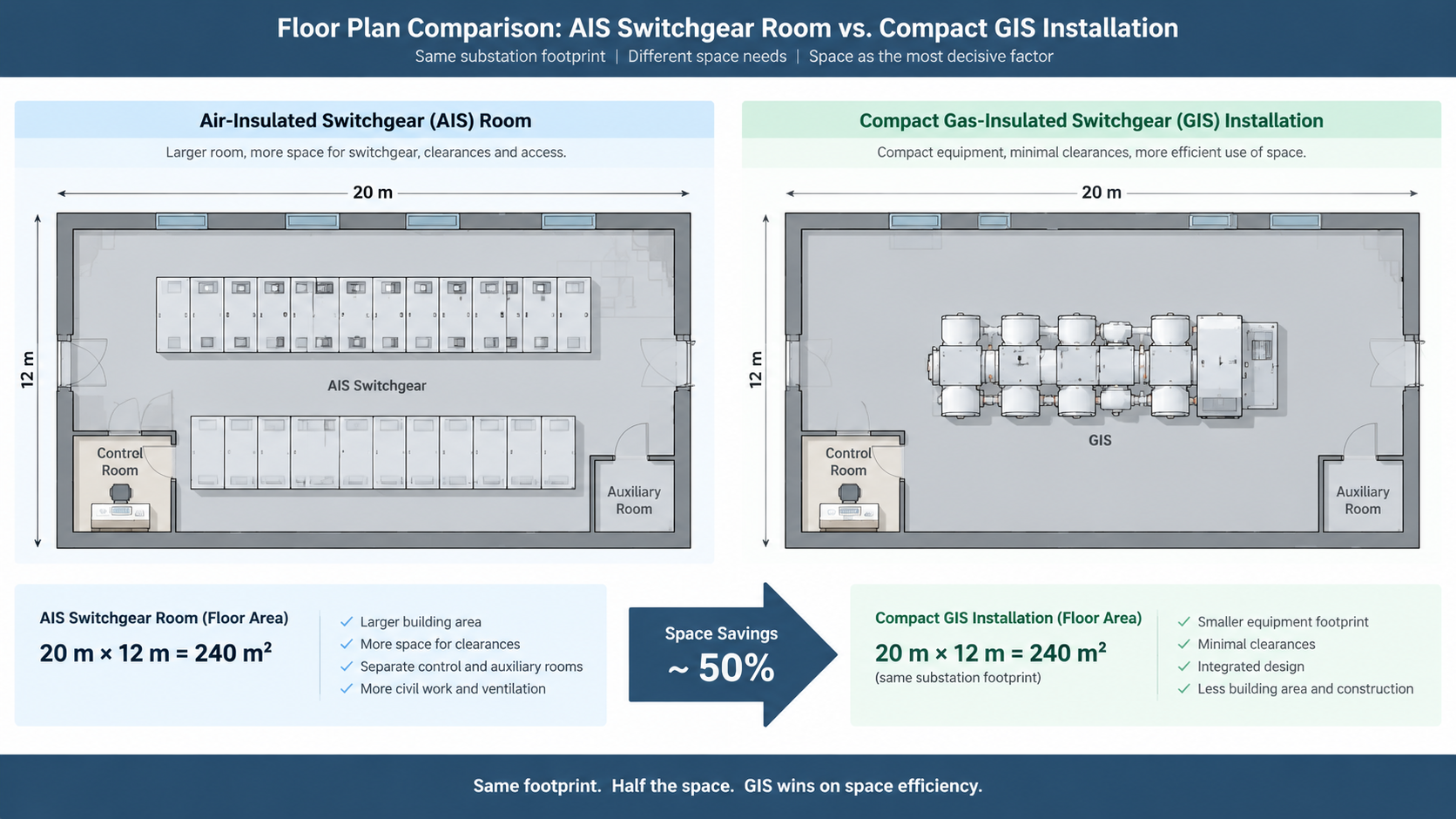
If the project has room for a conventional switchgear room, AIS almost always delivers the lower total cost of ownership. If it does not, GIS wins regardless of the price premium. Space-constrained situations where GIS is normally the only practical answer include urban substations, metro and underground stations, containerised substations, rooftop and basement switchrooms, offshore platforms, tunnels, and institutional sites where the electrical room cannot be extended.
Brownfield upgrades are a common version of this problem. An existing electrical room designed for older, lower-capacity equipment often cannot grow horizontally, and going upward is rarely practical for AIS because of access requirements. A compact GIS lineup can fit inside the existing envelope and make the capacity upgrade feasible at all.
The capital cost comparison is straightforward — AIS is cheaper per unit. The lifecycle comparison is not, and it is where projects get into trouble.
A defensible comparison therefore includes installation, building and land, the maintenance programme over 25–40 years, and the expected cost of one significant outage — not just the bay price.
The maintenance philosophies are opposites. AIS is transparent: a technician can see the insulators, inspect the contacts, tighten connections, replace a vacuum interrupter, and test relays without special equipment. GIS is deliberately opaque: the live parts are sealed, so condition assessment relies on gas density monitoring and partial discharge detection rather than visual inspection. Routine GIS maintenance intervals routinely extend to ten years or more, but an internal fault means opening the compartment, recovering and refilling the gas, and executing the repair with trained personnel.
Expandability follows the same pattern. Adding a bay to an AIS lineup is a routine project, while extending GIS usually means new gas compartments and careful factory planning. If load growth is uncertain, that inflexibility is a real risk.
SF6 is the reason the environmental argument has moved from a footnote to a decision driver. Its global warming potential is in the order of 23,500 times that of CO2, and regulators in several markets now require leak detection, reporting, and recovery, with restrictions on new equipment in some applications. The practical consequences for buyers are threefold: gas-tightness and leak-rate specifications now matter commercially as well as technically; SF6 handling and end-of-life costs should be budgeted rather than ignored; and SF6-free alternatives have become a genuine option rather than a laboratory curiosity.
Those alternatives include vacuum-interruption designs combined with dry air or solid insulation, and eco-gas mixtures based on fluoroketones or fluoronitriles. For a direct comparison of interruption media at medium voltage, see our VCB vs SF6 circuit breaker guide. Many are already commercially available for medium-voltage duties with comparable ratings, and a sealed SF6-free unit avoids the regulatory exposure that comes with the gas entirely. For a closer look at that trend, see our dedicated guide to SF6-free and eco-friendly switchgear.
AIS and GIS are both mature answers to the same problem, and the decision usually comes down to land versus budget — plus, increasingly, to gas regulation. Air-insulated switchgear is cheaper, transparent, expandable, and easy to maintain where space and clean conditions allow. Gas-insulated switchgear is compact, sealed against contamination, and long-lived, but it costs more upfront, is difficult to extend, and carries growing obligations around SF6. Decide from the footprint, the environment, the maintenance capability available on site, and the regulatory direction in your market; then compare total lifecycle cost rather than bay price.
AIS uses atmospheric air as the insulating medium, so clearances are large and the equipment is accessible and inexpensive. GIS seals the live parts in a pressurised gas compartment, which makes the assembly far more compact and immune to external contamination but considerably more expensive.
On a per-unit basis, yes — typically 1.5 to 2.5 times the cost. On a total installed and lifecycle basis, the difference narrows or can reverse where land and building costs are high and space savings are large.
AIS needs more frequent routine inspection, cleaning, and testing, but the work is simple and can be done by local crews. GIS needs very little routine maintenance, but any internal intervention requires gas handling and specialist support.
It can be extended only with careful planning and usually with factory involvement, because the layout is built around fixed gas compartments. AIS lineups are far easier to extend with additional panels.