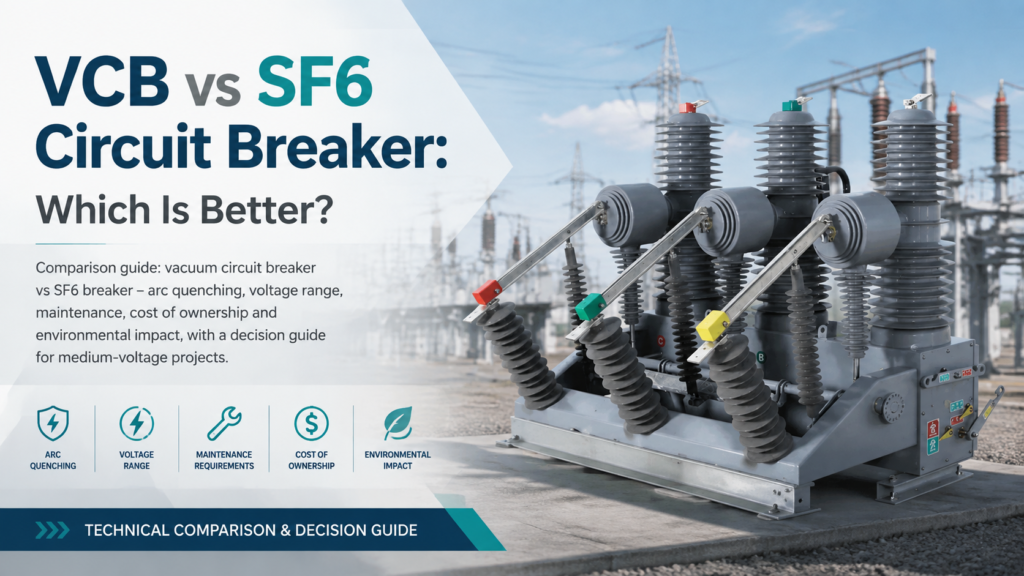
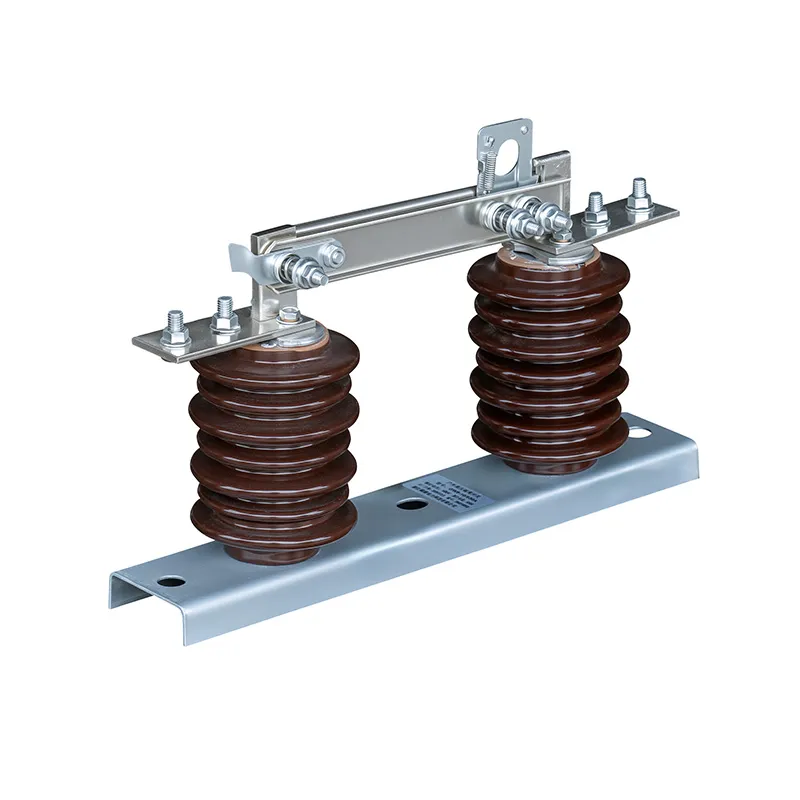
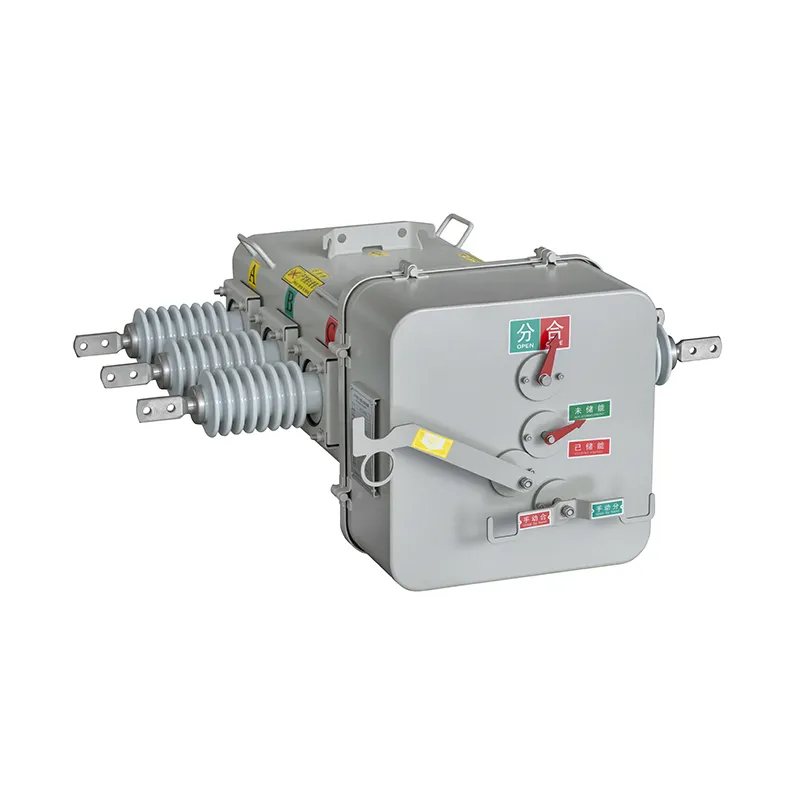
When you are designing or upgrading a medium-voltage distribution network, one of the first technology decisions you will face is the switching device. Two names come up again and again: the vacuum circuit breaker (VCB) vs SF6 Circuit Breaker. Both interrupt fault current reliably and have decades of field history, but they work in fundamentally different ways — and the right answer depends on your voltage class, site conditions, switching duty, and how much you value low maintenance and low emissions.
Short answer for most medium-voltage applications up to 40.5 kV — especially outdoor distribution — a vacuum circuit breaker is the better choice today. SF6 breakers still win where space is extremely tight (GIS) or where system voltage climbs above 66 kV. This guide compares both technologies across arc quenching, voltage range, maintenance, total cost, and environmental impact so you can make a decision with confidence. For a broader look at medium voltage circuit breakers and how they fit into a distribution system, see our related guide.
What Is VCB?
A vacuum circuit breaker interrupts current by separating its contacts inside a sealed, evacuated chamber. Because there is virtually no gas in the interrupter, the arc that forms when the contacts part cannot sustain itself: the charged particles diffuse into the surrounding vacuum almost instantly, and the arc is extinguished within a few milliseconds. This gives VCBs extremely fast interruption with no arc by-products and no auxiliary medium to monitor.
Key characteristics of VCBs:
Fast, clean arc quenching inside a sealed-for-life interrupter.
Low maintenance — no gas pressure, purity, or leak checks; the interrupter is sealed at the factory.
Long mechanical life , often rated for up to 30,000 operations, which suits frequent switching duty.
Environmentally neutral — vacuum has no global warming potential and nothing to recover at end of life.
VCBs dominate medium-voltage distribution from 12 kV to 40.5 kV, including outdoor pole-mounted breakers, switchgear panels, and industrial feeder circuits. The outdoor ZW32 deep fusion circuit breaker is a typical example of this class — a 12 kV vacuum breaker built for pole-mounted distribution service.
What Is an SF6 Circuit Breaker?
An SF6 circuit breaker uses sulfur hexafluoride gas as both the insulating and the arc-quenching medium. SF6 is strongly electronegative: it captures free electrons, so the arc deionizes rapidly, and the gas also provides outstanding dielectric strength between contacts. This combination is why SF6 technology has dominated high-voltage and extra-high-voltage transmission for decades, and why it enables compact gas-insulated switchgear (GIS) layouts.
Key characteristics of SF6 breakers:
Superior dielectric strength , allowing compact designs at high voltage — 66 kV up to 800 kV and beyond.
Proven heavy fault-current capability for transmission and large substation duty.
Gas management burden — pressure, purity, and leak monitoring are part of normal operation.
Regulatory exposure — SF6 is a potent greenhouse gas (GWP roughly 23,500 times CO₂), and rules on its use are tightening in the EU and other markets.
SF6 breakers are the standard choice for transmission substations and GIS installations. In outdoor medium- and high-voltage service, tank-type SF6 units such as the high-voltage SF6 gas-insulated tank circuit breaker are still used where the application demands the gas technology’s insulating margin.
VCB vs SF6 Circuit Breaker: Key Differences
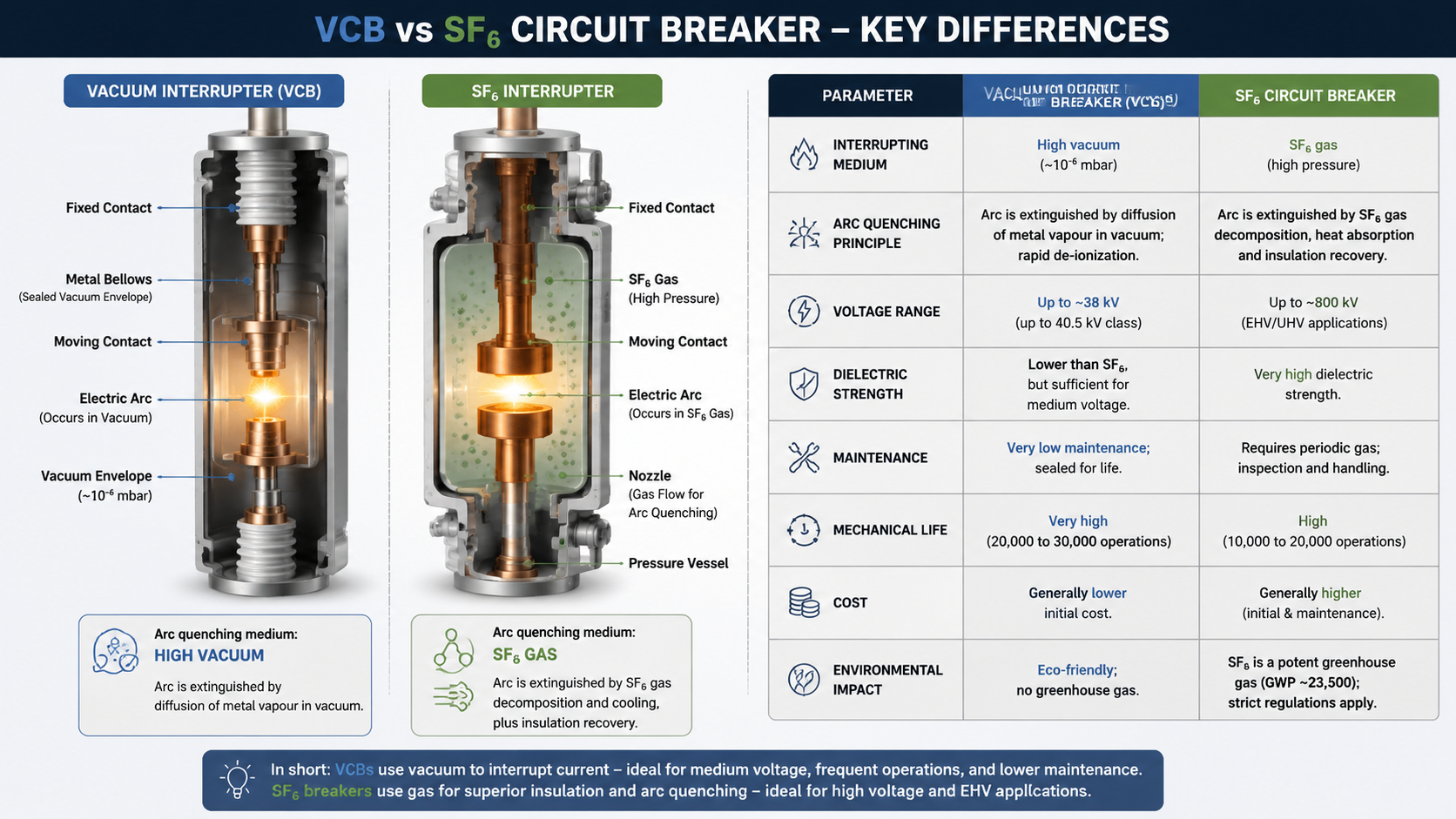
The table below summarizes the differences that matter most when comparing vacuum circuit breaker vs SF6 breaker for a real project.
Feature
Vacuum Circuit Breaker (VCB)
SF6 Circuit Breaker
Interrupting medium
High vacuum
SF6 gas
Typical voltage range
Up to 40.5 kV (medium voltage)
66 kV to 800 kV+ (also used at MV)
Arc quenching
Rapid diffusion of charged particles in vacuum
Electronegative gas absorbs free electrons
Dielectric strength
Excellent for medium voltage
Very high — enables compact EHV designs
Maintenance
Low — sealed interrupter, no gas checks
Moderate to high — gas pressure, purity, leak checks
Mechanical life
Up to ~30,000 operations
Typically 10,000–20,000 operations
Size & footprint
Compact at medium voltage
Larger in air-insulated form; very compact in GIS
Cost
Lower initial and lifetime cost at MV
Higher initial cost plus gas management expense
Environmental impact
None
SF6 GWP ~23,500× CO₂; regulated
Arc interruption and the voltage ceiling
The interrupting medium sets the practical limit of each technology. Vacuum interrupters excel in the 12–40.5 kV band: switching is fast, contact erosion is low, and frequent operations are not a problem. SF6 gas, with its higher dielectric strength, carries the load above 66 kV, where vacuum interrupters are rarely used in mainstream transmission. In the medium-voltage band where both technologies overlap, the performance gap is small — which is exactly why the rest of the comparison (maintenance, cost, environment) usually decides the choice.
Maintenance and total cost of ownership
VCBs are essentially fit-and-forget at medium voltage. The interrupter is sealed for life, so there is no gas to refill and no leak to find; maintenance reduces to periodic inspection and contact-wear checks. SF6 breakers, by contrast, carry an ongoing obligation: monitor gas pressure and purity, investigate alarms, and manage recovery and disposal at end of life. Over a 20-year service life, these activities add real money — and they matter even more on remote or pole-mounted sites where sending a crew for a gas check is expensive.
Environmental impact and regulation
This is the fastest-moving part of the comparison. SF6 is one of the most potent greenhouse gases known, and regulators in the EU and elsewhere are phasing down its use in new medium-voltage switchgear. Several markets now require leakage monitoring, and future MV installations must increasingly consider alternatives. A vacuum breaker eliminates the issue entirely: there is no greenhouse gas, no recovery program, and no compliance paperwork. For exporters and contractors selling into regulated markets, this is becoming a hard requirement rather than a preference.
Which Is Better: VCB or SF6 Circuit Breaker?
There is no universal winner — there is a right tool for the application. Use this decision guide as a starting point.
Low maintenance is a priority, especially on remote or pole-mounted sites.
Environmental compliance matters for your market or your customers.
Budget and total cost of ownership are under scrutiny.
Choose an SF6 circuit breaker when:
Your system voltage is above 66 kV.
The project is a GIS substation where a compact footprint is the deciding factor.
Very high fault levels and transmission-grade duty are involved.
In short: at medium voltage, VCB wins on maintenance, environment, and cost; SF6 keeps its stronghold at high and extra-high voltage and in space-constrained GIS layouts.
Outdoor Medium-Voltage Installations: VCB or SF6?
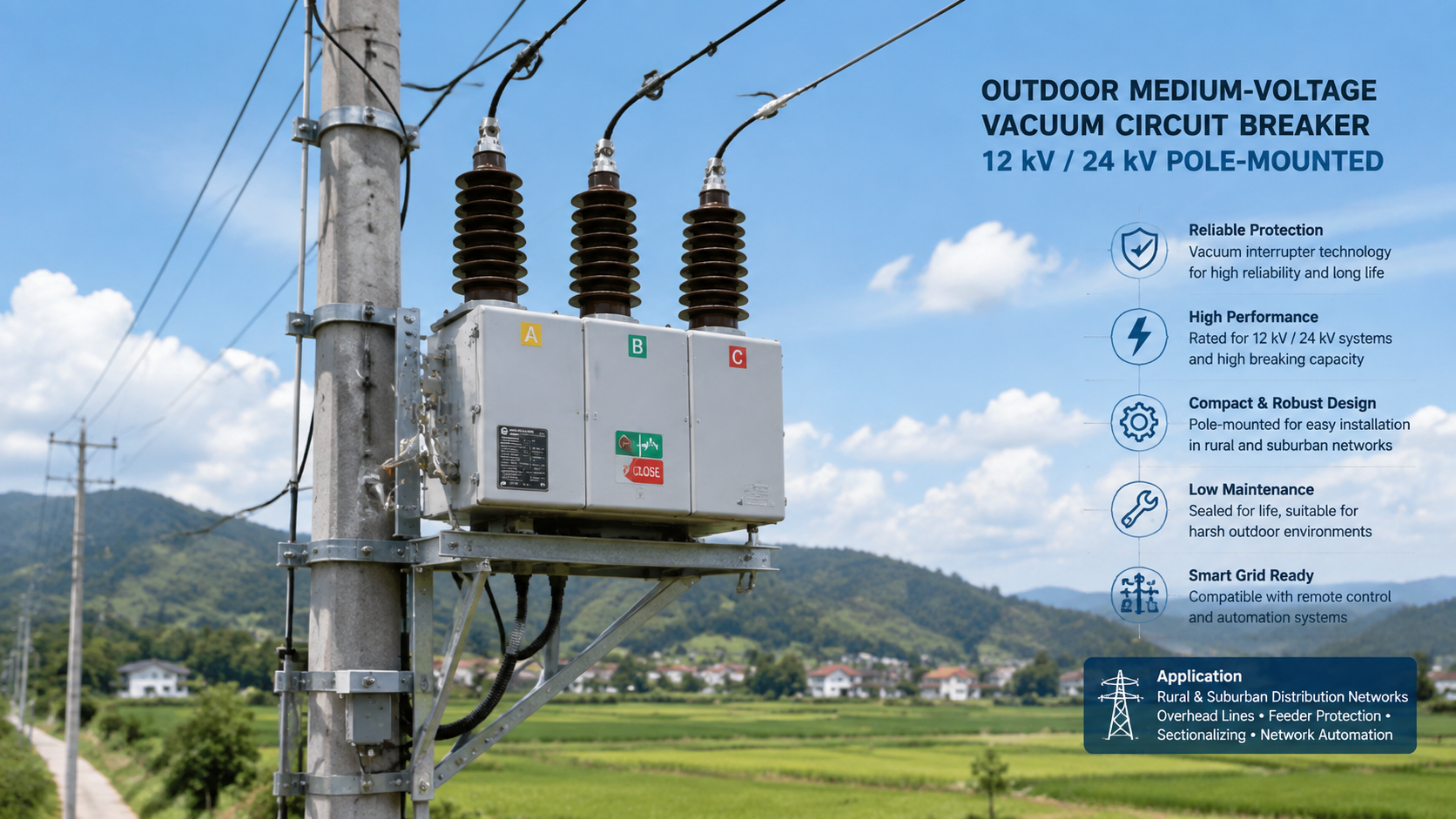
Because both technologies appear in outdoor service, it is worth calling out the medium-voltage outdoor case specifically. For 12 kV and 24 kV pole-mounted distribution — the backbone of most rural and suburban networks — the vacuum breaker is the mainstream choice. It handles the mechanical shock of outdoor operation, needs no gas monitoring from the utility, and delivers the fast reclosing duty that overhead lines demand. Products like the ZW32-12F outdoor vacuum circuit breaker are built exactly for this role. SF6 tank breakers remain relevant at higher outdoor voltage classes and in stations where the gas technology’s insulating margin is required, but for the 12–40.5 kV outdoor band, VCB is the pragmatic default.
Final Verdict
For the vast majority of medium-voltage projects — and nearly all outdoor distribution work up to 40.5 kV — the vacuum circuit breaker is the better choice: lower maintenance, lower lifetime cost, no greenhouse gas, and excellent switching performance. SF6 breakers keep a clear role at transmission voltages above 66 kV and in compact GIS substations, but their environmental and maintenance burden makes them hard to justify in the MV space where vacuum technology is mature and proven.
What is the main difference between VCB and SF6 circuit breaker?
The main difference is the arc-quenching medium. A vacuum circuit breaker extinguishes the arc in a sealed vacuum chamber, while an SF6 circuit breaker uses sulfur hexafluoride gas. This drives differences in voltage range, maintenance, size, cost, and environmental impact.
Which is better, VCB or SF6?
For medium-voltage applications up to 40.5 kV, a VCB is generally better because it needs less maintenance, costs less over its lifetime, and has no greenhouse gas impact. An SF6 breaker is better for voltages above 66 kV and for compact GIS substations.
Can a vacuum circuit breaker be used in high voltage?
Vacuum interrupters are mainstream up to about 40.5 kV. Above 66 kV, SF6 breakers are the established technology, though vacuum-based solutions for higher classes are being developed.
Is SF6 harmful to the environment?
Yes. SF6 has a global warming potential roughly 23,500 times that of CO₂, and its use is increasingly regulated. Leaks during operation, maintenance, or disposal release the gas into the atmosphere, which is why vacuum breakers are often preferred for new medium-voltage installations.
Which circuit breaker requires less maintenance?
The vacuum circuit breaker. Its interrupter is sealed for life, so there are no gas pressure, purity, or leak checks. SF6 breakers require regular gas monitoring and handling procedures.
Which is cheaper, VCB or SF6 circuit breaker?
At medium voltage, the VCB is cheaper both to buy and to own, because there is no gas system and no gas management cost. SF6 breakers cost more upfront and carry ongoing gas-related operating expense.
If your GE dryer is tumbling but blowing ice-cold air—or suddenly won’t start at all—there’s a very good chance the thermal fuse just sacrificed itself to protect your home. The good news?On most General Electric dryers, a bad thermal fuse is one of the easiest and cheapest fixes you can do yourself… if you know the right part number, the exact location, and how to test it with […]
We use cookies to enhance your browsing experience, serve personalised ads or content, and analyse our traffic. By clicking "Accept All", you consent to our use of cookies.