Blog
Electrical Symbol for Fuse Guide Standards Types and Uses
Learn the electrical symbol for fuse with IEC IEEE ANSI standards diagrams types comparisons and free downloadable CAD symbols
Read More
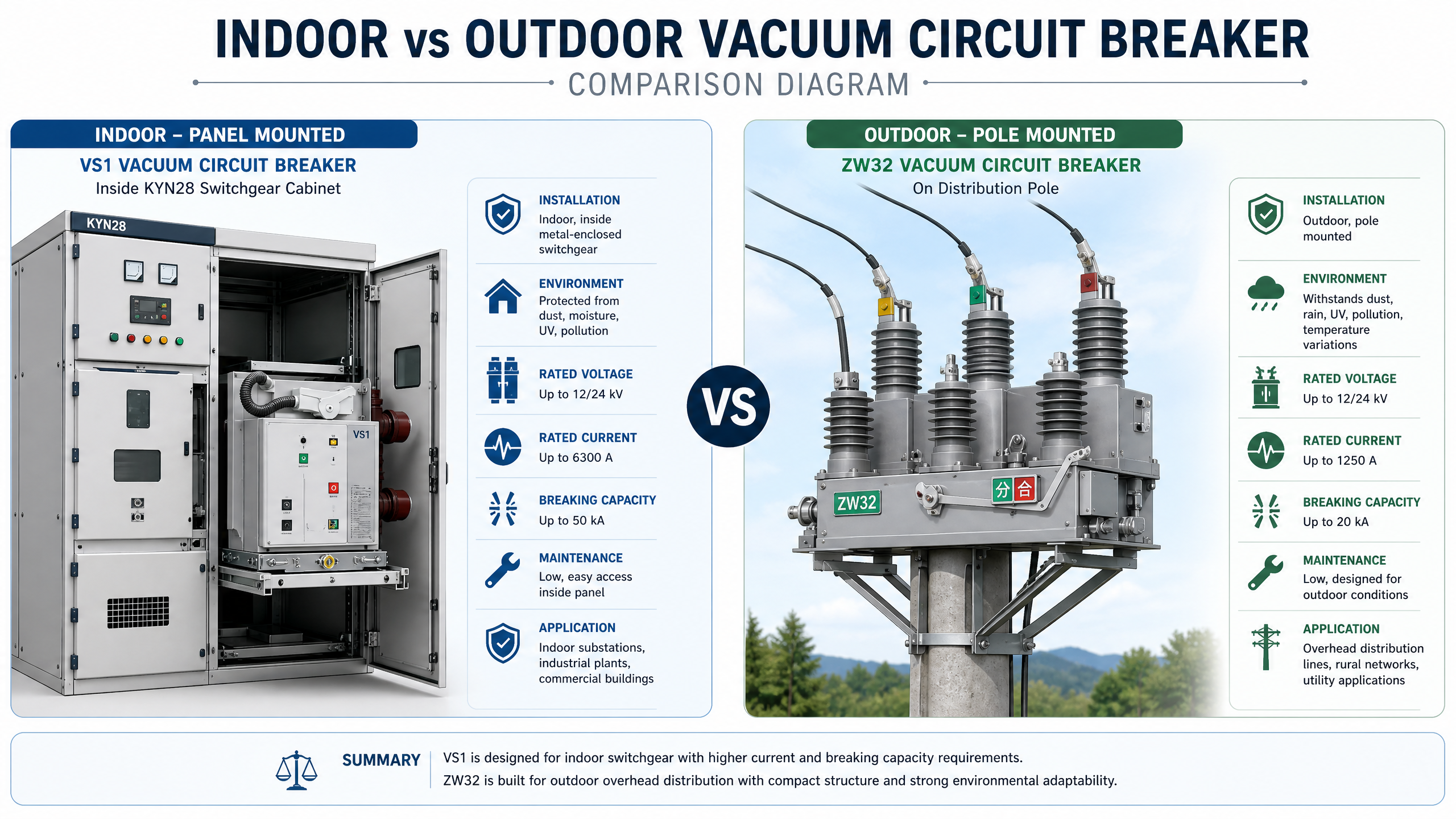
Indoor vs Outdoor Vacuum Circuit Breaker use the same vacuum arc-quenching technology, but they are engineered for completely different environments. An indoor VCB (typified by the VS1 / ZN63A series) lives inside a switchgear cabinet in a controlled room, so it is compact and needs only basic protection. An outdoor VCB (typified by the ZW32 series) stands on a pole or pad exposed to rain, UV, ice, dust, and temperature swings, so it needs a weatherproof enclosure, reinforced insulation, and a tougher mechanism.
Choosing between them is not about which is better, but about where the breaker will actually operate. This guide compares indoor vs outdoor vacuum circuit breaker design in detail, introduces the VS1 and ZW32 families, and gives you a practical selection checklist.
What Is a Vacuum Circuit Breaker?
A vacuum circuit breaker (VCB) is a medium-voltage switching device that interrupts current inside a sealed vacuum interrupter. When the contacts part, the arc is drawn in the vacuum, where the dielectric strength recovers almost instantly and extinguishes the arc with minimal contact erosion. Because the interrupting chamber is sealed for life, VCBs need little maintenance, cause no oil or gas emissions, and tolerate frequent operation better than oil or SF6 alternatives.
VCBs dominate 12 kV to 40.5 kV distribution networks around the world, whether inside substation buildings or out on overhead lines. The medium is the same in every VCB; the enclosure, insulation, and operating mechanism are what change with the installation site. If you are new to the equipment family, our vacuum circuit breakers overview explains the range and how each type is used.
Although both types interrupt current in vacuum, the design differences are significant and affect every purchasing decision. The table below summarizes the main comparison points, and the sections that follow explain each one.
| Feature | Indoor VCB (VS1 / ZN63A) | Outdoor VCB (ZW32) |
|---|---|---|
| Installation environment | Inside switchgear cabinets in electrical rooms or substation buildings | Outdoors on poles, pads, or platforms, fully exposed to weather |
| Enclosure / protection rating | IP2X to IP4X, finger-safe inside the panel | IP54 to IP67, weatherproof and gasketed |
| Insulation design | Air insulation plus epoxy resin; standard creepage distance | Reinforced creepage, silicone rubber or porcelain insulators, anti-tracking surfaces |
| Operating temperature range | Typically -5 °C to +40 °C | Typically -40 °C to +60 °C, with heaters for cold climates |
| Mounting style | Fixed or withdrawable (handcart) inside metal-clad panels | Pole-mounted or pad-mounted, three-phase separated columns |
| Typical models | VS1, ZN63A, ZN28 | ZW32, ZW8 |
| Accessories | Built into the panel: interlocks, CTs, protection relays | Often includes an integrated isolation switch, outdoor CTs, and a controller for distribution automation |
| Maintenance | Easy indoor access; withdrawable units can be racked out for service | Field maintenance, often at height or in exposed conditions |
| Relative cost | Lower; compact design reduces material cost | Higher; weatherproofing, insulation, and structure add cost |
Indoor VCBs are mounted inside metal-enclosed or metal-clad switchgear such as KYN28 or XGN panels. The cabinet provides the environmental protection, so the breaker itself only needs an IP2X to IP4X rating to stop fingers and tools from touching live parts. Because the room is clean and dry, there is no need for gasketed enclosures or corrosion-resistant hardware.
Outdoor VCBs face rain, dust, condensation, salt spray, and UV radiation directly. Their enclosures use gasketed, sealed designs with IP54 or higher protection, and hardware is plated or stainless steel to resist corrosion. In coastal or industrial pollution zones, manufacturers may specify IP65 or above plus special surface treatments.
Indoor breakers rely on air plus epoxy resin insulation, with creepage distances sized for a clean indoor environment. A typical 12 kV indoor unit needs roughly 125 mm of creepage, which a compact epoxy pole can easily provide.
Outdoor breakers must keep their dielectric strength when the insulator surface is wet, dusty, or polluted, so creepage distance is significantly longer, often 250 mm or more at 12 kV. Silicone rubber or porcelain insulators with shed profiles are standard. Silicone’s hydrophobicity makes water bead off instead of forming a conductive film, which is one reason outdoor poles look so different from indoor embedded poles.
Both types commonly use spring-operated mechanisms, with permanent magnet mechanisms available for frequent operation. The difference is how the mechanism is protected. An indoor mechanism sits in a dry room and can use standard grease and an open frame. An outdoor mechanism is sealed inside the enclosure, uses low-temperature grease, and often includes anti-condensation heaters so moisture cannot freeze or corrode the linkage.
Temperature range is another hard divider. Indoor equipment is rated for roughly -5 °C to +40 °C, matching a heated or ventilated building. Outdoor units must work from about -40 °C to +60 °C, cover ice loads, and survive direct summer sunlight, which pushes the mechanism and insulation to be far more robust.
Indoor VCBs are compact because the cabinet, not the breaker, handles clearances. The same 12 kV breaker that fits a 600 mm wide panel would be physically larger as an outdoor unit, where phase-to-phase distances are bigger and each phase gets its own insulator column.
Maintenance follows the same logic. Indoor withdrawable units can be racked out of the panel for inspection without shutting down the whole switchboard, and the working environment is comfortable. Outdoor units are serviced in the field, frequently on a pole, which means climbing equipment, weather constraints, and more careful planning for routine checks.
If you search for an indoor vcb vs1, you are looking at the most widely used indoor vacuum circuit breaker in medium-voltage distribution. The VS1-12, also designated ZN63A-12, is a 12 kV, three-phase indoor breaker with a spring-operated mechanism that supports both motor and manual charging. Its contacts sit in a vacuum interrupter molded into an epoxy resin pole, and the whole unit is designed to fit standard switchgear panels.
Typical VS1 ratings run from 630 A to 3150 A with short-circuit breaking capacities of 20 kA to 40 kA, and mechanical life of 10,000 to 30,000 operations depending on the actuator. The breaker comes in fixed and withdrawable (handcart) versions. Withdrawable units let maintenance staff rack the breaker out of a KYN28 panel without de-energizing the busbar, which is a major advantage in plants and substations where downtime is expensive.
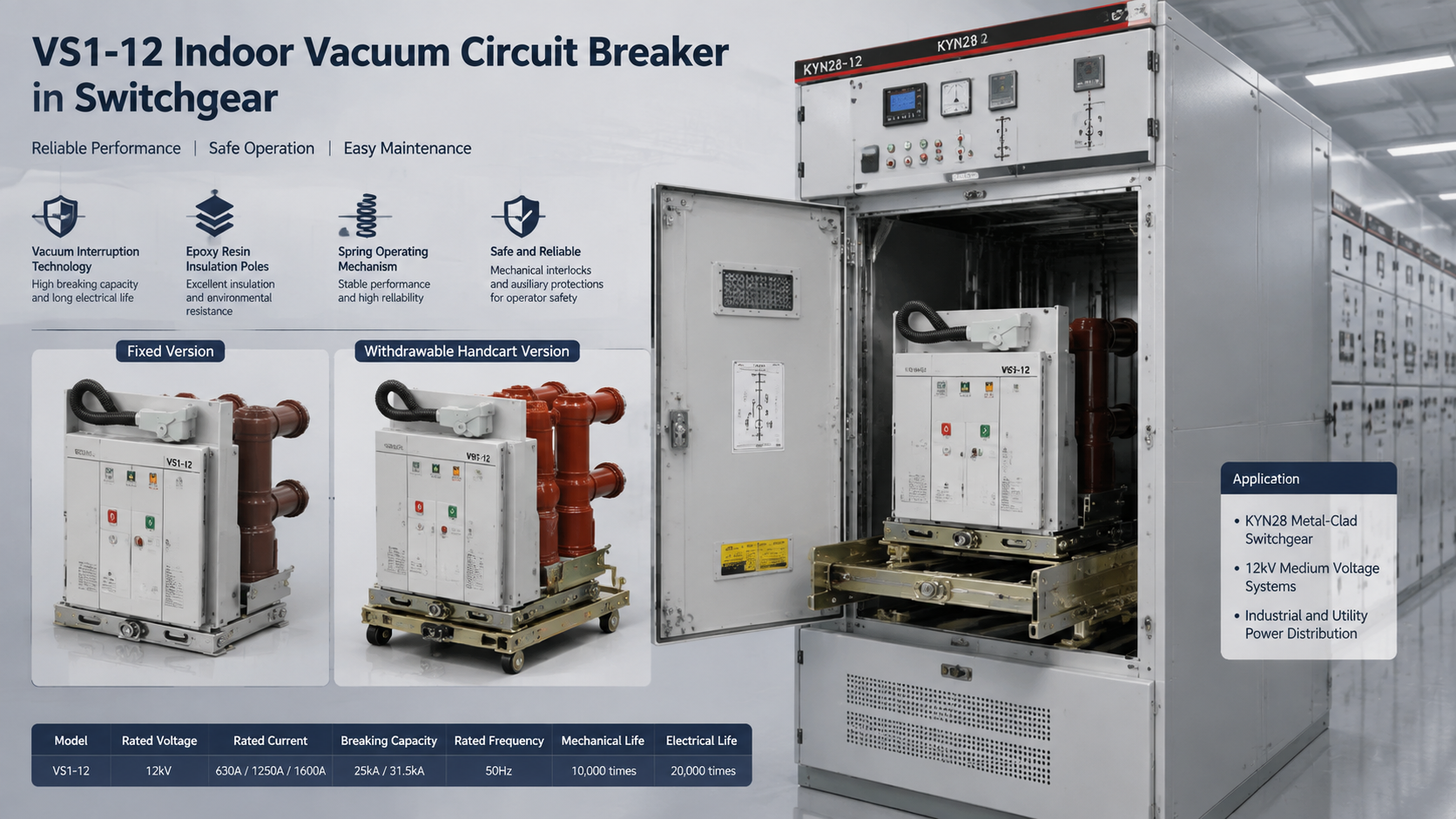 Choose a VS1-style indoor breaker for factories, commercial buildings, data centers, power plants, and any application where the switchgear is housed in an electrical room. For a complete look at mounting options and compatibility, browse our indoor vacuum circuit breakers category.
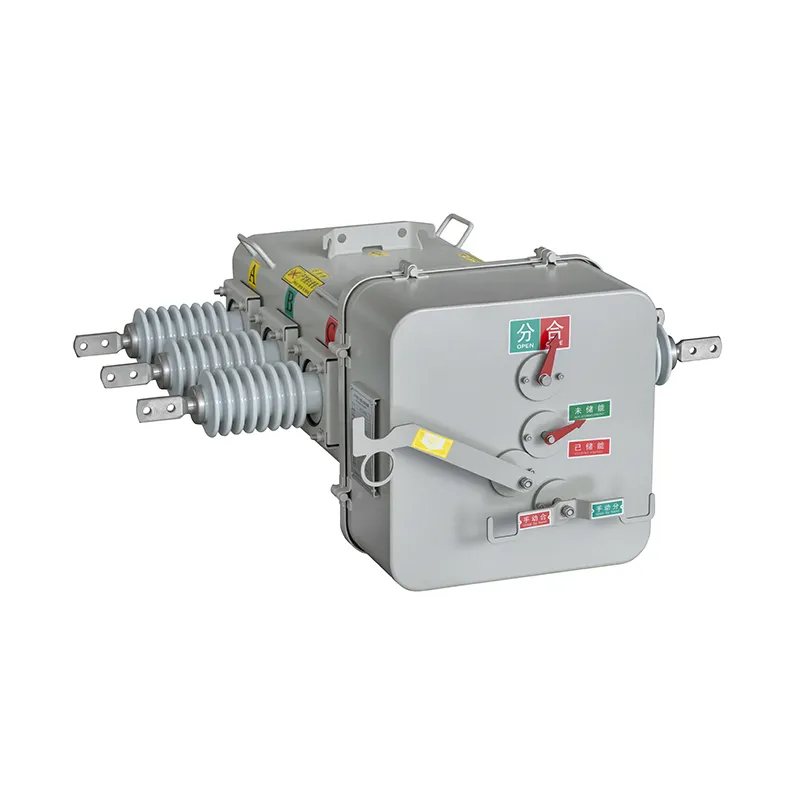
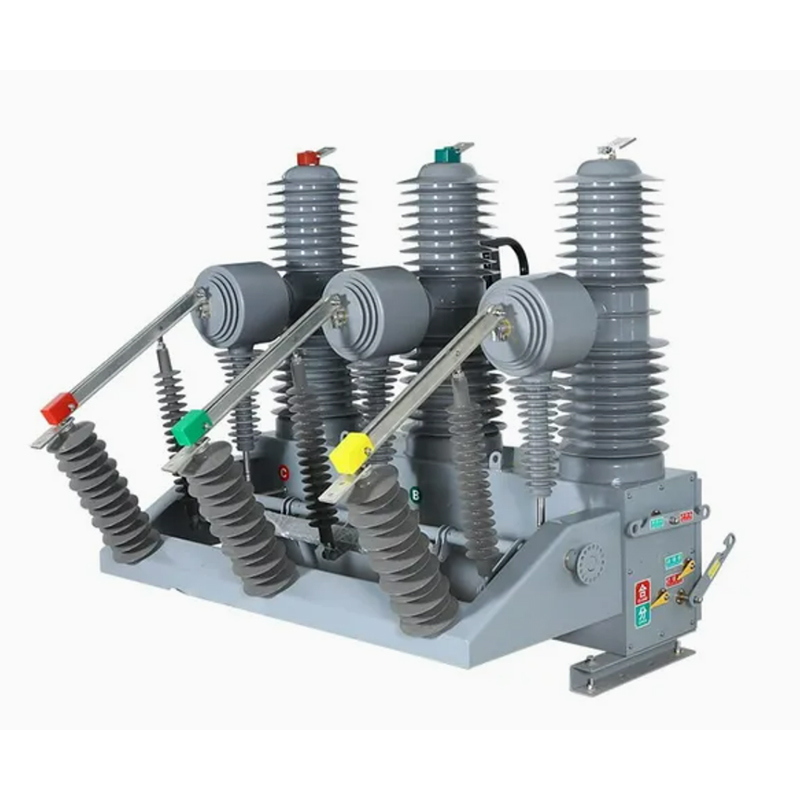
The outdoor vcb zw32 is the workhorse of overhead distribution networks. A ZW32-12 is a pole-mounted, three-phase outdoor breaker rated for 12 kV systems (with 24 kV and 35 kV variants), built with three separate insulator columns and a sealed mechanism box. It is designed to make and break load, overload, and short-circuit currents on overhead lines, and it frequently includes an integrated isolation switch with mechanical interlocks for visible safety isolation.
Outdoor ZW32 units typically offer rated currents from 400 A to 1250 A, breaking capacities of 12.5 kA to 25 kA (up to 31.5 kA in higher-rated models), mechanical life around 10,000 operations, and operation from -40 °C to +40 °C. Because they are installed without a building around them, they often ship with outdoor current transformers and a controller that enables remote monitoring, fault recording, and auto-reclosing for distribution automation.
Our ZW32-12F outdoor high voltage vacuum circuit breaker is a good example of the smart end of the family. It combines a spring or permanent magnet mechanism with an intelligent control unit that monitors voltage, current, and power, executes protection strategies, and supports remote operation, making it well suited to boundary switching between a utility network and a customer installation. Where fault isolation and automation matter, this is the class of equipment to evaluate. A more compact companion, the ZW32-12G outdoor AC vacuum circuit breaker, covers standard feeder protection at 630 A / 20 kA.
If you know your project is outdoors, start from the outdoor vacuum circuit breakers category and compare models by current, breaking capacity, and whether you need automation features.
The environment decides the type, not preference. Use this scenario mapping as a fast first filter:
| Project scenario | Recommended type | Why |
|---|---|---|
| Substation building, factory electrical room, commercial building | Indoor VCB (VS1 / ZN63A) | Controlled environment; compact design fits switchgear panels; easy maintenance access |
| Rural distribution lines, overhead feeders, pole-mounted transformers | Outdoor VCB (ZW32) | No building available; must survive rain, ice, UV, and pollution |
| User boundary point between utility and customer network | Outdoor VCB with controller (e.g., ZW32-12F) | Needs fault isolation, metering, and remote automation at the point of common coupling |
| Solar or wind plant collection and grid connection | Outdoor VCB (ZW32) | Remote, exposed sites; frequent switching and low maintenance requirements |
| Urban distribution substations where space is tight | Indoor VCB inside KYN28/XGN panels | Small footprint and withdrawable maintenance within the building |
Beyond the location, run through this short checklist:
Several mistakes appear repeatedly in real projects:
Indoor and outdoor vacuum circuit breakers share the same vacuum interruption core, but they are different products built for different environments. Indoor VS1-type breakers are compact, panel-mounted units for controlled rooms; outdoor ZW32-type breakers are weatherproof, pole-mounted units built to switch overhead lines in any climate. Match the type to the installation site, verify the IP rating and insulation class for outdoor service, and plan for the automation features you will need over the breaker’s life.
If you are comparing switching technologies at the same stage, our VCB vs RMU switchgear guide covers when a breaker or a ring main unit is the right choice, and the medium-voltage circuit breaker article explains the wider equipment family. When you are ready to specify, contact our engineering team with your voltage, fault level, and site conditions, and we will help you select the right indoor or outdoor vacuum circuit breaker.
Technically yes, but it is rarely economical. Outdoor breakers are larger, heavier, and more expensive, so installing one indoors wastes space and budget without adding benefit. Choose an indoor-rated model for indoor installation.
Yes. VS1-12 and ZN63A-12 are two names for the same type of 12 kV indoor vacuum circuit breaker, widely used in KYN28 and XGN switchgear. “ZN” is the Chinese classification code for an indoor vacuum breaker, while VS1 is the marketing model name.
In the Chinese equipment classification system, “Z” means vacuum, “W” means outdoor, and “32” is the design series number. So ZW32 identifies an outdoor vacuum circuit breaker series, in the same way “ZN63A” identifies an indoor vacuum breaker.
Generally yes. The weatherproof enclosure, longer creepage insulation, sealed mechanism, and optional integrated isolation switch add cost compared with a compact panel-mounted indoor breaker. The project cost gap can grow further with foundations, poles, and automation controllers.
For overhead rural distribution lines, an outdoor ZW32 is the standard choice because there is no building to house switchgear and the breaker must survive outdoor weather. A VS1 indoor breaker only makes sense if the line terminates inside a substation building.
At least IP54 for general outdoor use, with IP65 or higher recommended in coastal, industrial, or high-pollution areas. Confirm the pollution class and altitude of your site with the manufacturer, since both affect insulation requirements.
Learn the electrical symbol for fuse with IEC IEEE ANSI standards diagrams types comparisons and free downloadable CAD symbols
Read More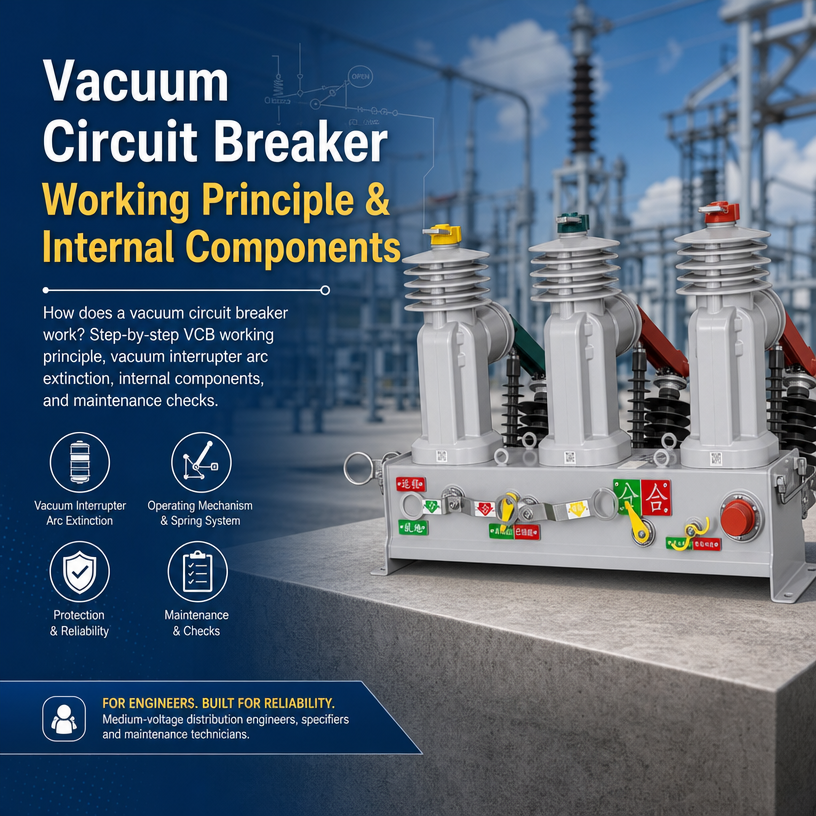
Understand the vacuum circuit breaker working principle step by step — how the vacuum interrupter extinguishes arcs, what is inside a VCB, and how to keep it reliable.
Read More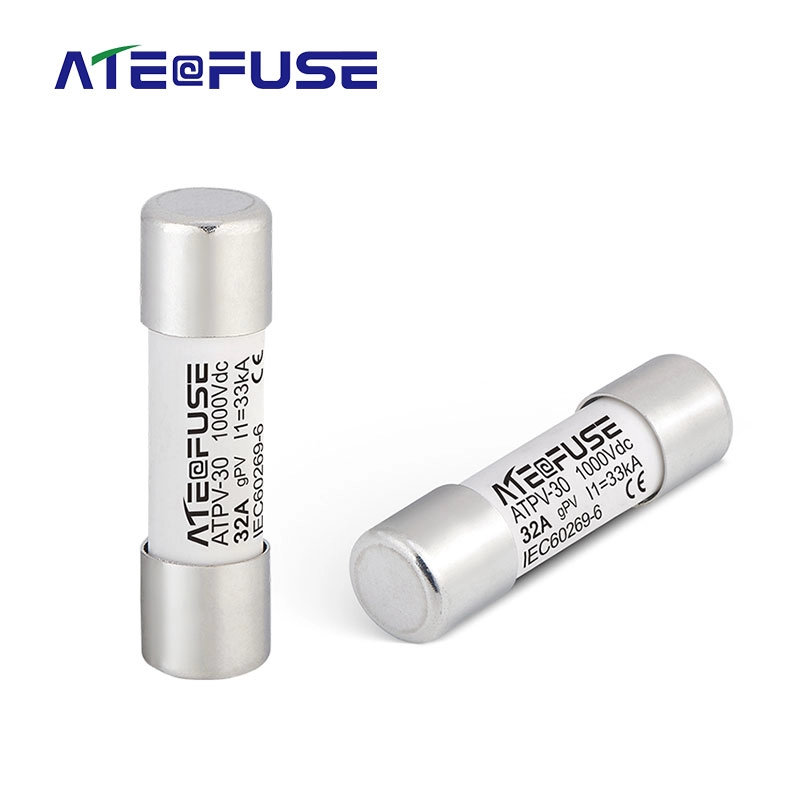
Learn electrical symbols for fuse with IEC and ANSI diagrams, types, ratings and schematic examples in this clear practical reference guide
Read More