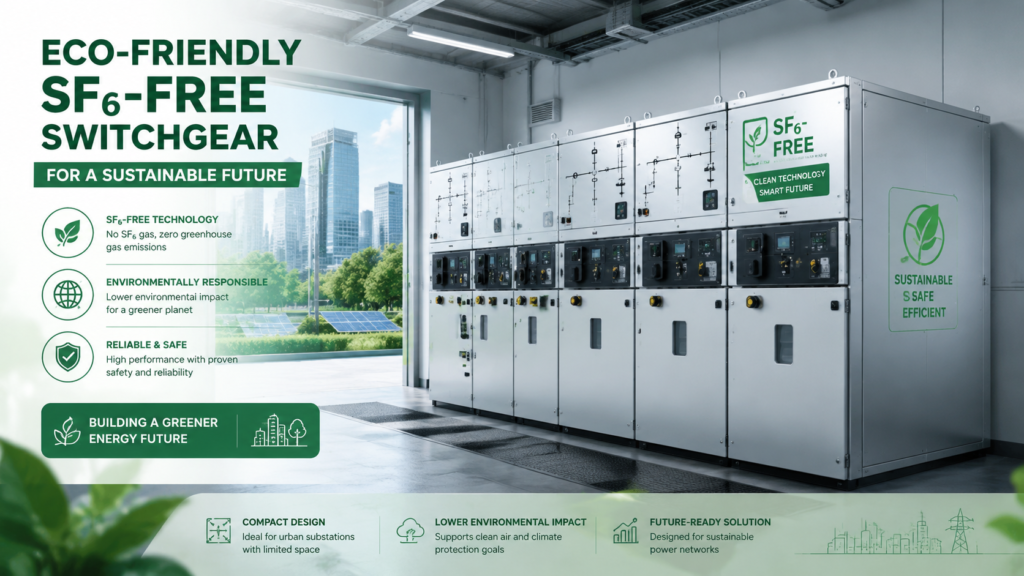
SF6-free switchgear is medium-voltage equipment that replaces sulfur hexafluoride (SF6) with vacuum switching, dry air, or solid insulation. The short version: SF6 is an outstanding insulator and arc quencher, but it is also the most potent greenhouse gas in widespread industrial use, with a global warming potential (GWP) roughly 23,500 times that of CO2. Under EU Regulation 2024/573, new medium-voltage switchgear up to 24 kV that relies on SF6 can no longer be put into operation after 1 January 2026, and similar restrictions are spreading worldwide. This guide explains what SF6 free switchgear is and why it matters, compares the main eco-friendly technologies, covers SF6-free ring main units (RMUs), and gives you a practical checklist for choosing eco friendly switchgear for your next project.
Why SF6 Is Being Phased Out
SF6 has been the default insulating and arc-quenching medium in medium- and high-voltage switchgear for decades because it delivers excellent dielectric strength in a compact package. That is exactly the problem: the same properties that make it a great insulator make it a very bad greenhouse gas. A single kilogram of SF6 has the warming effect of roughly 23.5 tonnes of CO2, and it stays in the atmosphere for over a thousand years. Industry estimates suggest around 8,000 tonnes of SF6 are released globally every year, equivalent to roughly 190 million tonnes of CO2, with electrical equipment the dominant source.
Regulators have responded with hard deadlines rather than voluntary targets. The EU F-gas Regulation (EU) 2024/573, in force since 11 March 2024, prohibits putting new switchgear using fluorinated gases into operation on a staggered schedule:
Voltage range
Rule for insulating / breaking medium
Prohibition from
Medium voltage up to 24 kV (covers most RMUs and MV panels)
No F-gases allowed
1 January 2026
Medium voltage 24 kV to 52 kV
No F-gases allowed
1 January 2030
High voltage 52 kV to 145 kV (up to 50 kA)
Only F-gases with GWP < 1
1 January 2028
High voltage above 145 kV or above 50 kA
Only F-gases with GWP < 1
1 January 2032
The rule bans new equipment, not existing installations, so legacy SF6 switchgear can stay in service and be maintained. But every new project ordered after the dates above must use SF6-free technology. Outside the EU, California’s CARB rules already bar utilities from acquiring new SF6-insulated gas-insulated equipment from 2025, and markets such as the UK, Japan, and Australia are moving in the same direction. If you sell or install switchgear internationally, SF6-free is no longer an option, it is a specification requirement.
What Is SF6-Free Switchgear?
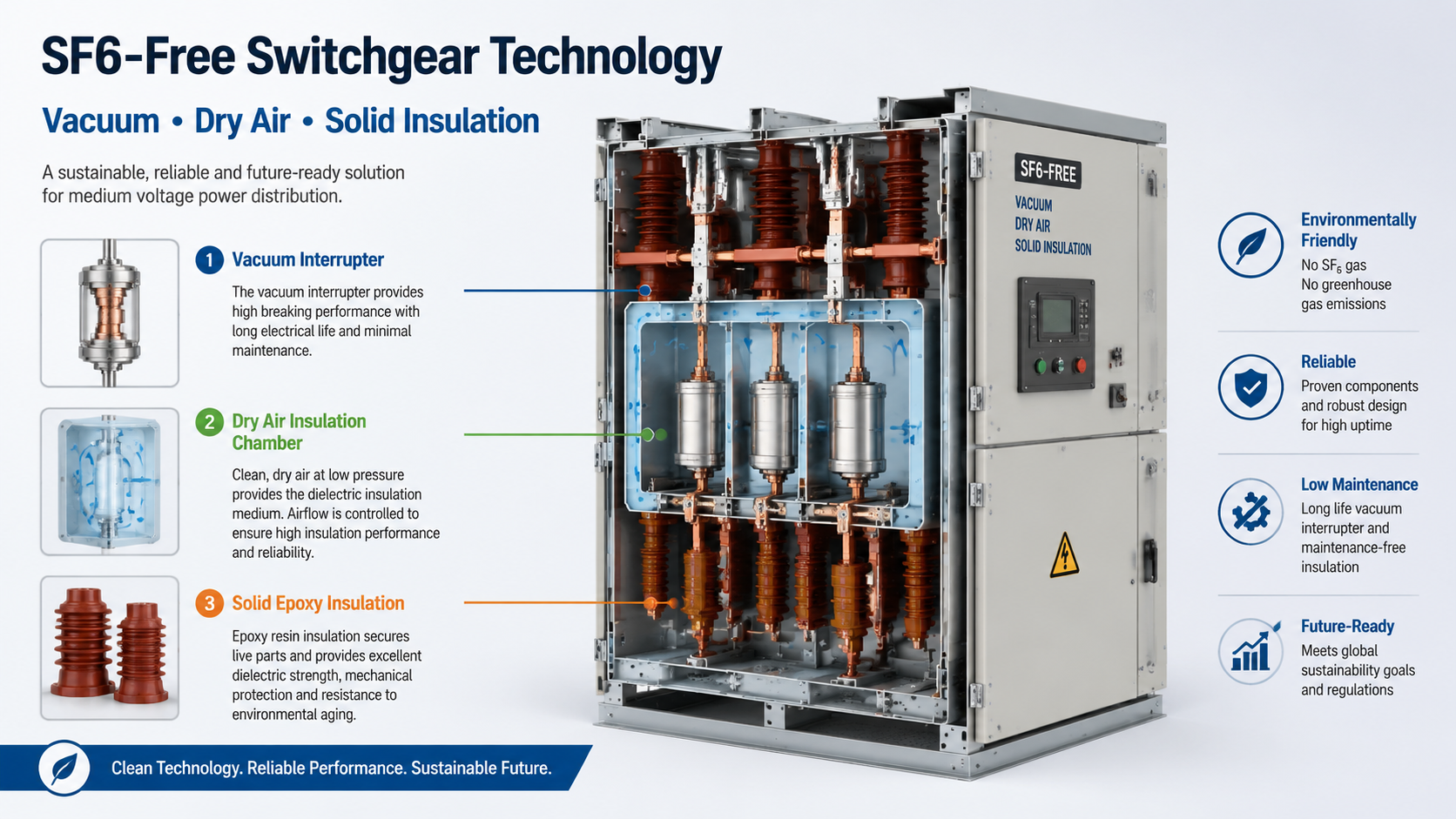
SF6-free switchgear performs the same protection and switching functions as conventional gas-insulated equipment, but it removes sulfur hexafluoride from the insulating and interrupting chain. Three proven technologies have replaced it in medium-voltage distribution:
Vacuum Interruption
Vacuum interrupters extinguish the arc inside a sealed vacuum chamber, where dielectric strength recovers almost instantly. Vacuum switching is fully SF6-free, needs no gas handling, tolerates frequent operation, and has an extremely long electrical life. It is the switching core of most SF6-free RMUs, load break switches, and circuit breakers on the market today.
Dry Air and Clean Air Insulation
Where gas insulation is still needed for compactness, manufacturers use dry air or a nitrogen/oxygen mixture instead of SF6. Dry air has a GWP of essentially zero, is safe to vent, needs no recovery equipment, and has proven dielectric performance at 12 kV to 24 kV when combined with vacuum switching. Air-insulated SF6-free RMUs achieve similar footprints to legacy SF6 units because the vacuum interrupter handles breaking while the air handles insulation.
Solid Insulation
Solid-insulated switchgear encapsulates the live conductors and switching elements in cast epoxy resin, removing gas from the equation entirely. There is no gas pressure to monitor, no leak path, and no recovery procedure, which simplifies maintenance and suits harsh or humid environments. Solid-insulated RMUs are increasingly popular in urban secondary networks.
Technology
How it works
Strengths
Typical use
Vacuum interruption
Arc quenched in a sealed vacuum interrupter
SF6-free, long life, frequent-operation tolerant, no gas handling
VCBs, load break switches, RMU switch cores
Dry air / clean air insulation
N2/O2 mixture or filtered dry air as insulation
GWP ≈ 0, safe to vent, compact, proven at 12–24 kV
SF6-free GIS and RMUs
Solid insulation
Epoxy encapsulation of live parts
No gas at all, low maintenance, robust in humid/dirty sites
Solid-insulated RMUs and panels
SF6-Free RMU: Ring Main Units Without the Gas
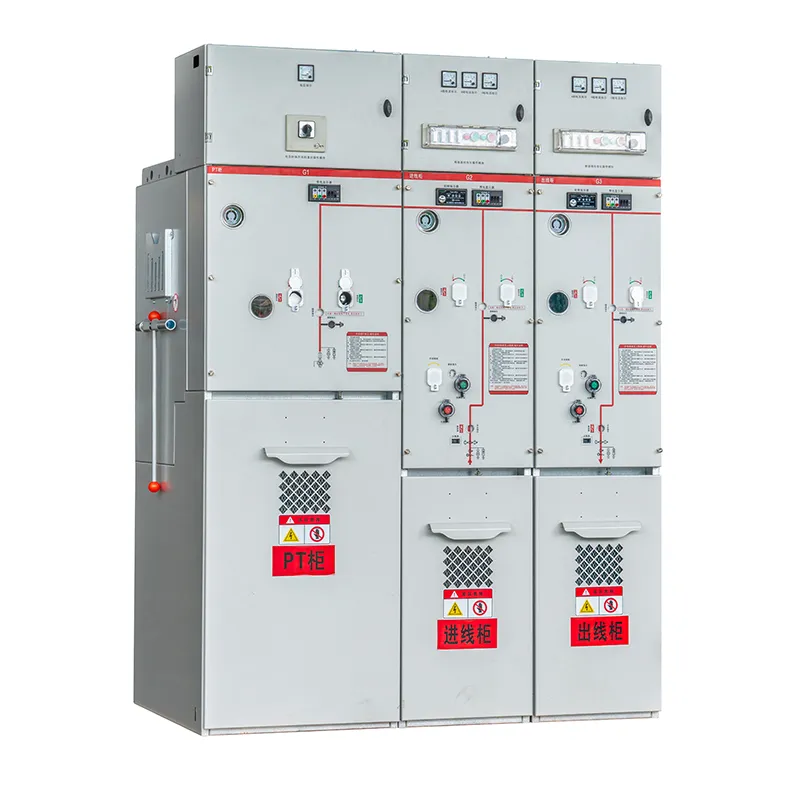
A ring main unit is the compact switching station that connects secondary distribution networks into a ring topology, providing loop supply, cable branching, and fault isolation. Traditional RMUs have been SF6-insulated, which makes them compact but ties them to gas monitoring and the regulatory clock. An sf6 free rmu keeps the same compact, fully enclosed design but replaces the SF6 with a vacuum load break switch combined with dry air or solid insulation.
Because the vacuum interrupter does the current breaking and the insulation medium handles only dielectric separation, SF6-free RMUs deliver the same 12 kV to 24 kV ratings, 20 kA to 25 kA fault levels, and IP67 gas-chamber protection as their SF6 predecessors, without any greenhouse gas. There is no gas pressure gauge to check, no leak testing, no SF6 recovery during maintenance, and no risk of being locked out by 2026 regulations. This makes them the practical choice for new urban substations, industrial distribution rooms, and renewable energy projects.
It is offered with a vacuum load break switch option, which removes SF6 from the switching compartment while keeping IP67 protection for the gas chamber and full compliance with GB/T 3906-2020 and IEC 62271-200. If you need a simpler configuration, the 10kV ring main unit range covers standard loop and branch applications. For a full picture of available configurations, browse the medium and high voltage switchgear category.
If you are deciding whether an RMU or a different switching topology fits your network, our ring main unit vs switchgear comparison and the RMU working principle guide explain how these units operate in practice.
SF6-Free vs SF6 Switchgear: Key Differences
Feature
SF6 switchgear
SF6-free switchgear
Insulating / breaking medium
SF6 gas for both insulation and breaking
Vacuum breaking; dry air or solid insulation
Global warming potential
GWP ≈ 23,500
GWP ≈ 0 (vacuum, dry air, solid)
Regulatory status
Banned for new MV units ≤ 24 kV from 2026 in the EU
Compliant with current and planned regulations
Gas handling
Filling, leak testing, recovery, reporting
None; no pressure monitoring required
Maintenance
Quarterly/annual gas pressure checks, leak management
Simpler; no gas-related tasks
Footprint
Very compact
Compact; dry-air designs slightly larger, solid designs similar
Standards
IEC 62271-200, IEC 62271-203
IEC 62271-200, IEC 62271-201 (solid), GB/T 3906
Upfront cost
Mature, lower
Often 10–15% higher today, falling as volumes grow
Lifecycle cost
Gas handling and reporting add recurring cost
Lower total cost of ownership over 15+ years
Benefits of Eco-Friendly Switchgear
Switching to eco friendly switchgear delivers benefits beyond compliance:
Lower carbon footprint. Eliminating SF6 removes the largest source of greenhouse gas emissions from distribution equipment and supports ESG and carbon-neutrality commitments.
Regulatory certainty. SF6-free units ordered today remain installable after 2026, 2028, and 2030 deadlines, protecting project schedules.
Simpler maintenance. No gas pressure checks, leak detection, or recovery procedures reduces routine work and specialist training.
Improved safety. No pressurized gas to leak, no decomposition by-products, and no gas disposal risk during end-of-life.
Lower lifecycle cost. Industry studies put SF6-free upfront costs roughly 10–15% higher but total ownership costs 20–30% lower over 15 years, driven by eliminated gas management.
Future-proofing. New standards and utility policies increasingly require SF6-free; specifying it now avoids premature replacement.
Challenges and Considerations
SF6-free technology is mature but not a drop-in clone of legacy SF6 gear in every respect:
Footprint. Dry-air insulated designs can be slightly larger than the most compact SF6 units. Check the actual panel width against your switch room or kiosk dimensions before specifying.
Upfront cost. Some SF6-free configurations still carry a price premium, though volumes and competition are closing the gap quickly.
Standards and approvals. Confirm the unit meets IEC 62271-200 (or IEC 62271-201 for solid-insulated) and any local standards such as GB/T 3906 in China, and that type tests cover internal arc classification and temperature rise.
Retrofit planning. Existing SF6 switchgear can keep operating, but plan replacements around the regulatory dates so you are never forced into a rushed procurement.
How to Choose SF6-Free Switchgear
Work through this checklist when evaluating suppliers:
What is the system voltage and fault level? Most SF6-free RMUs cover 12 kV to 24 kV at 20 kA to 25 kA, matching typical secondary networks.
Is the site urban, industrial, renewable, or commercial? Compact air-insulated RMUs suit space-constrained substations; solid-insulated units suit humid or dirty environments.
Does the product carry the right standards? Require IEC 62271-200 type tests and note the applicable national standard, such as GB/T 3906.
Do you need automation? Check for DTU integration, “three remote” functions, IEC 61850 or IEC 60870-5-104 communication, and fault indicators.
What is the total cost of ownership? Compare 15-year cost including maintenance, gas management (if any), and compliance reporting, not just the purchase price.
Can the supplier prove SF6-free construction? Ask whether the switch compartment uses a vacuum load break switch and dry air or solid insulation, and verify there is no SF6 anywhere in the unit.
Conclusion
SF6-free switchgear replaces the most potent industrial greenhouse gas with vacuum switching and dry air or solid insulation, delivering the same MV protection performance without the environmental and regulatory burden. The EU ban on SF6 in new switchgear up to 24 kV takes effect on 1 January 2026, so any project specified today should already be on an SF6-free platform. Start with SF6-free RMUs for secondary distribution, confirm the technology and standards with your supplier, and compare lifecycle cost rather than upfront price.
For a deeper look at how switching technologies compare, our VCB vs RMU switchgear guide explains when a vacuum breaker or a ring main unit is the right fit. When you are ready to specify, contact our engineering team with your voltage, fault level, and site conditions, and we will help you select SF6-free equipment that meets your performance and sustainability targets.
FAQ
What does SF6-free switchgear mean?
SF6-free switchgear is medium-voltage equipment that does not use sulfur hexafluoride as an insulating or interrupting medium. It typically uses vacuum interruption for breaking and dry air or solid epoxy insulation for dielectric separation, resulting in a global warming potential close to zero.
When does the SF6 ban take effect?
Under EU Regulation 2024/573, new medium-voltage switchgear up to 24 kV using F-gases can no longer be put into operation from 1 January 2026. The ban extends to 24–52 kV from 2030, and high-voltage equipment follows by 2028 and 2032. Existing SF6 installations can remain in service.
Is SF6-free switchgear more expensive?
Upfront prices are often 10–15% higher than comparable SF6 equipment today, but lifecycle costs are typically 20–30% lower over 15 years because there is no gas filling, leak testing, recovery, or compliance reporting. Prices are converging as SF6-free volumes grow.
What is an SF6-free RMU?
An SF6-free ring main unit is a compact, fully enclosed secondary-distribution switching unit that uses a vacuum load break switch combined with dry air or solid insulation instead of SF6 gas. It keeps the compact, IP67-protected design of a conventional RMU without any greenhouse gas.
Is vacuum switching SF6-free?
Yes. A vacuum interrupter extinguishes the arc in a sealed vacuum chamber with no gas at all, so vacuum switching is fully SF6-free. It is the standard breaking technology in SF6-free RMUs, load break switches, and circuit breakers.
Can existing SF6 switchgear be kept in service?
Yes. The regulations ban putting new SF6 equipment into operation after the relevant date; they do not force removal of existing installations. Legacy SF6 switchgear can continue operating with proper maintenance, but replacements and new projects should use SF6-free platforms.
Core Functions & Standards of Switch Isolators Switch isolators serve a critical role in electrical safety by providing positive isolation—a reliable and visible means to disconnect power for maintenance or emergency shutdown. This isolation is achieved through either an air gap or contact separation, ensuring no electrical continuity when switched off. The air gap typically offers a clear physical […]
What is a medium voltage breaker? When you see terms like “11kV breaker” or “33kV circuit breaker” on a single-line diagram, you’re dealing with a medium voltage breaker. In simple terms, a medium voltage circuit breaker is a switching and protection device designed to safely interrupt fault currents and switch normal load currents in the […]
We use cookies to enhance your browsing experience, serve personalised ads or content, and analyse our traffic. By clicking "Accept All", you consent to our use of cookies.