Blog
Fuse Electrical Symbol Guide IEC ANSI IEEE Standards
Learn the fuse electrical symbol with IEC and ANSI standards, variations, diagrams, and quick reference guide
Read More
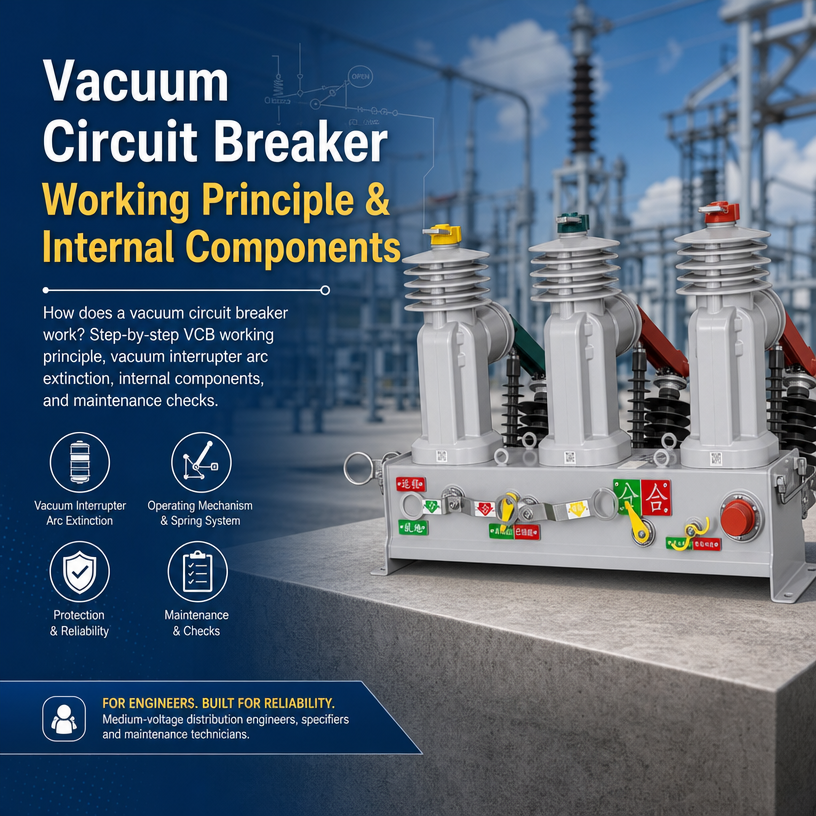
A vacuum circuit breaker (VCB) interrupts electrical current by separating its contacts inside a sealed vacuum chamber, where the arc dies on its own at the natural current zero. That one sentence is the whole vacuum circuit breaker working principle, but the practical story is in the details: what happens inside the vacuum interrupter, why vacuum extinguishes an arc in milliseconds, and which internal components make it work. This guide explains the working principle step by step, takes apart the internal components of a vacuum circuit breaker, and covers the checks that keep one reliable in service. If you are new to vacuum circuit breakers, this is the right starting point.
A vacuum circuit breaker is a switching device that makes, carries, and interrupts current in medium-voltage circuits using vacuum as both the arc-quenching and insulating medium. The fixed and moving contacts are enclosed inside a vacuum interrupter, a sealed ceramic or glass bottle evacuated to roughly 10⁻⁴ to 10⁻⁶ Pa. Because there is almost no gas inside, there is almost nothing to ionize, which is the key to how the device works.
VCBs are the dominant breaker technology for medium-voltage distribution, typically covering rated voltages from 3.6 kV up to 40.5 kV and breaking capacities up to 63 kA in the largest designs. They appear in indoor metal-clad switchgear, compact substations, capacitor and motor feeders, and outdoor pole-mounted installations. For a broader picture of where the technology sits in the network, see our guide to the medium voltage circuit breaker.
The operation follows the same logic as any circuit breaker — carry current normally, detect a fault, open the contacts, extinguish the arc, and hold the open gap — but each step happens faster and with less wear because of the vacuum environment. Here is the sequence in plain terms:
The whole interruption happens within a few milliseconds of contact separation — typically in well under one AC cycle — which is why VCBs are prized for fast fault clearing.
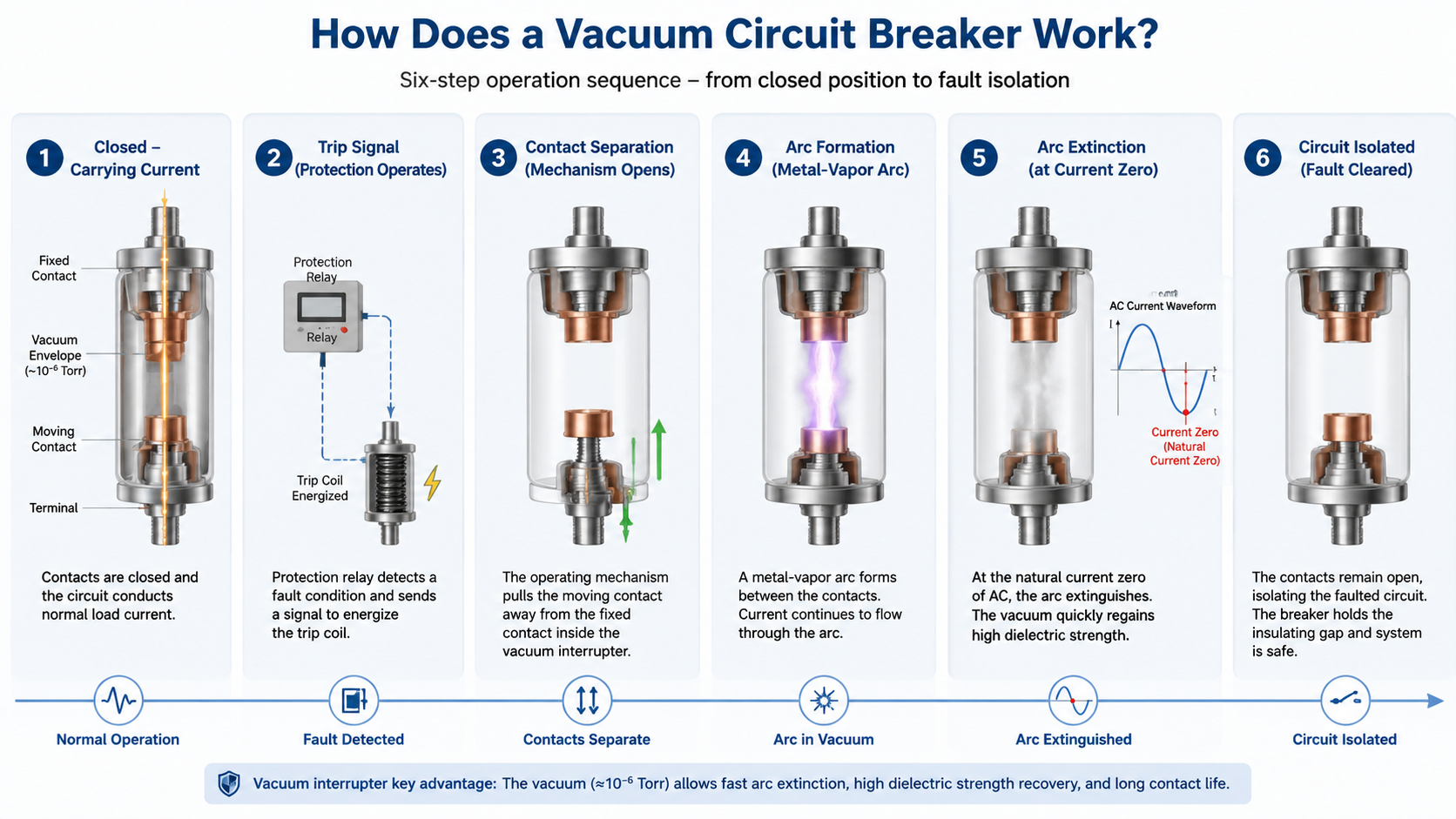
| Step | What happens | Result |
|---|---|---|
| Closed | Contacts carry normal load current | Circuit energized |
| Fault detected | Relay energizes the trip coil | Trip command issued |
| Contacts open | Mechanism separates contacts in vacuum | Arc forms between contacts |
| Current zero | Metal vapor condenses, dielectric strength recovers | Arc extinguished |
| Open position | Gap withstands recovery voltage | Fault isolated |
The physics behind the VCB working principle is what makes vacuum special. In air, oil, or SF6, the arc sustains itself through ionized gas that must be cooled, blown out, or quenched by the surrounding medium. Inside a vacuum interrupter there is no ionizable gas at all — the arc is a column of metal vapor released from the contact surfaces. That changes the game in three ways:
Designers add a longitudinal magnetic field through cup-shaped contact geometry so the arc stays diffuse instead of concentrating in one spot. A diffuse arc erodes the contacts far less, which is why a vacuum interrupter can handle tens of thousands of operations before contact replacement is even considered.
A VCB is a compact assembly, but every internal component has a specific job. The most important is the vacuum interrupter — commonly called the vacuum bottle — which is where current is actually interrupted.
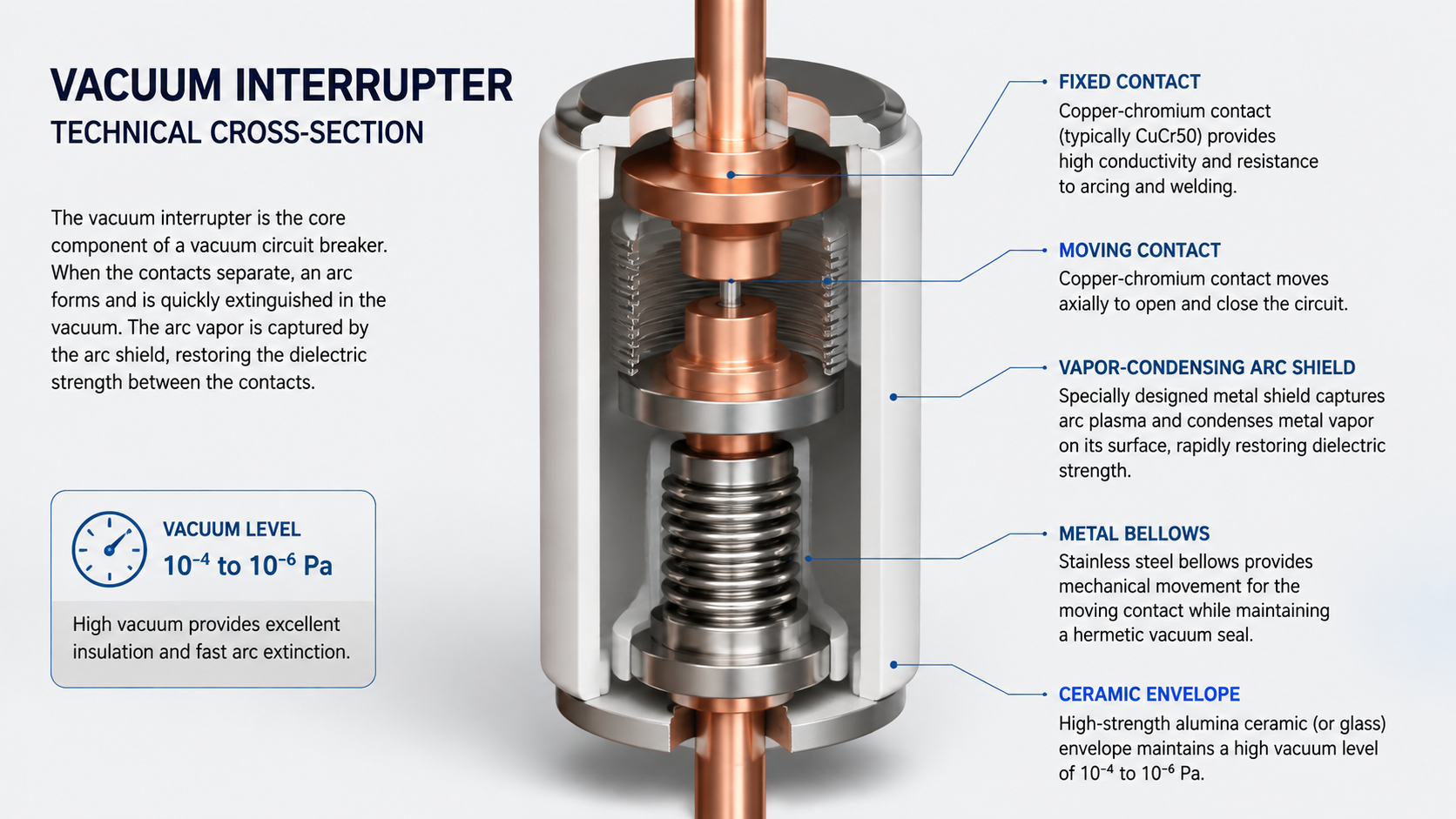
| Component | Function | Why it matters |
|---|---|---|
| Vacuum interrupter | Sealed chamber that contains the contacts and quenches the arc | The heart of the breaker; interruption happens inside it |
| Fixed and moving contacts | Carry current when closed; separate to interrupt it | Copper-chromium alloy resists arc erosion and weld |
| Bellows | Flexible metal seal that lets the moving contact travel while keeping the vacuum tight | Permits mechanical opening without leaking air into the bottle |
| Arc (vapor condensing) shield | Surrounds the contacts and condenses metal vapor | Protects the ceramic envelope and speeds dielectric recovery |
| Ceramic or glass envelope | Provides the vacuum-tight, insulating housing | Maintains the 10⁻⁴–10⁻⁶ Pa vacuum for the life of the bottle |
| Insulating pull rod | Links the operating mechanism to the moving contact | Transfers motion while insulating the mechanism from high voltage |
| Operating mechanism | Stores energy and drives closing and opening | Spring or permanent-magnet designs give fast, reliable operation |
| Contact springs and terminals | Maintain contact pressure and connect the breaker to the circuit | Ensure low-resistance current path and stable closed state |
Around these, an indoor breaker adds an epoxy or ceramic insulating support and a metal frame, while an outdoor breaker adds a weatherproof enclosure, bushings, and often integrated control and communication modules.
Inside the bottle, the moving contact is welded to the bellows, so it can travel a few millimeters to a few centimeters while the envelope stays sealed. The contact faces are made of a copper-chromium alloy that withstands the arc and resists cold welding when closed. The arc shield sits between the contacts and the ceramic wall, catching condensed vapor so the envelope never becomes a conductive film. Because the bottle is sealed at the factory and cannot be opened, its vacuum quality depends on manufacturing integrity — which is why vacuum-loss testing is part of VCB maintenance.
The working principle of a vacuum circuit breaker depends on the operating mechanism moving the contacts fast and holding them firmly. The most common design is the spring mechanism:
Permanent-magnet mechanisms replace most springs with a magnetic latch, giving fewer moving parts and a mechanical life of tens of thousands of operations. Auxiliary contacts in the mechanism feed status and position signals to the control and indication circuits.
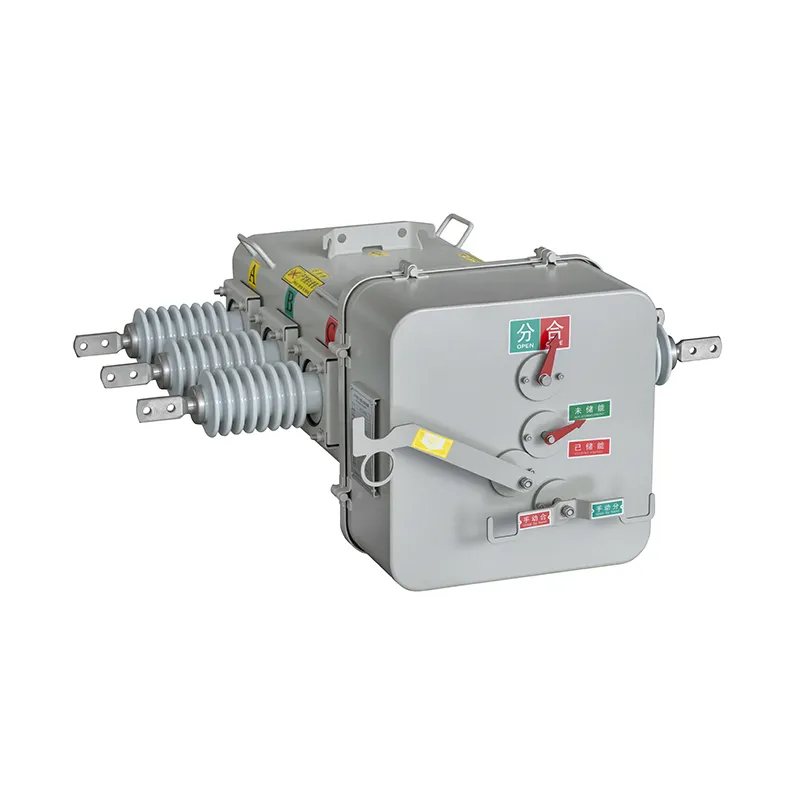
VCBs are built in two broad physical forms. Indoor VCBs mount in metal-clad switchgear panels, are often withdrawable, and suit substations, industrial plants, and commercial buildings. Outdoor VCBs are self-contained on poles or plinths and serve overhead distribution networks, where they provide sectionalizing, interconnection, and automatic fault isolation, often with auto-reclosing.
For pole-mounted outdoor duty, a good example is the ZW32-12G-T630-20 outdoor vacuum circuit breaker, a fully integrated design for 10–20 kV overhead networks with 630 A or 1250 A ratings, spring or permanent-magnet operation, IP65-class weather protection, and communication options such as RS485 and Ethernet for remote monitoring. Where a network boundary or tie position needs its own protected breaker, the ZW32-12F outdoor vacuum boundary circuit breaker plays a similar role in sectionalizing and protection schemes.
Vacuum is not the only interruption medium, but for medium voltage it has become the default. Comparing the three mainstream technologies makes the VCB working principle advantages concrete:
| Criterion | Vacuum breaker | SF6 breaker | Oil breaker |
|---|---|---|---|
| Interruption medium | Vacuum in a sealed bottle | SF6 gas under pressure | Insulating oil |
| Arc extinction | Metal-vapor arc dies at current zero | Gas blast cools and quenches the arc | Oil vaporizes and quenches the arc |
| Maintenance | Low; no medium to refill | Moderate; gas pressure and quality checks | High; oil filtering, level, and leak checks |
| Safety and environment | No oil, no greenhouse gas | SF6 is a potent greenhouse gas | Oil is flammable; fire and leak risk |
| Typical use | Medium-voltage distribution, frequent switching | High-voltage transmission and some MV GIS | Older MV/HV installations |
For higher-voltage transmission duty where gas insulation is required, an SF6 gas-insulated tank circuit breaker may be the right fit; the choice always comes down to voltage level, duty, environment, and lifecycle cost.
A vacuum circuit breaker is low-maintenance, but “low” does not mean “never.” These are the checks that matter:
A VCB with a sound vacuum interrupter and a healthy mechanism typically serves for decades with only routine checks between operations.
The vacuum circuit breaker working principle is simple in concept — open the contacts in a vacuum, let the metal-vapor arc die at current zero, and let the gap recover its insulation in microseconds — but it depends on a handful of well-made internal components: the sealed vacuum interrupter, its copper-chromium contacts, the bellows, the arc shield, and a fast operating mechanism. That combination gives fast fault clearing, low maintenance, long life, and an environmentally clean footprint, which is why VCBs dominate medium-voltage distribution.
If you are specifying or replacing a breaker for a distribution project, compare it with our VCB vs RMU switchgear guide to understand how the device fits into a complete switchgear assembly, and contact CNSOVIO with your system voltage, fault levels, and duty requirements for application-specific selection support.
A vacuum circuit breaker interrupts current by opening its contacts inside a sealed vacuum chamber. The arc that forms between the contacts is made of metal vapor only, and it extinguishes naturally when the AC current reaches zero, after which the vacuum gap rapidly regains its insulating strength and keeps the circuit open.
There is no gas inside the interrupter to sustain ionization. The arc is a metal-vapor discharge from the contact material. Near the current zero crossing, the vapor condenses back onto the contacts and the arc shield within microseconds, and the gap recovers its dielectric strength fast enough to prevent re-striking.
A vacuum interrupter contains fixed and moving contacts made of copper-chromium alloy, a metal bellows that lets the moving contact travel while keeping the vacuum seal, a vapor-condensing arc shield, and a ceramic or glass envelope holding a vacuum of roughly 10⁻⁴ to 10⁻⁶ Pa.
Vacuum interrupters are rated for tens of thousands of mechanical operations and typically 10,000 to 30,000 electrical operations at rated current, depending on design and duty. Mechanical life for spring and permanent-magnet mechanisms is commonly 30,000 operations or more.
The most common failure modes are loss of vacuum in the interrupter (detected by a withstand test), contact wear from repeated fault interruption, mechanism problems such as weak spring charging or failed latches, and insulation breakdown from pollution or moisture.
Yes, but much less than oil or SF6 breakers. Routine checks cover vacuum integrity, contact and mechanism condition, insulation, and functional operation, typically on an interval of several years or after a specified number of operations.

Learn the fuse electrical symbol with IEC and ANSI standards, variations, diagrams, and quick reference guide
Read More
Shop electrical fuses Lowes guide Types prices brands safety tips and aisle locations for fast fuse replacement
Read More
What Is A Fuse Electrical Panel? A fuse electrical panel is the “control center” of your home’s power, but with old‑school protection instead of modern breakers. It takes electricity from the utility line, distributes it to each circuit in your house, and uses fuses to cut power if something goes wrong. Simple definition In plain […]
Read More