How to Import Switchgear From China: Step-by-Step Guide
A step-by-step import guide for MV switchgear and vacuum circuit breakers from China, covering specification, factory verification, FAT, packing and customs.
Read More
Comparing switchgear vs switchboard vs panelboard matters because all three enclose switching and protective devices, and in casual conversation the words get used interchangeably. In a specification they do not. The distinction is driven by what the assembly is designed to interrupt, how it is tested, and which standard it is listed to — and confusing them at tender stage is one of the fastest ways to end up with equipment that fails inspection.
The short answer: switchgear is a metal-enclosed assembly of drawout circuit breakers with integral protection and metering, built to clear high fault currents. A switchboard is a larger, front-accessible assembly of breakers and switches that distributes power from one bus to many outgoing circuits. A panelboard is a single, compact panel of branch-circuit breakers feeding final circuits. This guide compares the three on construction, ratings, standards and application so you can specify the right one, and use the right word for it.
If the assembly contains a main protective device that must interrupt a large fault current and coordinate with upstream protection, it is switchgear. If it takes one incoming feed and splits it into a dozen or more feeder circuits with front-accessible breakers, it is a switchboard. If it is a wall-mounted enclosure of branch breakers at the end of the distribution chain, it is a panelboard.
Where the industry gets into trouble is the middle ground. A 4000 A low-voltage distribution section with a main breaker and twelve feeder breakers is called a switchboard in North America and “low-voltage switchgear” in much of Europe and Asia, even when the construction is nearly identical. The label matters because it determines which standard the assembly is designed and type-tested to, and therefore which fault ratings you are allowed to claim.
Switchgear is a general term for the switching and protection equipment in a power system, and as a product it usually means a metal-enclosed assembly with compartmentalised, drawout circuit breakers. In medium voltage, an MV switchgear panel contains a vacuum or SF₆ breaker on a withdrawable truck, busbars in a separate compartment, cable terminations in another, and low-voltage control gear in a fourth. Compartmentalisation is the point: an internal arc in one compartment should not propagate into the next.
Switchgear carries the protection scheme. Current transformers, voltage transformers, a protective relay and a trip circuit are part of the assembly, not an afterthought. That is why switchgear is specified by rated short-circuit breaking current, rated short-time withstand current, internal arc classification and loss of service continuity category, and why it is the only one of the three that is routinely type-tested for internal arc fault.
A switchboard is a dead-front assembly of circuit breakers, switches and fusible units mounted on a common bus, accessible from the front, and used to distribute power to multiple outgoing circuits. North American practice anchors it to UL 891, which covers assemblies rated up to 600 V with short-circuit withstand ratings typically up to 100 kA and bus ratings from a few hundred to several thousand amps.
Construction is simpler than switchgear: devices are bolted to the bus and connected by cables or bus bars, usually without individual compartmentalisation or drawout mechanisms. That makes switchboards cheaper and denser per circuit, and it makes them the default choice for the main distribution board of a commercial building, a factory sub-distribution point, or the low-voltage side of a packaged substation. The trade-off is serviceability — maintenance on one circuit usually means working near live parts of others.
A panelboard is a single panel or group of panel units designed for installation in a cabinet, with buses and automatic overcurrent devices, intended to be placed in or against a wall and accessible only from the front. In plain terms, it is the breaker panel in an electrical closet. Ratings are modest: typically 600 V maximum, 100 A to 1,200 A, with a limited number of branch devices.
Panelboards exist to serve final circuits — lighting, socket outlets, small motors, HVAC equipment. They have no integral protection relay, no metering beyond an optional analogue meter, no compartmentalisation and no drawout mechanism. A panelboard does not interrupt a feeder fault; it protects the branch circuit downstream of it. Related vocabulary worth keeping straight: a “load centre” is a specific North American product family of panelboards for lighting and appliance branch circuits, and “panel” is the loose colloquial term that should never appear in a specification.
| Attribute | Switchgear | Switchboard | Panelboard |
|---|---|---|---|
| Function | Switching, protection, metering of a power section | Distribution from one bus to many feeders | Branch-circuit protection at the load end |
| Typical voltage | LV 690 V; MV 3.6–40.5 kV | Up to 600 V (UL) / 690 V (IEC) | Up to 600 V |
| Typical current | 630 A to 4,000 A per panel (MV) | 400 A to 6,000 A bus | 100 A to 1,200 A |
| Device type | Drawout breaker with relay | Fixed or plug-in breaker, switch, fuse | Bolted branch breaker |
| Compartmentalised | Yes, by design | Usually no | No |
| Internal arc tested | Yes, per IEC 62271-200 | Rarely; arc-resistant versions exist | No |
| Access | Front and rear | Front only | Front only, wall mounted |
| Relative cost per circuit | Highest | Moderate | Lowest |
The single biggest source of confusion on international projects is that the two standard systems slice the same equipment differently. If you write a US-style specification for a project built to IEC standards, the contractor will price something you did not ask for.
| Equipment | North American standard | IEC equivalent |
|---|---|---|
| MV metal-clad switchgear | IEEE C37.20.2 | IEC 62271-200 |
| MV metal-enclosed interrupter switchgear | IEEE C37.20.3 | IEC 62271-200 / 62271-103 |
| LV switchgear (power circuit breakers) | UL 1558 | IEC 61439-1 and -2 |
| Switchboard | UL 891 | IEC 61439-2 (distribution assembly) |
| Panelboard | UL 67 | IEC 61439-3 (distribution board) |
| Arc-resistant design | IEEE C37.20.7 | IEC 62271-200 internal arc class |
One consequence is worth flagging early. IEC 61439-1 has no equivalent of the UL 891/1558 split, so a European supplier may offer one “type-tested assembly” for what a North American engineer would call two different products. The design verification still has to be done, but it is done under a different framework — see our comparison of AIS and GIS switchgear for how that plays out at the room level in medium voltage.
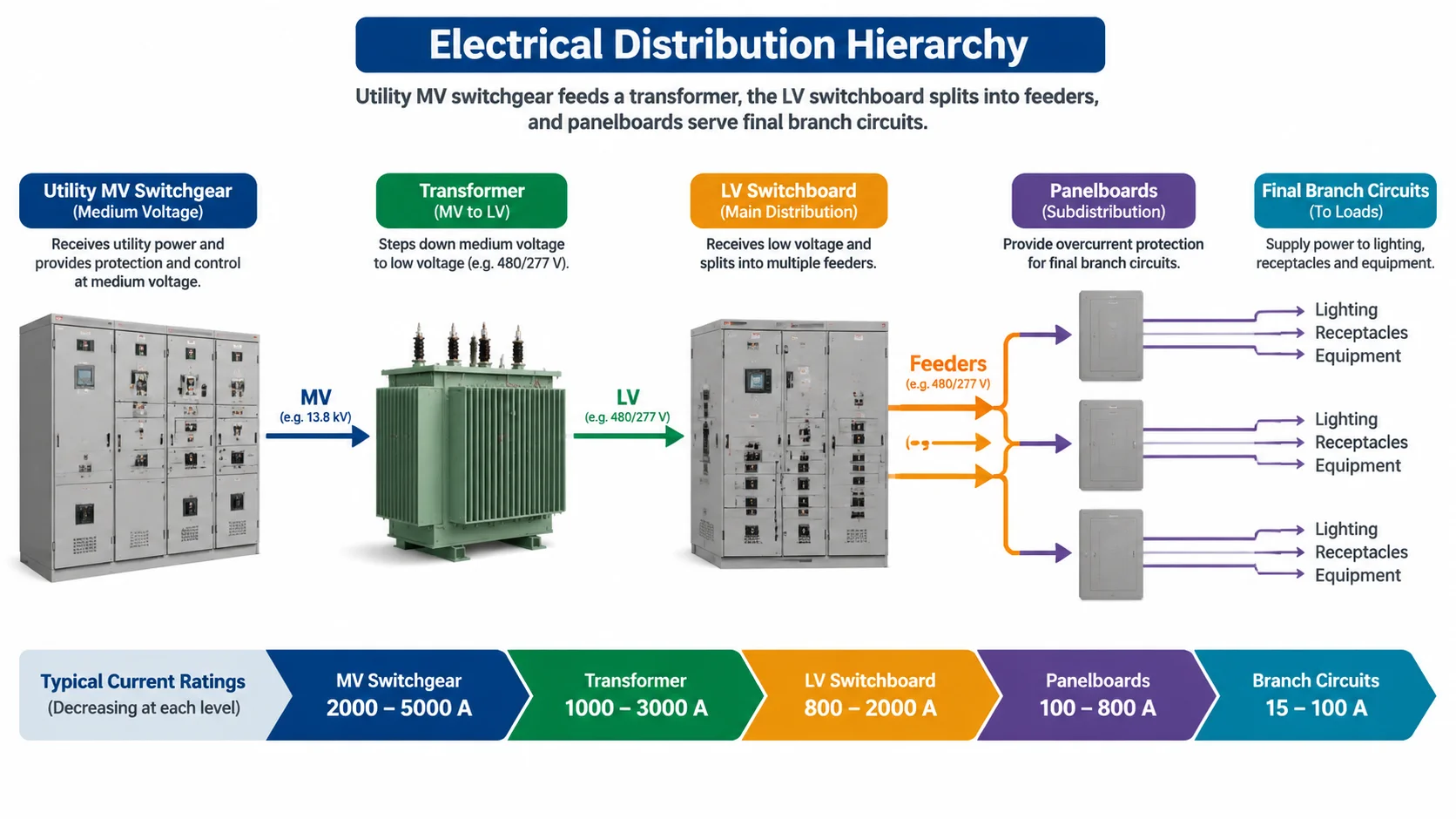
A typical industrial installation uses all three, in a fixed order. The utility feed lands in MV switchgear that steps down through a transformer. The transformer secondary feeds a low-voltage switchboard that splits power into feeders for each building or process area. Each feeder ends in a panelboard that serves the final circuits in that area. Getting the layering right is what keeps fault levels manageable and cable sizes sane.
Two practical notes. First, the MV switchgear is where the protection study lives — relay settings, current transformer ratios, and coordination curves are all defined there, which is why vacuum circuit breakers are the usual choice in that layer. Second, the low-voltage end is where cost accumulates: a project will typically have one switchgear line-up, a handful of low-voltage switchgear sections, and dozens of panelboards.
“Panel” is not a product; it is shorthand. A load centre is a UL-listed panelboard family for lighting and appliance circuits. A distribution board in IEC terminology is the panel that splits a submain into final circuits, and it may be built to IEC 61439-3 with a form of separation a North American panelboard would never have.
The word that causes the most expensive mistakes, though, is “switchgear” used loosely for a distribution cabinet. If a specification says switchgear but the drawings show a fixed-mounted assembly of moulded-case breakers, you have a switchboard with a switchgear price tag — or worse, a switchboard being asked to meet an internal arc type test it was never designed for.
Switchgear protects and switches a power section, a switchboard distributes from a bus to many feeders, and a panelboard protects final branch circuits. The three sit in a deliberate hierarchy, and the vocabulary changes across the Atlantic in ways that can shift a tender by tens of thousands. If you are assembling a distribution scheme and want the equipment layers matched to your fault levels, send over the single-line diagram and we will map the assemblies and ratings for you.
No. Switchgear is built around drawout breakers with integral protection and is type-tested for internal arc; a switchboard is a simpler front-access assembly of breakers and switches distributing from a common bus. Some products sit between the two categories, which is where the terminology gets muddy.
No. A panelboard is rated and listed for branch-circuit distribution only, with limited current ratings and no compartmentalisation. Using one to split a large feeder is a code violation and a fault-withstand risk.
Scale and function. A switchboard takes a large incoming feed and distributes to many feeders with bus ratings up to thousands of amps; a panelboard distributes a single submain to final branch circuits, typically below 1,200 A.
Yes. Any assembly with energised busbars requires an incident energy assessment for labelling under NFPA 70E or an equivalent local rule. Arc-resistant construction reduces the risk but does not remove the labelling requirement.