How to Import Switchgear From China: Step-by-Step Guide
A step-by-step import guide for MV switchgear and vacuum circuit breakers from China, covering specification, factory verification, FAT, packing and customs.
Read More
Buyers outside China meet three model numbers again and again on medium-voltage quotations: KYN28, KYN61 and XGN15. They are not brands and they are not proprietary designs — they are standard Chinese switchgear configurations, published in catalogue form, built by dozens of factories to broadly similar drawings. Knowing what each one is tells you, within a minute, whether the quotation is aimed at your application or has simply been matched on voltage.
This guide decodes the naming convention, explains what KYN28, KYN61 and XGN15 physically are, compares their ratings and typical applications, and lists the details worth verifying on a datasheet before you approve a medium-voltage switchgear order.
In IEC markets, switchgear is usually described generically: “12 kV metal-clad, withdrawable, 630 A, 20 kA”. In China the same equipment is described by a model code that encodes construction, operating mode, installation location and design series. Procurement teams that do not read the code tend to compare prices across products that are not equivalent — a fixed-type compact unit against a metal-clad withdrawable panel, for example.
The code also tells you what you can and cannot change. A KYN28 panel is defined around a specific breaker truck and busbar arrangement; asking a factory to substitute a different breaker brand is a real engineering change, not a checkbox on an order form.
Chinese switchgear model designations follow a letter-position convention rather than an arbitrary number. Once you know the first four letters, the rest is mostly a design serial and the voltage class.
| Letter position | Meaning | In KYN28 | In XGN15 |
|---|---|---|---|
| 1st | Enclosure construction | K — metal-clad (armoured) | X — metal-enclosed box |
| 2nd | Operating mode | Y — withdrawable truck | G — fixed mounted |
| 3rd | Installation | N — indoor | N — indoor |
| 4th–5th | Design serial | 28 | 15 |
| Suffix | Rated voltage (kV) | 12 | 12 |
The practical implication: KYN panels are metal-clad and withdrawable, so each functional unit is a truck that can be racked out for maintenance. XGN panels are metal-enclosed and fixed, so the switch is bolted in place and isolation is done by the switch itself plus an earthing switch. That single difference drives cost, footprint, serviceability and the maintenance procedure for the next twenty years. HXGN designs add a leading H for ring-network duty, which is why the same compact unit is often catalogued as HXGN15.
KYN28A-12 is the most widely produced MV switchgear configuration in China. It is an indoor, metal-clad, withdrawable assembly for 3.6 kV, 7.2 kV and 12 kV systems, built around a vacuum circuit breaker truck — normally the ZN63A (also sold as VS1) or an equivalent such as the VD4 pattern. Functional units are separated into breaker, busbar, cable and relay compartments by earthed metal partitions.
Typical ratings, taken from published catalogue data: rated current 630 A to 4,000 A, rated short-circuit breaking current 20 kA to 50 kA, rated short-time withstand 20–50 kA for 4 s, power-frequency withstand 42 kV and lightning impulse withstand 75 kV at 12 kV. The enclosure is IP4X with compartment doors open to IP2X. A single panel is commonly 800 mm wide, 1,500 mm deep and 2,300 mm high, weighing 800 to 1,200 kg. It is the default choice for substation incomers, bus couplers and feeder circuits in factories, buildings and utility secondary substations.
KYN61-40.5 applies the same metal-clad withdrawable architecture one voltage class up. It serves 35 kV and 40.5 kV systems, typically with a ZN85-40.5 vacuum breaker truck, and is used where a 33 kV or 35 kV distribution network needs indoor metal-clad switchgear rather than an outdoor arrangement. Insulation levels step up accordingly — in the Chinese GB/DL framework, roughly 95 kV power-frequency withstand and 185 kV lightning impulse for the 40.5 kV class.
Two things change beyond the ratings. Physical size grows: a 40.5 kV panel is considerably wider and deeper than the 12 kV equivalent, and the room layout, cable trench and earthing arrangement all need re-checking. Second, the breaker truck is heavier and the racking mechanism demands more floor strength. Projects that assume a 12 kV footprint carries over to 33 kV tend to discover the problem at installation.
XGN15-12 is a compact, fixed-type metal-enclosed ring main unit built around an SF₆ load break switch, usually with two ring switches and one transformer branch that is either fused or breaker-protected. It is the standard answer for 12 kV distribution networks where a full metal-clad panel line-up is over-specified: residential block substations, small industrial feeders, wind and solar collector circuits, and utility ring networks.
Typical ratings are 12 kV, 630 A busbar and load break switch, 20 kA short-time withstand for 3 s and 50 kA peak, with fuse ratings up to about 125 A on the protected branch. Because the whole unit is sealed, the enclosure is compact — a three-way unit often fits in about 1.5 m of wall space, which is why it is used where floor area is at a premium. Our page on the XGN15-12F ring main unit lists the configuration options, and this 10 kV ring main unit shows the alternative layout with a different switch arrangement.
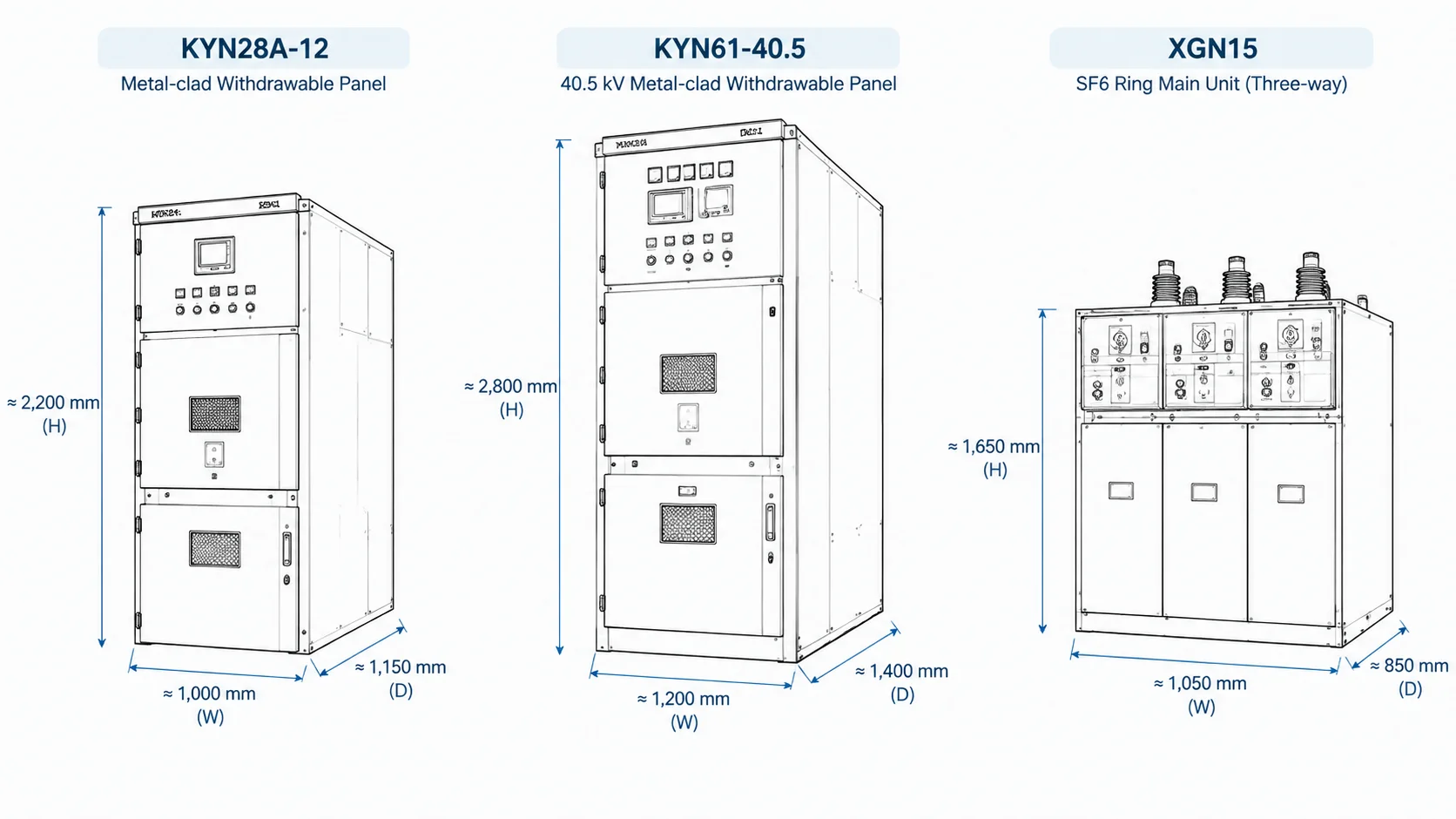
| Attribute | KYN28A-12 | KYN61-40.5 | XGN15-12 |
|---|---|---|---|
| Construction | Metal-clad, compartmented | Metal-clad, compartmented | Metal-enclosed, sealed |
| Switching device | Withdrawable VCB | Withdrawable VCB | SF₆ load break switch |
| Rated voltage | 12 kV | 40.5 kV | 12 kV |
| Rated current | 630–4,000 A | 1,250–2,500 A | 630 A |
| Short-circuit rating | 20–50 kA | 20–31.5 kA | 20 kA withstand, fuse-protected branch |
| Fault interruption | Breaker + relay | Breaker + relay | HV fuse + striker |
| Typical footprint | 800 × 1,500 mm per panel | 1,400 × 2,800 mm per panel | ~1,500 mm for three ways |
| Best fit | Substation and feeder panels | 33/35 kV indoor distribution | Ring networks, small substations |
Use KYN28 whenever a circuit needs automatic protection, metering and remote indication — substation incomers, bus couplers, transformer feeders above about 1,250 kVA, motor feeders, and anything on a SCADA system. Use KYN61 only when the system voltage genuinely sits at 35 kV or 40.5 kV; below that the cost and footprint penalty is unjustified.
Use XGN15 where the network is a ring and the only protection needed is a fuse on the transformer branch. It is also the right answer for renewable collector circuits and packaged substations where the switchgear has to be compact, sealed and largely maintenance-free. In IEC markets the SF₆ content is increasingly a procurement issue; if that applies to your project, our guide to SF₆-free switchgear covers the alternatives, and the arrangement-level comparison in AIS vs GIS switchgear explains when gas insulation is worth the complication at all.
If a datasheet quotes only the breaker rating and the voltage, it is a marketing sheet rather than a technical one. Ask for the type test report number and the routine test certificate template before you compare prices.
KYN28 is the 12 kV metal-clad withdrawable standard, KYN61 is the same architecture at 40.5 kV, and XGN15 is the compact SF₆ ring main unit that replaces a panel line-up where a fuse is enough protection. Read the model code, verify the short-time withstand rating and the internal arc class, and confirm which breaker is actually inside the truck. If you are comparing quotations across these three families, send us the single-line diagram and we will tell you which configuration fits and where the submitted ratings fall short.
K for metal-clad (armoured) construction, Y for withdrawable, N for indoor, 28 for the design series, and 12 for the 12 kV rated voltage. The same sequence applies to KYN61-40.5 at the 40.5 kV class.
KYN28 is a compartmented, withdrawable breaker panel with relay protection. XGN15 is a fixed, sealed ring main unit using an SF₆ load break switch and a fuse. One protects circuits, the other mainly switches and isolates them.
The H prefix denotes ring-network duty. Many factories catalogue the same compact unit under both designations, so always confirm the switch and fuse configuration rather than the label.
Not directly. KYN28 is an indoor design with IP4X enclosure protection. Outdoor applications use a container or kiosk substation, or a dedicated outdoor product such as a vacuum recloser or outdoor ring main unit.
XGN15 is normally the lower-cost option per functional position because it uses fixed switching devices and no relay protection. The comparison flips once you need fault protection, metering and remote control, which an XGN15 cannot provide.