How to Import Switchgear From China: Step-by-Step Guide
A step-by-step import guide for MV switchgear and vacuum circuit breakers from China, covering specification, factory verification, FAT, packing and customs.
Read More
Choosing between a load break switch vs circuit breaker comes down to a single question: is the device allowed to interrupt a fault current? A load break switch (LBS) opens and closes a circuit that is carrying normal load current. It does that job cleanly, repeatedly, and cheaply. What it cannot do is clear a short circuit. A circuit breaker can do both — it switches load current and it extinguishes an arc produced by a fault measured in tens of kiloamps.
That distinction sounds academic until someone in a ring main unit review suggests using load break switches everywhere because they are cheaper. They are cheaper, and for circuits that never need automatic protection that is the right call. This article compares the two on interrupting duty, standards, ratings and cost, then shows where each one belongs in a real medium-voltage network.
A load break switch is a mechanical switching device with a defined making and breaking capacity for load current. Inside a ring main unit it is the device an operator turns to isolate a transformer feeder, transfer load between two ring cables, or earth a section before maintenance. Because it only has to break the current that the connected load actually draws, the arc it produces is modest and can be handled by an air-break arc chute, a small amount of SF₆, or a vacuum interrupter in a compact bottle.
The limit is defined by standard. Under IEC 62271-103, a load break switch is tested to make and break rated normal current and a specified limited overload, and to withstand — but not interrupt — rated short-circuit current for a short duration. In practice that means an LBS can close onto a fault once, hold the fault current while an upstream breaker clears it, and survive. It cannot be the device that clears the fault.
A circuit breaker is a switching device with a rated short-circuit breaking current. That single rating is what separates the two product families. A 12 kV vacuum circuit breaker rated 20 kA can interrupt 20,000 amps of fault current in roughly two to three cycles, then reclose, then interrupt it again if the fault is persistent — the standard duty cycle is O-0.3s-CO-180s-CO.
Because it can interrupt fault current, the breaker becomes the actuator for a protection scheme. A relay measures current through current transformers, decides the current is abnormal, and energises the shunt trip coil. Nothing in that chain exists in a load break switch. The vacuum interrupter is also built for a harder life: 10,000 mechanical operations and dozens of full short-circuit interruptions before contact replacement.
Condensed into one view, the two devices separate cleanly along every commercial and technical line:
| Attribute | Load break switch | Circuit breaker |
|---|---|---|
| Primary function | Switching and isolation under load | Switching plus fault interruption |
| Short-circuit interruption | None (withstand only) | Rated short-circuit breaking current |
| Automatic tripping | No — needs a fuse or upstream breaker | Yes, via relay and shunt trip |
| Typical rated current | 400 A / 630 A | 630 A to 4,000 A |
| Typical fault rating | 20 kA withstand, 50 kA making | 20 kA to 50 kA breaking |
| Governing standard | IEC 62271-103 | IEC 62271-100 |
| Relative cost | Lower | Two to four times higher for the same frame |
| Usual location | RMU ring and transformer branches | Incoming, bus coupler, large motor feeders |
The numbers make the gap obvious. A 1,000 kVA transformer on an 11 kV network draws about 52 A at full load. The same transformer, with 5.75% impedance, delivers roughly 900 A of short-circuit current at its terminals when the secondary is bolted — and the fault current at the 11 kV terminals of the feeder itself can be 12.5 kA to 25 kA depending on source strength. A device rated for 630 A of load current is not in the same conversation as a 20 kA fault.
This is why the rating plates matter more than the catalogue description. A load break switch is specified by rated current, rated short-time withstand current and duration (for example 20 kA for 3 s), and rated peak withstand current. A circuit breaker is specified by rated short-circuit breaking current, rated short-circuit making current, and operating sequence. If a datasheet quotes only “630 A” and nothing about short-time withstand, it is telling you where the device is allowed to sit in the network.
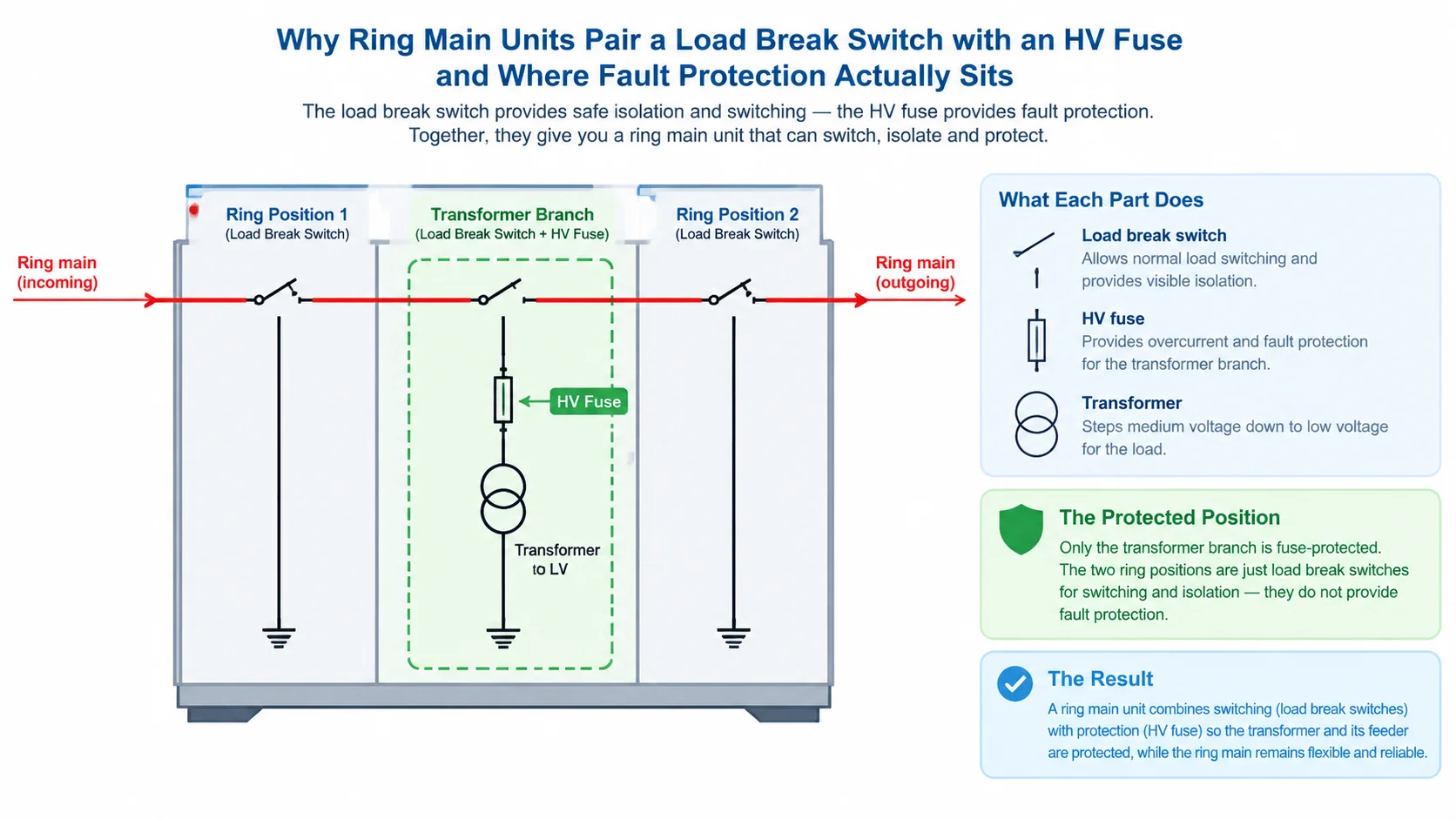
In a conventional MV network the two devices divide the work along a predictable pattern. Load break switches sit where the only task is to reconfigure the network or isolate a healthy section: ring cable positions, transformer feeders protected by HV fuses, and sectionalising points on overhead lines. Circuit breakers sit where a fault must be cleared without waiting for anyone to arrive: substation incomers, bus couplers, feeders to dense load, capacitor banks, and any circuit feeding a transformer above roughly 1,250 kVA where fuse protection becomes impractical.
That is why a ring main unit normally contains two load break switches and one fused or breaker-protected transformer branch. The ring switches let the utility loop the network in and out; the protected branch is the one place where fault current has to be interrupted. Reading an RMU single-line diagram is largely an exercise in spotting which position carries protection.
Cost follows the same geography. A 630 A load break switch position typically runs 40–60% of an equivalent breaker position, and fits a 375 mm ring compartment against 800 mm for a 1,250 A metal-clad breaker panel — a difference that often settles the plant room layout before the electrical argument begins.
A load break switch plus a high-voltage fuse is the oldest cost-effective protection combination in distribution. The switch handles switching; the fuse handles interruption. When the fuse operates, the striking pin fires a striker, which trips the switch open on all three phases so the faulted branch is fully isolated rather than left single-phased.
The combination has real boundaries. Fuses cannot be adjusted, they must be replaced after every operation, and above roughly 630 kVA the fuse required for transformer inrush coordination becomes too large to protect the transformer properly. At that point the transformer branch needs a circuit breaker with a relay. If you need a reminder of what the fuse side of that arrangement looks like, our guide to power fuses and fuse links covers the selection logic.
| Parameter | Typical 12 kV LBS | Typical 24 kV LBS | What it tells you |
|---|---|---|---|
| Rated voltage | 12 kV | 24 kV | Maximum system voltage, not nominal |
| Rated normal current | 630 A | 630 A | Continuous load it can carry and break |
| Short-time withstand | 20 kA / 3 s | 20 kA / 3 s | Fault current it can hold while upstream clears |
| Rated peak withstand | 50 kA | 50 kA | First-cycle asymmetric peak it survives |
| Making capacity | 50 kA peak | 50 kA peak | Ability to close onto a fault once |
| Mechanical life | 5,000 operations | 5,000 operations | Switching endurance before overhaul |
Three mistakes show up again and again in tender reviews. The first is treating “load break switch” and “isolator” as synonyms — an isolator has no making or breaking capacity at all and must never be operated under load. The second is ordering an LBS with a motor operator and assuming it can be used for remote fault isolation; it can be opened remotely, but only after the upstream breaker has cleared the fault, otherwise the operator is opening a live fault.
The third is ignoring the earthing switch. In an RMU the earthing switch is a separate device with its own making capacity, and it must be interlocked so it can only be closed with the load break switch open. A unit that omits the interlock will eventually be earthed onto a live cable.
Some configurations defeat the LBS-plus-fuse answer entirely: a fault level above the fuse’s interrupting rating, a transformer above 1,250 kVA, a motor feeder needing overload and phase-failure protection, a utility requiring automatic reclosing, or a SCADA system that must see and clear faults remotely. There the comparison is no longer LBS versus breaker but breaker versus breaker, which is where our comparison of vacuum and SF₆ breakers and the vacuum circuit breaker range take over. For the room-level view of air-insulated versus gas-insulated layouts, see AIS versus GIS switchgear.
A load break switch switches load and isolates circuits; a circuit breaker does that and also clears faults. Choose the LBS where protection already exists upstream or where a fuse covers the branch, and choose the breaker wherever a fault must be interrupted automatically. If you are specifying ring main units or compact switchgear and want to confirm which positions in your single-line diagram need which device, send the diagram over and we will map the ratings for you.
No. A load break switch has no short-circuit breaking rating and no automatic trip mechanism. It can hold fault current for a few seconds while an upstream breaker clears it, but it cannot clear the fault itself.
It will attempt to and fail, which is why interlocking matters. Opening an LBS onto a fault produces an arc far beyond its tested breaking capacity and can destroy the unit and injure the operator. Protection must always be upstream.
No. An isolator (disconnector) provides a visible break but has essentially no making or breaking capacity and must only be operated with the circuit de-energised. A load break switch is tested to break rated load current.
Sealed SF₆ and vacuum RMU units are typically maintenance-free for their design life. Air-break designs need periodic contact inspection, and the earthing switch interlock should be function-tested at every scheduled outage.