Wind/Solar Farm MV Switchgear Requirements
What solar and wind farms need from MV switchgear: collector duties, ratings and derating for intermittent output, insulation technology, enclosure requirements and grid code compliance.
Read More
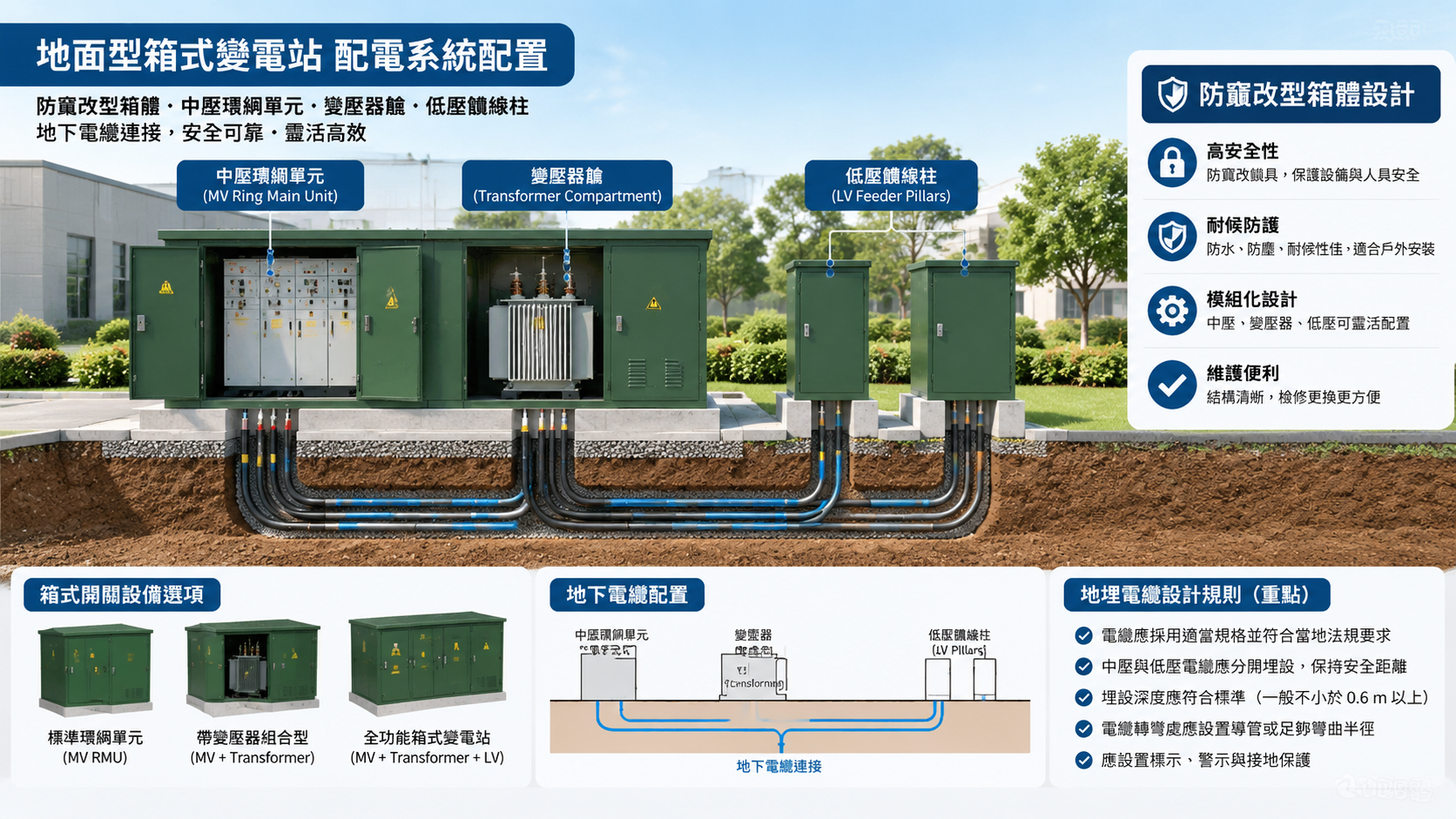
A pad mounted installation moves the substation out of the building and into the street, the car park or the landscaping, which is why it has become the default arrangement wherever overhead lines are not acceptable. Pad-mounted transformer and pad-mount switchgear assemblies put the equipment at surface level in a tamper-resistant enclosure, fed by underground cable instead of overhead conductors.
The result is a cleaner public realm and a network far less exposed to weather and vehicles — but the engineering emphasis moves from the conductors to the cable system, the enclosure and the earthing. This guide covers where pad-mount arrangements are used, what the switchgear options are, and the underground distribution design rules that determine whether the installation is reliable for decades. The wider underground distribution solutions offered for these projects follow the same logic.
A pad-mounted installation is a surface-level assembly of electrical equipment on a concrete pad or steel foundation, connected to the network by underground medium-voltage cables. The enclosure is normally compartmented and tamper-resistant, designed to be operated with the doors closed wherever possible, and finished to sit acceptably in a public environment.
Two configurations dominate. In the first, the pad hosts a transformer and its protection only, frequently with a loop facility to allow the cable system to continue past it. In the second, the pad hosts a combined assembly — switchgear, transformer and often low-voltage distribution — which is effectively a compact substation placed outside. The choice depends on whether the low-voltage distribution can be accommodated indoors or must also be moved out to the pad.
| Option | Switching and protection | Where it is the right answer |
|---|---|---|
| Ring main unit with load break switches and fuses | Loop switching plus fuse protection on the transformer feeder | Standard distribution pads with a single transformer and moderate fault level |
| Ring main unit with circuit breakers | Loop switching plus relay-based protection with adjustable settings | Where coordination with upstream devices must be precise or fault levels are high |
| Sectionalising pad | Loop switching with no transformer | Building the ring through a site so a cable fault can be isolated without interrupting customers |
| Combined switchgear, transformer and LV pad | Full distribution function in one enclosure | Compact sites where LV distribution cannot be housed indoors |
| SF6-free or sealed compact unit | As above, with sealed gas-free insulation | Where appearance, footprint or environmental reporting favour a sealed design |
Compact sealed assemblies are common in this application because they reduce the enclosure size needed to achieve the required clearances and because the live parts are protected from water, dust and wildlife. A unit such as a ring main unit with load break switches and fuses covers the standard distribution pad, and a 10 kV ring main unit does the same job where the network is designed around 10 kV. Where the connection point has higher fault levels, a breaker-based assembly takes over, and the wider medium and high voltage switchgear range covers both. Air insulation remains the default wherever there is room for it; the comparison of AIS and GIS switchgear sets out when a sealed design is worth the premium.
Once the conductors go underground, the failure modes change. Overhead faults are usually transient and visible; cable faults are permanent, harder to locate and more expensive to repair. Design accordingly:
Where the pad hosts a transformer, its selection follows the installation rather than the other way round. Three considerations usually decide the outcome.
Because the transformer and the switchgear are often supplied as separate items, the interface between them — primary connections, protection, earthing and the thermal coordination of the two compartments — is where responsibilities most often fall between scopes. Define it in writing.
The enclosure is what makes a pad-mounted installation acceptable in a public place, so it carries more responsibility than an indoor cubicle does. Specify an ingress protection rating appropriate to the exposure, materials and coatings that will resist the local atmosphere, ventilation that keeps the interior within the equipment’s ambient range without admitting dust and wildlife, and locking arrangements that prevent unauthorised access while still allowing utility staff to operate the equipment safely. Where personnel may be exposed to an internal arc, arc-rated construction with vents directed away from access routes is a requirement rather than a nicety.
Access planning extends beyond the doors: working space for operating equipment in protective clothing, a pad kept clear of planting and parked vehicles, and a safe route that does not cross traffic lanes. Where the pad is public-facing, vehicle impact protection is normally part of the design.
A pad-mounted solution trades overhead exposure and building space for a cable system, an enclosure and a stricter discipline about earthing and drainage. Decide the network arrangement first, choose the switchgear configuration from the fault level and coordination requirements, then treat the transformer, the enclosure and the underground cable system as one design rather than three separate purchases. That is what turns a pad in a car park into an asset that goes twenty years without a call-out.
Send us the network arrangement, fault level, load schedule and site conditions, and we will advise on the pad-mounted switchgear configuration — including how it compares with the compact substation and low voltage distribution options for the same site.
It is a distribution transformer installed at ground level in a tamper-resistant enclosure on a concrete or steel pad, connected to the network by underground medium-voltage cables and usually located close to the load it serves. Pad mounting is standard where overhead distribution is not acceptable.
The switching and protection assembly installed in the same kind of surface-level enclosure — typically a ring main unit with load break switches and fuses for a standard distribution pad, or a breaker-based assembly where fault levels or coordination requirements are higher.
Mainly for appearance, safety and resilience. Underground cable removes visual intrusion, reduces exposure to wind, ice and vehicle damage, and removes the conductor from public reach — at the cost of higher installation expense and permanent, harder-to-locate faults.
It can be, with design provisions: a foundation above the expected flood level, sealed cable entries from above, corrosion-resistant materials and coatings for salt exposure, and drainage that keeps standing water away from terminations and cable boxes.